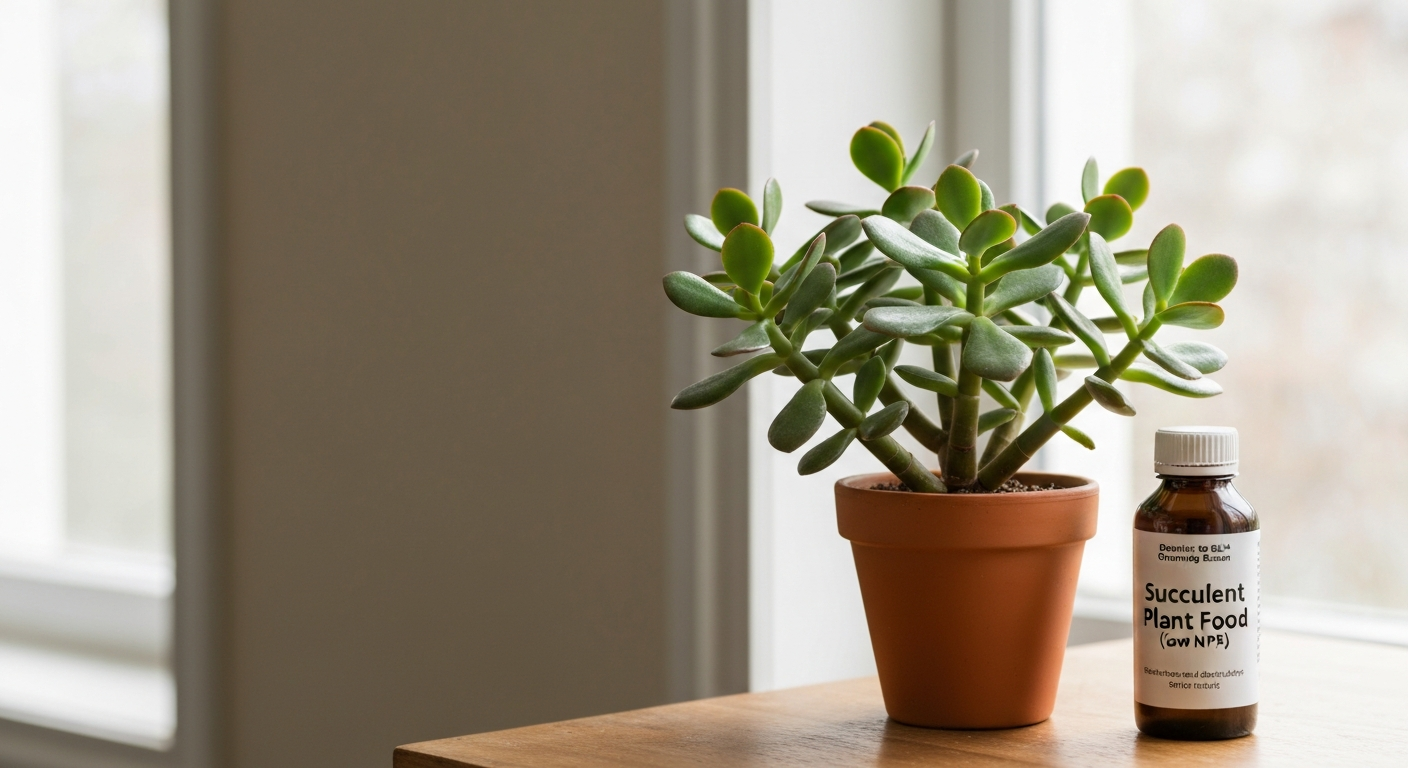
Yes, you can use Miracle-Gro on jade plants, but the product you choose matters a lot. Miracle-Gro Succulent Plant Food (0.5-1-1) is the safest pick and is actually labeled for jade plants by name. The standard Water-Soluble All-Purpose formula (24-8-16) can also work, but only if you dilute it to half the houseplant rate and feed far less often than the label suggests. Skip the granular all-purpose products and anything with a high nitrogen number, jade plants are slow-growing succulents that need light, infrequent feeding, not the aggressive schedule suited to tomatoes or flowering annuals.
Can You Use Miracle-Gro on Jade Plants: Safe Feeding Guide

Marcus Weir
20 Jul 2026
How jade plants actually use nutrients
Jade plants (Crassula ovata) are CAM succulents, meaning they open their stomata at night and store water in their thick leaves. That water-storing strategy also means they cycle nutrients slowly compared with leafy houseplants. In practical terms, a jade that looks perfectly healthy probably isn't hungry. University extension offices at UConn, Clemson, and Wisconsin all note the same thing: jade plants have relatively low fertilizer needs, and the main risk isn't underfeeding, it's overfeeding.
During active growth (roughly spring through early autumn), jade plants benefit from a modest nutrient boost to support new leaf and stem development. The rest of the year, particularly in winter when growth slows or stops, feeding does more harm than good. Salts accumulate in the potting mix without roots actively pulling nutrients out, and that buildup is where most fertilizer problems start.
Nutrient deficiency warning signs
- Pale or yellowish new leaves despite adequate light — may indicate nitrogen deficiency
- Very slow growth even during the spring and summer growing season
- Small, dull leaves that lack the deep green gloss healthy jade plants show
- Leggy, thin stems reaching toward light without producing new leaves at a reasonable rate
Worth noting: most of these symptoms are far more commonly caused by poor light or overwatering than by actual nutrient shortage. Before reaching for fertilizer, check that your plant gets at least four hours of bright indirect or direct sun and that the soil is drying out fully between waterings.
The Miracle-Gro lineup and how each product fits jade plants
Miracle-Gro makes a wide range of products, and they are not interchangeable for succulents. Some are genuinely useful for jade plants; others are designed for fast-growing vegetables or broad-leaf ornamentals and carry enough concentrated nitrogen to cause real problems if you use the full labeled rate. For guidance on using Miracle-Gro with other woody fruit plants, see our guide on can you use Miracle Grow on fig trees for product-specific recommendations using Miracle-Gro on fig trees. If you're also caring for woody plants, see guidance on using Miracle-Gro on evergreens for tips specific to trees and shrubs. If you’re curious about other species, see our guide on "can I use Miracle-Gro on bird of paradise" for species-specific advice. Here is how the main product types break down.
- Miracle-Gro Succulent Plant Food (0.5-1-1 liquid): specifically formulated for indoor succulents, lists jade plants by name on the label, low nitrogen, low salts — the best Miracle-Gro option for jade
- Miracle-Gro Water-Soluble All-Purpose Plant Food (24-8-16): high nitrogen water-soluble powder; usable on jade at half the houseplant dilution rate (1/4 tsp per gallon instead of 1/2 tsp), but must be used sparingly
- Miracle-Gro LiquaFeed All-Purpose (12-4-8): liquid concentrate for the LiquaFeed feeder system; higher nitrogen than succulent formula, not ideal for jade but workable at reduced frequency — every 4 to 6 weeks during active growth only
- Miracle-Gro Slow-Release / Osmocote Smart-Release (15-9-12 granules): polymer-coated controlled-release pellets; release rate is harder to control in hot or well-lit indoor settings, and the nitrogen level is high for a slow-growing succulent — not recommended for jade in containers
- Miracle-Gro All-Purpose Granular: designed for garden beds and fast-growing plants; too high in nitrogen and salts for container jade plants — avoid
Miracle-Gro product types vs. what jade plants actually need
| Product | NPK Analysis | Suitable for Jade? | Notes |
|---|---|---|---|
| Miracle-Gro Succulent Plant Food | 0.5-1-1 | Yes — best choice | Labeled for jade by name; apply every 2 weeks during active growth at label rate |
| Miracle-Gro Water-Soluble All-Purpose | 24-8-16 | Yes — with dilution | Use at 1/4 tsp per gallon (half the houseplant rate); feed every 4–6 weeks, not weekly |
| Miracle-Gro LiquaFeed All-Purpose | 12-4-8 | Marginal | Workable at reduced frequency (every 4–6 weeks active growth only); not the first choice |
| Osmocote Smart-Release Plus | 15-9-12 | Not recommended | Release rate unpredictable indoors; nitrogen too high for slow-growing jade in containers |
| Miracle-Gro All-Purpose Granular | varies, high N | No | Too concentrated for container succulents; high salt risk |
| Espoma Organic Cactus! (alternative) | 1-2-2 | Yes — excellent alternative | Organic, low-nitrogen, formulated for succulents; apply every 2–4 weeks during active growth |
How to feed your jade plant with Miracle-Gro: step by step
Using Miracle-Gro Succulent Plant Food (recommended)
- Water your jade plant thoroughly first and let it drain — never apply fertilizer to completely dry soil, as dry roots absorb salts too rapidly and burn
- Shake the Succulent Plant Food bottle gently before use
- For pots up to 6 inches: apply 1 pump directly to the soil surface, aiming away from the stem base
- For pots larger than 6 inches: apply 2 pumps directly to the soil surface
- Alternatively, mix 8 pumps per quart of water and use that solution as your regular watering for that feeding session
- Allow the pot to drain fully — never let jade plants sit in a fertilizer-filled saucer
- Reapply every two weeks during active growth (spring and summer); reduce to once a month in early autumn and stop entirely from late autumn through winter
Using Miracle-Gro Water-Soluble All-Purpose (diluted)
- Water the jade plant normally the day before feeding so roots are hydrated but not waterlogged
- Mix 1/4 teaspoon of the powder per gallon of water — this is half the 'houseplant' label rate, which itself is already lower than the outdoor rate
- Stir until fully dissolved; do not apply undissolved granules to the soil
- Pour slowly and evenly over the soil, covering the root zone; avoid splashing the lower stem
- Let the pot drain completely and empty the saucer within 30 minutes
- Feed no more than once every 4 to 6 weeks during the active growing season; do not feed in autumn or winter
One thing I do consistently: I feed jade plants right after a regular watering day rather than replacing that watering. The roots are already moist, which buffers the nutrient salts and dramatically lowers the chance of root burn. It's a small habit that has made a noticeable difference in how my plants handle fertilizer over the years.
Feeding schedule: timing by season and location
The core rule for jade plant feeding is simple: feed during active growth, stop during dormancy. Jade plants in most indoor settings in the Northern Hemisphere grow most actively from March through September. They slow down in October and effectively rest from November through February, even if they never drop their leaves or look dramatically different. Feeding during that rest period adds salts to the root zone that the plant isn't pulling out, and those salts accumulate into the problem zone.
| Season | Indoor Jade (low light, stable temp) | Outdoor Jade (bright light, seasonal temp) |
|---|---|---|
| Early spring (Mar–Apr) | Begin feeding — 1x per month to start | Begin feeding once nighttime temps stay above 50°F |
| Active growth (May–Aug) | Feed every 2 weeks with succulent food or every 4–6 weeks with diluted all-purpose | Feed every 2–4 weeks; water and feed more generously with heat and sun |
| Late summer / early autumn (Sep–Oct) | Taper off — feed once in September, then stop | Reduce feeding; stop by mid-October before bringing indoors |
| Winter (Nov–Feb) | No feeding — let the plant rest | No feeding; move indoors if temps drop below 40°F |
Outdoor jade plants in full sun during a warm summer can handle slightly more frequent feeding than indoor ones because they're growing faster and transpiring more water, which naturally flushes the root zone. That said, even an outdoor jade rarely needs more than twice-monthly feeding. Compare this with something like a fig tree or butterfly bush, where seasonal feeding windows and growth rates are quite different, the feeding logic for jade is decidedly more conservative.
The real risks: salt buildup, root burn, and overfertilization
The biggest risk with Miracle-Gro on jade isn't a single overdose, it's repeated feeding at too-high a concentration over weeks or months. Water-soluble fertilizers leave behind soluble salts as the water evaporates. In a fast-draining succulent mix with light, infrequent watering (which is exactly how you should be growing jade), those salts have fewer opportunities to be flushed out naturally. Over time, substrate electrical conductivity (EC) rises. UMass Extension recommends using the 'pour‑through' leachate method and regular EC/pH monitoring of container substrates (biweekly–monthly depending on crop) to prevent nutrient and salt buildup (Best Management Practices (BMPs) for Nursery Crops, UMass Extension (container EC/pour‑through guidance)) Best Management Practices (BMPs) for Nursery Crops — UMass Extension (container EC/pour‑through guidance). Horticultural research shows that root growth in container plants can be inhibited at EC levels around 2.5 dS/m, and jade is classified as moderately sensitive to salinity, meaning it has some tolerance but will eventually show damage.
Overfertilization also manifests as a nitrogen excess problem specifically. High nitrogen pushes lush, soft, watery growth that looks good briefly but makes the plant more vulnerable to rot, pests, and cold damage. A jade plant that's been overfed with a high-nitrogen formula like the 24-8-16 All-Purpose will often look great for a month, then start dropping leaves or showing yellowing around midsummer.
How to prevent these problems
- Always water the plant before applying any fertilizer — never feed into dry soil
- Use the succulent-specific formula when possible; its low NPK leaves less salt residue
- Stick to the conservative feeding schedule: every 2 weeks max with succulent food, every 4–6 weeks with diluted all-purpose
- Flush the pot with plain water every 1 to 2 months during the growing season — pour water slowly until it runs freely from the drainage hole, then repeat twice more (roughly 3x the pot volume total)
- Empty saucers after every watering and feeding to prevent reabsorption of salt-laden water
- Skip the entire feeding season if your jade is newly repotted — wait at least 30 days before starting fertilizer in fresh potting mix
- Watch for the white crust: a chalky deposit on the soil surface or pot rim is a visible salt accumulation signal; leach immediately if you see it
Troubleshooting: what fertilizer damage looks like and how to fix it
Fertilizer problems on jade plants don't always look like what you'd expect. Because jade stores water in its leaves, it can mask salt stress for weeks before symptoms become obvious. Here are the most common damage patterns I've seen and what actually helps.
Brown, crispy leaf edges
This is the classic fertilizer burn symptom. The tips or edges of leaves turn tan or brown and dry out, starting on older leaves first. It almost always means salt concentration in the root zone is too high. Action plan: stop all feeding immediately, flush the pot with 3x its volume of plain water over 30 minutes, let it drain fully, and do not feed again for at least 6 to 8 weeks. University of Maryland Extension and other land‑grant extensions recommend leaching a container with roughly three pot‑volumes of water to remove soluble salts; repeat if buildup is heavy and empty the saucer to allow proper drainage University of Maryland Extension guidance on leaching with ~3× pot volume. If the crust is heavy, scrape off the top half-inch of soil and replace it with fresh mix before flushing.
Yellow or pale new leaves
Counterintuitively, this can actually be a sign of overfertilization rather than deficiency, particularly when root damage from salt stress disrupts the plant's ability to absorb water and micronutrients even when macronutrients are plentiful. It can also appear after a sudden increase in feeding frequency. Action plan: flush the pot, hold off feeding for 4 to 6 weeks, and check your watering routine. If yellowing persists after 6 weeks of no feeding and correct watering, then, and only then, consider whether a small feeding might help.
Leaf drop (especially lower leaves)
Jade plants naturally shed a few older leaves, but rapid or widespread leaf drop combined with recent fertilizer use is a red flag. This often signals root damage. Action plan: unpot the plant and inspect the roots. Healthy jade roots are firm and pale tan to white. Damaged roots from salt burn will be brown, mushy, or shrunken at the tips. Trim any necrotic roots with clean scissors, let the root ball air-dry for a day, then repot into fresh, dry succulent mix. Hold water for 5 to 7 days after repotting to allow cut root ends to callous, then resume a normal (no-fertilizer) watering schedule.
Slowed or stopped growth during the growing season
If your jade was growing fine and then stalled out in spring or summer despite adequate light and watering, accumulated salts may be suppressing root function. Action plan: perform two to three thorough flush-and-drain cycles over a two-week period, then give the plant four weeks without any fertilizer. If growth resumes, the flush worked. If it doesn't, check for root rot or a pot-bound situation, jade plants that have completely filled their pot with roots sometimes stall until they're given more space.
Wilting despite wet soil
A wilting jade with moist soil is one of the more alarming scenarios, and overfertilization is a known cause. When root tips die from salt damage, the plant can no longer move water efficiently even when the medium is saturated. Action plan: this is a repotting situation. Remove the plant from its pot, shake off as much old medium as possible, inspect and trim damaged roots, and repot into completely fresh, dry succulent mix. Do not water for a full week. Resume with plain water only for the next 30 to 60 days before considering any fertilizer at all.
Better alternatives to Miracle-Gro for jade plants
Miracle-Gro Succulent Plant Food is genuinely a good option, but it isn't the only one. For guidance on using Miracle-Gro with other common houseplants, see can you use Miracle-Gro on poinsettias. Espoma Organic Cactus! at 1-2-2 is an excellent organic alternative with a higher phosphorus-to-nitrogen ratio that suits jade's slow-growing, root-focused needs. It's mixed at roughly half a cap per quart of water and applied every 2 to 4 weeks during active growth. The lower nitrogen and organic base mean less salt residue between feedings.
For gardeners who prefer a set-it-and-forget-it approach, a very light application of a slow-release granular fertilizer formulated specifically for cacti and succulents (not the standard Osmocote or general Miracle-Gro granular) can work in larger outdoor pots during summer. The key is choosing a product with a balanced or lower-nitrogen analysis. Whatever you use, the principle stays the same: jade plants reward restraint. Less fertilizer, less frequently, is almost always the right call.
FAQ
Definitive answer: Can you use Miracle‑Gro on jade plants (Crassula ovata)?
Yes — with important caveats. Use Miracle‑Gro formulations made or labeled for succulents/cacti (Miracle‑Gro Succulent Plant Food) or use any balanced liquid fertilizer at a much weaker dilution and only during active growth. Avoid full‑strength, high‑salinity all‑purpose mixes on a regular schedule; overuse risks salt buildup, root burn and leaf damage. For most houseplant jades, a dilute succulent‑specific product or a slow‑release low‑rate granule is the safest approach.
Which Miracle‑Gro formulations are appropriate or inappropriate for jade plants? (quick comparison)
Miracle‑Gro Succulent Plant Food — Appropriate: formulated and labeled for succulents (manufacturer lists jade/Crassula); low concentration and recommended dosing for small pots. Miracle‑Gro Water‑Soluble All‑Purpose (24‑8‑16) — Caution: high analysis; only use at strong dilution (¼–½ label rate or less) and rarely. Miracle‑Gro LiquaFeed All‑Purpose (12‑4‑8) — Caution: can be used if diluted heavily and applied sparingly during growth. Miracle‑Gro Osmocote/Smart‑Release (polymer‑coated controlled‑release) — Appropriate if you choose a low‑release product and apply at reduced rate (follow product label for container plants; consider half recommended rate for succulents). Summary: prefer the Succulent/Cactus product or a controlled‑release low‑rate fertilizer; avoid regular-strength all‑purpose water‑soluble on a frequent schedule.
Step‑by‑step: How to apply Miracle‑Gro Succulent Plant Food (liquid) to a jade plant
1) Wait until plant has adjusted to its pot (if recently repotted, wait ~30 days). 2) Use the product labeled for succulents/cacti. 3) Follow label dosing for pot size (manufacturer typically gives pumps per pot) or mix per label for watering; if unsure, err on the weaker side (½ the recommended dose). 4) Apply during the active growing season (spring–summer) only. 5) Frequency: every two weeks at label rate or every 3–4 weeks at half‑rate; many extensions recommend feeding succulents every 4–8 weeks—adjust by observing growth. 6) Do not fertilize in winter/rest period. 7) Water normally before or after feeding to prevent concentrated salt contact with roots.
Step‑by‑step: Using a water‑soluble all‑purpose Miracle‑Gro (if you choose to)
1) Only use when you need a quick nutrient boost during active growth. 2) Mix heavily diluted — aim for 25–50% of the houseplant label recommendation (e.g., if label says 1/2 tsp per gallon for houseplants, use 1/8–1/4 tsp per gallon). 3) Apply no more often than every 2–4 weeks during spring–summer. 4) Monitor for salt crust or leaf symptoms and stop if signs appear. 5) Never combine high concentration with dry potting mix; always dissolve fully in water and flush soil lightly after feeding if using repeatedly.
Slow‑release granules (Osmocote / Smart‑Release) — how to use with jade plants
1) Use a low‑release product labeled for container plants. 2) Apply at a reduced rate — roughly half the label rate for decorative container plants/succulents. 3) Mix into potting medium at repotting or sprinkle on surface and water in. 4) Expect feeding for several months; avoid additional liquid feeding unless growth is very slow. 5) Monitor substrate and flush if white salts develop. Controlled‑release reduces risk of quick salt spikes vs frequent soluble feeding.
Scheduling: When (seasonally and indoor vs outdoor) to feed jade plants
During active growth (spring and summer) only. Outdoors in growing season: feed more confidently (every 4–6 weeks with low rate or label succulent product). Indoors under bright light: feed sparingly (every 3–6 weeks low rate). Do not fertilize during shorter photoperiods/low temperatures (typically autumn–winter), when jade is semi‑dormant.
Next Article
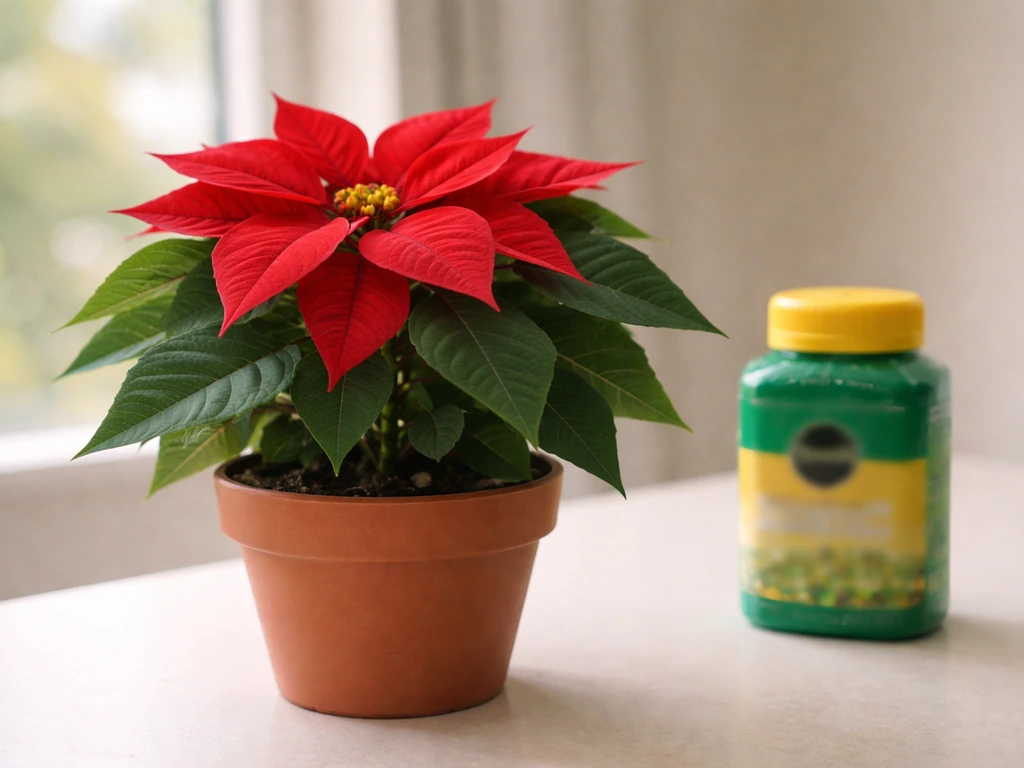
Can You Use Miracle-Gro on Poinsettias? Safe Rates and Timing
Learn if Miracle-Gro is safe for poinsettias, exact rates and timing, how to avoid root burn, and care tips.