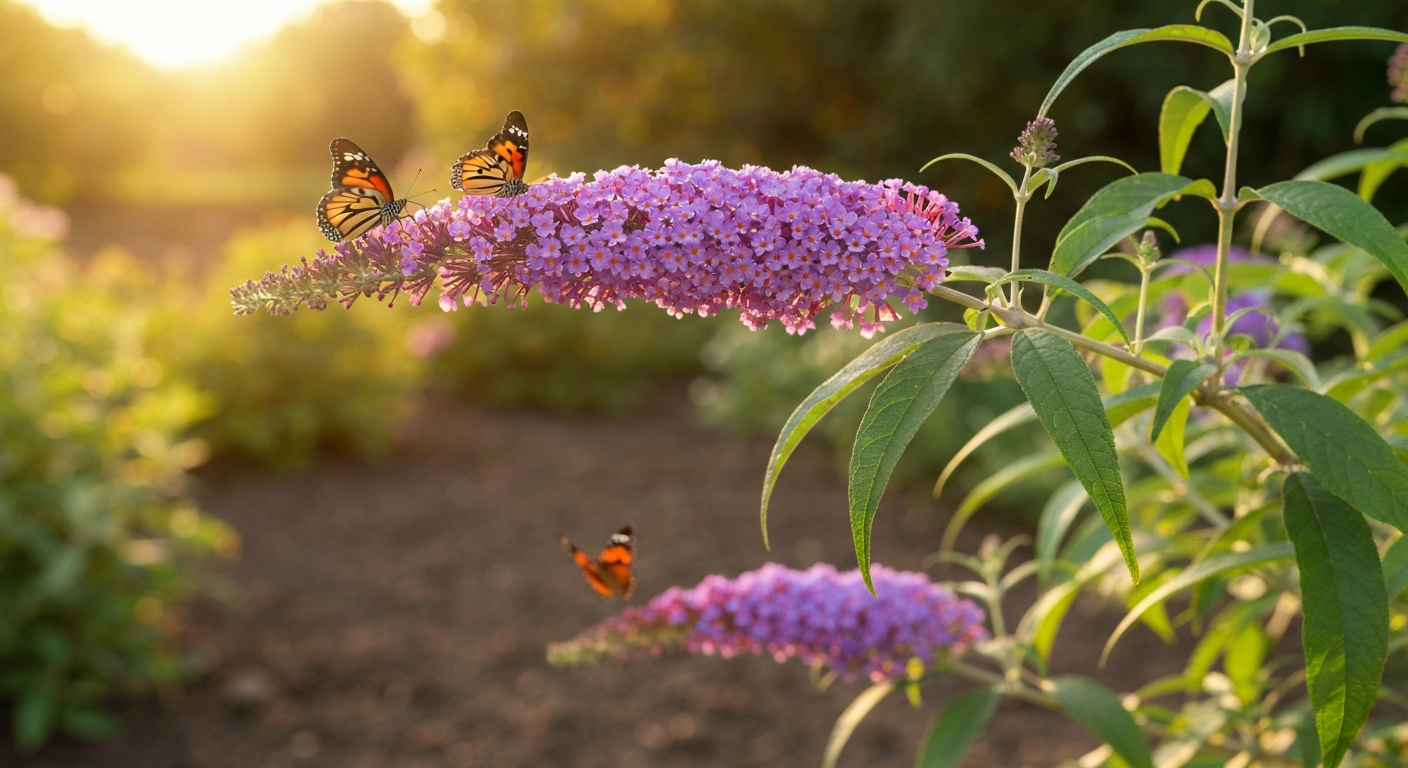
Yes, you can use Miracle-Gro on butterfly bushes (Buddleja), and it works well when applied at the right time with the right product. The safest bet for most gardeners is a balanced, slow-release granular like Miracle-Gro Shake 'N Feed once in spring, or the water-soluble 24-8-16 All Purpose Plant Food diluted and applied every 7 to 14 days through the active growing season. What you want to avoid is overdoing nitrogen, which pushes leafy growth at the expense of those long, fragrant flower spikes that make butterfly bushes worth growing in the first place.
Can you use Miracle-Gro on butterfly bushes? Clear guide

Marcus Weir
23 Jul 2026
Why butterfly bushes' nutrient needs actually matter
Butterfly bushes are vigorous growers with a strong natural inclination to bloom, which means they don't need heavy feeding the way a hungry vegetable garden does. Most Buddleja cultivars bloom on new wood produced in early summer, so the plant's real priority is pushing out fresh shoots from late winter onward, then channeling energy into flower production through summer. That growth habit shapes everything about how you feed them.
Buddleja genuinely prefers well-drained soil, full sun, and moderate water. It tolerates lean soil reasonably well, and in very fertile soil it can actually get too lush, producing masses of foliage but fewer blooms. When excess nitrogen is in the picture, the plant gets the message to keep vegetating rather than flowering. NC State Extension notes plainly that overfertilizing with nitrogen may reduce flowering and produce excessive shoot growth in woody ornamentals, and butterfly bush is a textbook example of that risk.
Soil pH also plays a role. Buddleja does best in a slightly acidic to neutral range, roughly 6.0 to 7.0. If your soil is already reasonably fertile and your pH is in that window, your butterfly bush may need almost no supplemental fertilizer beyond what organic matter in the soil provides. I've had plants perform beautifully with nothing more than a single spring compost top-dress. If your soil is poor, sandy, or compacted, that's when a product like Miracle-Gro genuinely earns its place.
Which Miracle-Gro product types suit butterfly bushes
Not every Miracle-Gro product is an equally good fit. Here's how the main types stack up for butterfly bushes specifically.
Water-soluble concentrate (24-8-16)
Miracle-Gro Water Soluble All Purpose Plant Food (24-8-16) is the most versatile option. You mix 1.5 tablespoons per 1.5 gallons of water and apply every 7 to 14 days through the active season. The relatively high potassium (K=16) compared to phosphorus (P=8) is actually reasonable for a flowering shrub since potassium supports flower and root development. The nitrogen level (N=24) is high on paper, but at the correct dilution rate it's not excessive for an actively growing shrub. The risk comes when people over-concentrate the mix or apply it too frequently. This format works especially well for container-grown butterfly bushes that need more frequent feeding than in-ground plants.
Granular slow-release (Shake 'N Feed)
Miracle-Gro Shake 'N Feed is the easier, lower-risk option for in-ground butterfly bushes. You apply it once in spring, work it lightly into the soil surface, and it releases nutrients gradually for up to two to three months. For a plant like butterfly bush that doesn't want heavy feeding, this set-it-and-forget-it approach is harder to mess up. It also reduces the risk of salt buildup that can come from repeated liquid feeding. The downside is less flexibility: you can't quickly adjust nutrients mid-season if the plant looks deficient.
Fertilizer spikes
Miracle-Gro tree and shrub spikes are convenient but are the weakest option for butterfly bushes. Spikes release nutrients unevenly, concentrating them right at the spike location rather than across the root zone. For a woody plant with a spreading root system, that uneven distribution isn't ideal. I'd skip spikes for butterfly bush and stick with granular or liquid options.
| Product Type | Best For | Pros | Cons |
|---|---|---|---|
| Water-soluble 24-8-16 | Containers, quick response needed | Fast-acting, easy to adjust rate | Higher overfeed risk, more labor |
| Granular slow-release (Shake 'N Feed) | In-ground plantings | Low-effort, gradual release, lower burn risk | Less flexible, can't adjust mid-season |
| Fertilizer spikes | Neither ideal | Convenient to insert | Uneven distribution, not recommended for spreading root zones |
Exact timing: when to feed and when to hold off
At planting time
Don't fertilize at planting. University of Maryland Extension and other sources are clear on this: newly planted trees and shrubs need water and root establishment, not a nutrient push. University of Maryland Extension's guidance in Fertilizing trees and shrubs and nutrient deficiency symptoms advises not to fertilize newly planted trees and shrubs at planting and to focus on watering and root establishment instead Fertilizing trees and shrubs and nutrient deficiency symptoms — University of Maryland Extension. Fertilizer at planting can stress tender roots and slow establishment. If planting in good soil, wait at least four to six weeks before considering any feeding.
Early spring feed
The most important feed of the year is in early spring, at or just before bud break. This is when you apply slow-release granular if you're going that route, or begin biweekly liquid feeding once you see new growth starting. For most of the US, that's roughly March to April. The RHS notes that butterfly bush blooms on shoots produced in early summer, so fueling that spring push with a balanced feed directly supports your summer flower display.
After pruning
Buddleja responds well to hard pruning in late winter or early spring, often cut back to a low framework. See Buddleja growing/pruning guidance, RHS Growing Guide for recommendations to hard-prune Buddleja in late winter or early spring to promote healthy regrowth Buddleja growing/pruning guidance — RHS Growing Guide. After that pruning, a light application of balanced fertilizer, either liquid or granular, helps drive the vigorous new growth the plant needs to produce blooms. Think of the post-pruning feed as the launch fuel for the season. Keep nitrogen moderate: you want growth, but you also want those shoots to eventually flower rather than just keep elongating.
During flowering season
Through summer, container plants benefit from continued liquid feeding every 7 to 14 days. In-ground plants fed with slow-release granular in spring generally don't need supplemental feeding through summer unless they show signs of deficiency (yellowing leaves, poor growth). Avoid high-nitrogen liquid feeds once the plant is actively blooming: potassium-forward formulas or simply stopping liquid feeding at this point lets the plant hold its flower energy rather than redirecting it to foliage. Also avoid any fertilizer application in late summer or fall, as this can stimulate tender new growth that won't harden off before frost.
Application rates and frequency: containers vs. in-ground
Container-grown butterfly bushes dry out and flush nutrients more quickly than in-ground plants, so they need more regular feeding through the season. In-ground plants in decent soil often do fine with a single slow-release application in spring. The table below summarizes recommended rates and frequencies drawn from Miracle-Gro product guidance and extension recommendations.
| Product Type | In-Ground Rate / Frequency | Container Rate / Frequency |
|---|---|---|
| Water-soluble 24-8-16 | 1.5 tbsp per 1.5 gal water; every 14 days during growing season | 1.5 tbsp per 1.5 gal water; every 7–14 days; begin ~30 days after potting |
| Granular slow-release (Shake 'N Feed) | Apply per label (typically 1 scoop per sq ft of drip zone); once in spring, possibly once mid-summer | Apply per container label; once in spring or repot annually with fresh slow-release mixed in |
| Fertilizer spikes | Not recommended for butterfly bush | Not recommended for butterfly bush |
One important note on containers: salts build up in potting mix over time from repeated liquid feeding. University of Idaho Master Gardener guidance recommends leaching container media by applying roughly twice the pot volume in water to flush accumulated salts, roughly every four to six months. If you're feeding a container butterfly bush with liquid Miracle-Gro all season, do a good flush every couple of months to keep the root environment healthy.
Step-by-step application instructions
Water-soluble concentrate (mixing and watering)
- Water your butterfly bush thoroughly the day before or the morning of feeding so you're never applying fertilizer to dry, stressed roots.
- Measure 1.5 tablespoons of Miracle-Gro Water Soluble All Purpose Plant Food into a clean watering can.
- Add 1.5 gallons of water and stir until the granules are fully dissolved, roughly 30 to 60 seconds.
- Pour the solution evenly around the drip zone of the plant, not directly against the main stem.
- For containers, apply until you see water running from the drainage holes, confirming the solution reached the full root zone.
- Rinse any granules off foliage if they landed there to prevent leaf scorch.
- Log the date so you know when the next application window (7 to 14 days out) falls.
Granular slow-release application
- Apply in early spring just as you see the first signs of new growth or right after your hard pruning.
- Measure the amount specified on the Shake 'N Feed label for the size of your plant or container.
- Scatter granules evenly over the soil surface within the plant's drip zone, keeping granules a few inches away from the main stem.
- Work the granules lightly into the top inch of soil with a hand rake or your fingers.
- Water the area thoroughly to begin activating the release coating.
- Note the date: slow-release products typically last two to three months, so plan any mid-season reapplication accordingly.
Hose-end Garden Feeder
- Fill the Garden Feeder reservoir with the measured amount of Miracle-Gro Water Soluble All Purpose Plant Food as directed on the feeder.
- Attach to your hose and turn on water at a moderate pressure.
- Sweep the feeder slowly back and forth across the root zone, keeping the spray moving so you don't concentrate solution in one spot.
- Apply until the reservoir is empty, then follow up with plain water from the hose for a minute to flush concentrated product away from the stem base.
- Clean the feeder reservoir after each use to prevent salt crust buildup in the mechanism.
Practical checklist before you feed
- Confirm the plant is well-watered: never fertilize a wilted or drought-stressed butterfly bush.
- Check that it's within the active growing season (spring through mid-summer for most climates) and not within six weeks of your first expected frost.
- Have a measuring spoon or kitchen scale on hand: eyeballing fertilizer amounts is how overfeed mistakes happen.
- Read the specific product label for your Miracle-Gro formulation, as N-P-K ratios and recommended rates vary between products.
- If using liquid feed on containers, check when you last flushed the pot. If it's been more than two months of regular feeding, do a leach flush this session.
- Consider a soil test if you haven't done one in two or more years. Many extension services offer low-cost tests. If your soil already shows high nitrogen or elevated EC, skip feeding entirely until levels come down.
- Keep a simple garden log: date, product used, rate, and any observations. This makes troubleshooting much easier if problems appear later.
Risks and mistakes that are genuinely worth avoiding
Most problems I've seen with Miracle-Gro on butterfly bushes come down to too much, too often, or at the wrong time. Here are the warning signs to watch for and what they usually mean.
- Lots of lush green foliage but few or no flower spikes: this is the classic excess-nitrogen symptom. The plant is in vegetative overdrive. Stop feeding, and if it's mid-season, let the plant coast until it naturally shifts to flowering mode.
- Leaf tip burn or brown leaf margins: a common sign of salt stress, especially in containers. Flush the container thoroughly with two to three times the pot volume in plain water and reduce feeding frequency.
- Yellowing leaves with green veins (chlorosis): can indicate iron or magnesium deficiency, sometimes triggered by overly high pH or a soil locked up by excess fertilizer salts. Test soil pH and EC before adding more fertilizer.
- Wilting even with regular watering: root burn from over-concentrated fertilizer solution or salt buildup. Flush, reduce rate, and give the plant time to recover before feeding again.
- Stunted new growth after pruning despite feeding: often a sign the root system is pot-bound (in containers) or the soil EC is too high. Repot if roots are circling and crowded, or do a thorough soil flush.
- Pollinators avoiding the flowers: while butterfly bushes are generally pollinator-friendly, research published in PLOS ONE and Scientific Reports shows that fertilizer inputs can alter nectar and pollen composition and affect pollinator foraging. If you're gardening with pollinators in mind, lean toward minimal, balanced feeding rather than aggressive fertilization. The Xerces Society recommends soil nutrient testing before adding fertilizer in pollinator habitat contexts.
- New growth flush in late summer or fall after an out-of-season feed: this soft, immature growth is frost-vulnerable. Don't fertilize after mid-summer in climates with cold winters.
Organic alternatives worth considering
If you're managing your butterfly bush in a pollinator garden or just prefer a gentler approach, organic options are genuinely effective. A two-to-three inch layer of compost worked into the soil surface in early spring gives a slow, balanced nutrient release without the salt risk of synthetic fertilizers. Fish emulsion or a balanced organic granular (something in the 4-4-4 or 5-5-5 range) applied at half the recommended rate is another solid choice. These products release nutrients more slowly and are far harder to over-apply to a plant that prefers lean feeding anyway.
How this compares to feeding other plants with Miracle-Gro
Butterfly bush has a fairly specific fertilizer personality: moderate needs, sensitive to excess nitrogen, and prone to salt stress in containers. That makes it useful to contrast with a few other plants where Miracle-Gro use comes up often. Bird of paradise, for instance, is a heavy feeder that handles higher nitrogen rates and more frequent liquid feeding than butterfly bush will tolerate. Evergreens have their own considerations: they prefer acidic-formulated fertilizers and tend to need lower rates than the all-purpose 24-8-16. If you wonder "can you use Miracle-Gro on evergreens," the short answer is yes, use an acid-formulated, lower-rate product designed for evergreens rather than the general 24-8-16 and follow label directions to avoid excess nitrogen and salt buildup can you use miracle grow on evergreens. Fig trees fed with Miracle-Gro benefit from balanced nutrition similar to butterfly bush, but figs are hungrier and can handle more frequent liquid applications during fruit development. Jade plants are succulents that need feeding diluted to about half the standard rate and only during active growth, making them significantly more sensitive than butterfly bush. For more on that topic, see our guide Can you use Miracle-Gro on jade plants, which explains proper dilution and timing for succulents. Poinsettias require careful phosphorus and potassium balance to hold their bracts, and like butterfly bush, too much nitrogen leads to disappointing color. If you wonder whether you can use Miracle-Gro on poinsettias, see the separate guidance on can you use Miracle-Gro on poinsettias for details. The common thread across all these plants is that the Miracle-Gro label rate is a starting maximum, not a target: most ornamentals, including butterfly bush, do better at the lower end of the recommended range.
Troubleshooting quick reference
| Symptom | Likely Cause | Fix |
|---|---|---|
| No blooms, lots of foliage | Excess nitrogen | Stop feeding; wait for plant to shift to flowering mode |
| Brown leaf tips or margins | Salt buildup (containers) | Flush pot with 2–3x pot volume of plain water; reduce feed frequency |
| Yellow leaves with green veins | Iron/magnesium deficiency or high soil EC | Test soil pH and EC; adjust pH or flush salts before adding fertilizer |
| Wilting despite watering | Root burn from over-concentrated solution | Flush soil, reduce rate, allow recovery before next feed |
| Stunted post-pruning regrowth | Pot-bound roots or high soil EC | Repot if root-bound; flush media and reduce fertilizer |
| Leggy, weak stems | Low light plus excess nitrogen | Improve sun exposure and reduce nitrogen rate |
| Soft new growth in late summer | Out-of-season feeding | Stop all feeding; no fertilizer after mid-summer in cold climates |
FAQ
Can you use Miracle‑Gro on butterfly bushes (Buddleja)?
Yes — but use it carefully. Butterfly bushes tolerate and benefit from moderate feeding to support vigorous, repeat flowering. Choose a balanced approach (light slow‑release in ground; dilute water‑soluble or occasional slow‑release for containers). Avoid heavy, high‑nitrogen feeding that produces lush leafy growth at the expense of flowers.
When should you avoid applying Miracle‑Gro to a newly planted butterfly bush?
Delay routine fertilizer at planting for most newly set shrubs. Focus on consistent watering and root establishment for the first 4–8 weeks. If soil is very poor and a starter fertilizer is desired, use a low‑rate slow‑release placed away from the stem and follow extension guidance — but generally wait about 30 days if using Miracle‑Gro potting soil or water‑soluble feeds.
Which types of Miracle‑Gro products are appropriate for butterfly bushes (water‑soluble, granular/slow‑release, spikes)?
Recommended options: 1) Slow‑release granular (Shake ’N Feed or similar) — good for in‑ground shrubs; feeds for 2–3 months with lower risk of salt shock. 2) Water‑soluble (All‑Purpose 24‑8‑16) — useful for containers or to correct a shortfall; use at reduced frequency/dilution. 3) Spikes — generally avoid for shrubs unless manufacturer rates are adjusted and spikes are placed at dripline. Choose formulations with moderate N and not excessively high nitrogen.
Exact timing: when to feed butterfly bushes (planting, spring, after pruning, flowering)?
Timing summary: - At planting: generally avoid routine fertilizer; wait 4–8 weeks. - Early spring (at bud break/new growth): main annual feed (slow‑release granular) for in‑ground plants. - After hard pruning (late winter/early spring): give water and a light balanced feed or light slow‑release to support regrowth. - During flowering season (spring–fall): containers may receive diluted water‑soluble every 2–4 weeks; in‑ground plants usually only light top‑ups if growth/flowering is weak. - Avoid late‑season high‑N feeding (late summer/autumn) that delays hardening off.
What safe application rates and frequencies should I use for containers vs in‑ground butterfly bushes?
Use conservative rates: Containers: - Water‑soluble (e.g., 24‑8‑16): dilute per label, but for Buddleja reduce to ½ label strength and apply every 2–4 weeks during active growth. - Slow‑release granular: use manufacturer pot rate or slightly reduced (e.g., ¾ of label) applied once in spring; leach media every 4–6 months. In‑ground: - Slow‑release granular (Shake ’N Feed): apply once in early spring at label shrub rate (or slightly reduced) and repeat every 8–12 weeks only if needed; typically one application per season is sufficient. - Water‑soluble: rarely needed for established in‑ground plants; if used, apply at ½ label frequency and wait at least 4 weeks after planting. Always follow label maximums and avoid cumulative overapplication.
Step‑by‑step application instructions for each product type
Water‑soluble (containers or quick feed): 1) Mix according to label, then reduce to ½ strength for Buddleja. 2) Water the pot first, then apply feed evenly to potting mix. 3) Repeat every 2–4 weeks while actively growing. Slow‑release granular (in‑ground or container): 1) In spring, broadcast evenly under the dripline, keeping granules several inches from the trunk/stem. 2) Lightly scratch into top 1–2 inches of soil or mulch over. 3) Apply once (or every 8–12 weeks at reduced rate if needed). Miracle‑Gro spikes: 1) Follow package spacing for shrub size, place spikes around dripline, not against stem. 2) Use spikes only as label allows and reduce number by ~25% for Buddleja to avoid overfeeding.
Next Article
Can You Use Miracle-Gro on Jade Plants: Safe Feeding Guide
Can you use Miracle‑Gro on jade plants? Clear yes/no guidance, dilution, feeding schedule, risks and fixes.