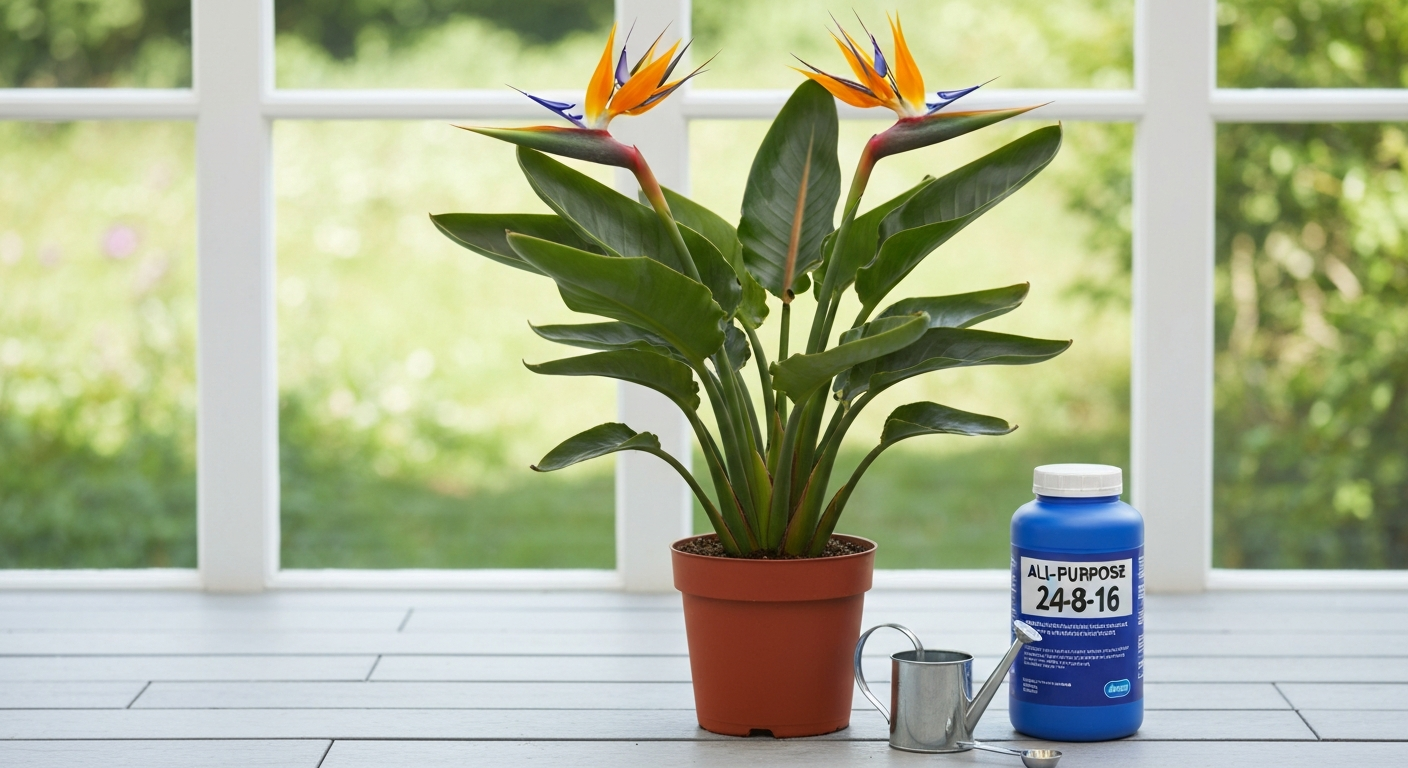
Yes, you can use Miracle-Gro on bird of paradise. Strelitzia is a heavy feeder that responds well to regular fertilizing, and several Miracle-Gro formulas fit the job nicely. The key is picking the right product for your situation, following the label rates closely, and timing your feeds around the plant's growing season. Get those three things right and your bird of paradise will reward you with lush foliage and, eventually, those striking orange-and-blue blooms.
Can I Use Miracle-Gro on Bird of Paradise: Yes, How & When

Marcus Weir
5 Aug 2026
Which Miracle-Gro products actually work for bird of paradise
Not every Miracle-Gro product is the right fit, so it helps to know your options before you head to the garden center. Here are the three main categories worth considering.
Miracle-Gro Water Soluble All-Purpose Plant Food (24-8-16)
This is the classic blue powder that dissolves in water. It carries an N-P-K of 24-8-16, which is higher in nitrogen and potassium than phosphorus. For bird of paradise, that profile works well during active vegetative growth because the plant puts a lot of energy into building large, paddle-shaped leaves. I reach for this one most often for potted indoor specimens and container plants on the patio during spring and summer. It gives you a quick nutritional hit, results show up within a week or two, and you can dial back application as flowering season approaches.
Miracle-Gro Indoor Plant Food
The pump-bottle liquid formula is a gentler, lower-strength option (roughly 1-1-1 NPK depending on the SKU). It is convenient for small indoor pots and is less likely to shock roots if you accidentally over-apply a pump or two. I use it as a low-maintenance option through the winter months when the plant is not actively growing and a heavy feeding program would do more harm than good. It is not the powerhouse feed you want for a large outdoor bird of paradise in full sun, but for a modest potted Strelitzia on a bright windowsill, it earns its place.
Miracle-Gro Shake 'N Feed All-Purpose (12-4-8, slow-release granular)
The granular slow-release formula carries a 12-4-8 N-P-K and feeds for up to three months per application. This is my go-to for in-ground landscape bird of paradise and for large container plants that I do not want to babysit every two weeks. You scatter it, work it into the top inch or two of soil, water it in, and then mostly leave it alone. For in-ground plants especially, the slow-release approach mirrors how extension services like UF/IFAS recommend fertilizing landscape Strelitzia: roughly every three months during the growing season following label directions.
What to check on the label before you feed
Bird of paradise is forgiving within a reasonable range, but reading the label carefully before every application will save you from the most common problems. Here is what to look for specifically.
- N-P-K numbers: The three numbers on the front of any fertilizer package tell you the percentage of nitrogen (N), phosphorus (P), and potassium (K) by weight. For the water-soluble all-purpose, that is 24-8-16. For Shake 'N Feed, it is 12-4-8. Both are suitable for bird of paradise during growth; neither is a high-phosphorus bloom booster, which is fine because Strelitzia does not respond to the same phosphorus push that some annuals do.
- Dilution instructions: The water-soluble powder calls for 1/2 teaspoon per gallon for indoor plants and 1 1/2 tablespoons per 1 1/2 gallons for outdoor use. Those are manufacturer-tested rates and going stronger does not produce better results. It produces salt damage.
- Application rate and frequency: Shake 'N Feed in-ground rate is 4 tablespoons per 4 square feet (a 2-by-2-foot area), reapplied every three months during the growing season. The water-soluble product should be applied every 7 to 14 days during active growth. The indoor pump-bottle formula calls for 1 pump per small pot or 2 pumps per larger pot roughly every two weeks.
- Product-specific cautions: Labels carry standard warnings to keep products away from children and pets, store in a cool dry location, and download the Safety Data Sheet (SDS) if you need detailed hazard information. Some labels also note to avoid getting concentrated product on plant foliage before diluting, which can cause leaf scorch.
- Expiry and storage notes: Water-soluble powders are stable when kept dry, but a lumpy or discolored product may have absorbed moisture. Do not use clumped powder that will not dissolve cleanly, as the ratio of nutrients may have shifted.
Feeding a potted bird of paradise: step by step
Container plants need more attention than in-ground ones because nutrients leach out every time you water. blank" rel="noopener noreferrer">NC State Extension's 'Plants Grown in Containers' explains that controlled‑release (slow‑release) fertilizers supply nutrients for months and reduce salt peaks, while water‑soluble fertilizers give quick feed but require repeat applications and carry higher risk of salt build‑up in small pots. University of Wisconsin Extension research confirms that potted bird of paradise are heavy feeders and benefit from feeding every two weeks in summer and once a month in winter. Peer‑reviewed studies show applied research on Strelitzia postharvest biology (example: Synergistic effect of graphene oxide and silver nanoparticles as biostimulant improves the postharvest life of cut flower bird of paradise, Frontiers in Plant Science (PMC)) blank" rel="noopener noreferrer">Synergistic effect of graphene oxide and silver nanoparticles as biostimulant improves the postharvest life of cut flower bird of paradise — Frontiers in Plant Science (PMC). Here is how I handle it in practice.
- Water the pot thoroughly the day before you plan to fertilize. Applying fertilizer to dry soil concentrates salts around roots and is the number-one cause of fertilizer burn on container plants.
- For the water-soluble all-purpose powder: dissolve 1/2 teaspoon per gallon of water. Mix it until the powder is completely clear. I use a clean one-gallon watering can and mark it at the fill line so I am consistent.
- Pour the solution slowly at the base of the plant until it runs freely from the drainage holes. This ensures the entire root zone gets fed and also flushes any previous salt buildup downward.
- During the growing season (roughly March through September in most of the US), repeat every 7 to 14 days using the water-soluble formula. Every 14 days is a comfortable rhythm for most indoor setups and gives roots a brief recovery period between feeds.
- Pre-flowering adjustment (late summer into fall): reduce nitrogen input by switching to the lower-strength indoor formula or cutting the water-soluble dose in half. High nitrogen at this stage pushes leafy growth and can delay or suppress bloom formation.
- Winter (October through February): drop back to once a month using the gentle indoor pump formula or stop the water-soluble feed entirely if the plant is in a low-light situation. Cold, dim conditions slow growth to near zero and unused fertilizer just builds up as salt.
- Flush the pot with plain water every 4 to 6 weeks during the feeding season. Pour water through slowly until it runs clear from the bottom. This clears accumulated salts before they reach damaging levels.
For large containers: the slow-release alternative
If you have a large bird of paradise in a statement pot (think anything 12 inches or bigger), you can use Shake 'N Feed instead of mixing liquid every two weeks. Scatter the granules lightly over the soil surface at the label rate for containers, water in, and revisit in three months. You can still supplement with a half-strength liquid feed mid-season if the plant shows pale new leaves, but the granular approach dramatically reduces the time and mental energy of container feeding.
Feeding an in-ground bird of paradise: step by step
Landscape-planted Strelitzia in USDA zones 9 to 11 can stay in the ground year-round and build into large, clumping specimens. These plants are more buffered by soil volume than container plants, so they tolerate a quarterly slow-release schedule well. UF/IFAS extension recommendations align closely with the Shake 'N Feed label for this type of application.
- Apply Shake 'N Feed All-Purpose granules at 4 tablespoons per 4 square feet of planting area (approximately a 2-by-2-foot zone around the base of the plant). For a large established clump, estimate the canopy footprint and apply accordingly, keeping granules a few inches away from the central stems.
- Work granules gently into the top 1 to 3 inches of soil with a hand fork or a light rake. Do not dig deep enough to disturb the thick, fleshy roots that Strelitzia develops.
- Water the area thoroughly immediately after application to begin dissolving and activating the granules. Without watering in, granules sit inert and can scorch surface roots if concentrated.
- Repeat every three months during the active growing season. In warm climates where the plant grows nearly year-round, that typically means applications in early spring, early summer, and early fall. In cooler regions where growth slows in winter, skip the cold-season application entirely.
- Pre-flowering: in the 6 to 8 weeks leading up to your expected bloom period, skip or reduce nitrogen and consider adding compost as a top-dressing instead. Compost improves soil biology without pushing vegetative growth, and the Missouri Botanical Garden recommends compost alongside slow-release fertilizer for best flowering performance.
- Post-flowering: resume a normal feeding schedule once spent flower stalks have been removed. This is when the plant rebuilds energy reserves for the following season.
Timing and rates at a glance
| Scenario | Product | Rate | Frequency |
|---|---|---|---|
| Potted — growing season (spring/summer) | Water-Soluble All-Purpose (24-8-16) | 1/2 tsp per gallon | Every 7–14 days |
| Potted — pre-flowering or fall | Water-Soluble All-Purpose at half strength OR Indoor Plant Food | 1/4 tsp per gallon or 1–2 pumps | Every 2 weeks |
| Potted — winter/dormant | Indoor Plant Food or none | 1–2 pumps | Once a month or skip |
| Potted (large container) — growing season | Shake 'N Feed granular (12-4-8) | Label rate for container size | Every 3 months |
| In-ground — growing season | Shake 'N Feed granular (12-4-8) | 4 tbsp per 4 sq ft | Every 3 months |
| In-ground — pre-flowering | Compost top-dressing or reduced granular | 2-inch compost layer | Once before bloom season |
| In-ground — winter/dormant | None | Skip | Skip |
Young plants vs established plants: feeding is not one-size-fits-all
A newly purchased bird of paradise from a nursery or a seedling you have recently repotted needs a gentler approach than an established plant. Here is where I see most beginner mistakes: people assume that more fertilizer equals faster growth, and they end up burning young roots that have not yet had time to anchor into fresh soil.
If you have just repotted or transplanted a bird of paradise, hold off on any Miracle-Gro application for at least four weeks. The roots need time to recover from the disruption and to grow into the new soil before they can handle the salt load that comes even with label-rate fertilizer. If you used a potting mix that already contains fertilizer (such as Miracle-Gro Performance Organics Container Mix, which feeds for roughly 30 days from planting), follow the manufacturer advice to start a separate feeding program only after that initial period has passed.
For very young seedlings or divisions, I start with the indoor pump formula at half the suggested pump count, or a quarter-strength water-soluble solution, and I only feed once a month until the plant shows consistent new leaf growth. That new growth is your signal that the root system is healthy and can handle a more regular feeding schedule.
Established plants that have been in the ground or in a container for two or more years can follow the full schedule described above without concern. Their extensive root systems distribute and process nutrients efficiently, and they genuinely benefit from consistent feeding to fuel the large leaf canopy they maintain.
How feeding affects flowering (and how to work with it)
Bird of paradise is notoriously slow to flower, and fertilizer timing plays a real role in nudging the plant toward bloom. The frustrating truth is that nitrogen, which is the first and largest number in any Miracle-Gro formula, drives leafy vegetative growth. That is exactly what you want when establishing the plant, but too much nitrogen late in the season actively delays flowering by keeping the plant in a growth mode rather than a reproductive one.
Here is the practical approach I follow. From early spring through midsummer, feed consistently with the water-soluble all-purpose or Shake 'N Feed at full label rates. This is when the plant is building the leaf mass and root strength it needs to support flowers. Once you hit late summer (roughly August in the Northern Hemisphere), scale back. I cut liquid feeding frequency in half and drop the concentration to about half-strength. For in-ground plants, I skip the fall granular application entirely if I want blooms in the coming late winter or early spring season.
Phosphorus helps with root development and plays a supporting role in flower initiation, and both the 24-8-16 water-soluble and 12-4-8 granular products contain a modest amount. But I would not recommend chasing a high-phosphorus bloom booster as a shortcut. What consistently promotes flowering in Strelitzia is the combination of a strong plant built through proper feeding, adequate light (full sun to part shade), slightly restricted watering in fall, and patience. Plants under five years old often simply will not flower regardless of fertilizer, and that is normal.
Overfertilization and other things that can go wrong
Bird of paradise handles fertilizer reasonably well, but it is not bulletproof. Here are the signs to watch for and what to do about them.
Signs of too much fertilizer (excess)
- Brown, crispy leaf tips or margins, often starting at the very tip of older leaves. This is classic fertilizer salt burn.
- White crust on the soil surface of container plants. This is salt accumulation from repeated applications without sufficient flushing.
- Wilting even when the soil is moist, caused by salt drawing moisture away from roots.
- Rapid, soft, pale green new growth that seems weak or floppy, indicating excess nitrogen pushing vegetative growth faster than the plant can support.
- No flowers despite a healthy, leafy plant in adequate light.
Signs of too little fertilizer (deficiency)
- Slow growth overall with smaller-than-normal new leaves.
- Pale yellow-green foliage across the whole plant, particularly visible in new growth. This is often nitrogen deficiency.
- Older leaves yellowing and dropping early.
- No new leaf production over several weeks during what should be the active growing season.
How to fix overfertilization in containers
If you have over-applied or accumulated salts, flush the container with plain water immediately. Set the pot in a sink or outside and pour water slowly through the soil for several minutes until it runs clear from the drainage holes. Let the pot drain completely, then stop feeding for at least 4 weeks. Trim any visibly burned leaf tips with clean scissors. The plant will usually recover within a few weeks if the root damage is not severe.
Miracle-Gro vs other fertilizer options: a quick comparison
Miracle-Gro is convenient and effective, but it is not the only option. For guidance specific to butterfly bushes, see the guide 'Can you use Miracle-Gro on butterfly bushes'. Other plants in the Strelitzia family sit in the same category as plants like jade or poinsettias where gardeners often ask the same question: is the branded water-soluble fertilizer the best choice, or are there situations where alternatives perform better? For guidance specifically about using Miracle-Gro on poinsettias, see our article Can you use Miracle-Gro on poinsettias. If you're wondering whether the same approach applies to succulents like jade, see can you use Miracle-Gro on jade plants for tailored guidance. For guidance on using Miracle-Gro on fig trees, see our article on feeding figs, which covers suitable products, rates, and timing.
| Fertilizer type | Example | Pros for bird of paradise | Cons to consider |
|---|---|---|---|
| Water-soluble synthetic (Miracle-Gro 24-8-16) | Miracle-Gro Water Soluble All-Purpose | Fast uptake, measurable results, widely available, easy to adjust dose | Requires repeat mixing, salt buildup risk in containers, easy to over-apply |
| Slow-release granular synthetic | Miracle-Gro Shake 'N Feed 12-4-8 | Low maintenance, consistent feed for 3 months, lower salt peaks | Cannot quickly adjust if plant shows stress, not ideal for severe deficiency |
| Balanced organic liquid | Fish emulsion (typically 5-1-1) | Gentle, improves soil biology, lower burn risk | Smells strong indoors, lower N-P-K requires more frequent application, variable NPK |
| Compost top-dressing | Aged compost or worm castings | Feeds soil microbes, improves drainage and water retention, zero burn risk | Slow release of nutrients, not a substitute for fertilizer on heavy feeders in containers |
| Balanced granular organic | Espoma Plant-tone or similar | Feeds slowly, builds soil health, low burn risk | Slower than water-soluble for correcting deficiency, more expensive per application |
My honest recommendation is to use Miracle-Gro water-soluble all-purpose as the primary feeder during the growing season, supplement with compost top-dressing for in-ground plants, and switch to a gentle indoor formula or slow-release granular when the plant needs less attention. Miracle-Gro works as well on Strelitzia as it does on many of its related houseplant applications, including some of the other heavy feeders home gardeners commonly ask about like fig trees or evergreens.
Environmental and safety notes
Miracle-Gro products carry standard safety cautions on their labels and Safety Data Sheets. Keep all formulas away from children and pets, store them in a cool, dry location with lids tightly sealed, and never apply near storm drains or waterways where runoff can carry concentrated nutrients into local ecosystems. When using granular products, water them in thoroughly to prevent birds or wildlife from encountering concentrated granules on the soil surface. Wash hands after handling any fertilizer product, and rinse any spills off hard surfaces before they wash off into gutters.
Troubleshooting quick-reference
| Symptom | Likely cause | Fix |
|---|---|---|
| Brown, crispy leaf tips | Fertilizer salt burn or over-application | Flush container with plain water; skip feeding for 4 weeks |
| White crust on soil surface | Salt buildup from repeated feeds without flushing | Flush thoroughly; increase flushing frequency to every 4 weeks |
| Pale yellow-green new leaves | Nitrogen deficiency | Resume or increase feeding with water-soluble formula at label rate |
| No growth during spring/summer | Under-feeding or poor light or rootbound pot | Feed at label rate, check pot size, confirm plant has adequate light |
| Lush foliage but no flowers | Excess nitrogen or plant too young or insufficient light | Reduce nitrogen, ensure full sun, confirm plant is at least 3–5 years old |
| Wilting despite moist soil | Salt accumulation damaging roots | Flush immediately; allow pot to drain fully; reduce feeding frequency |
| Granules visible on soil after watering | Insufficient watering-in after application | Water more deeply after applying Shake 'N Feed to activate release |
FAQ
Quick answer — can I use Miracle‑Gro on bird of paradise (Strelitzia)?
Yes. Bird of paradise responds well to regular feeding; several Miracle‑Gro products are suitable if used at label rates. Choose the product type to match container vs in‑ground planting and follow dilution and frequency instructions to avoid overfertilization.
Which Miracle‑Gro products are appropriate for bird of paradise and when should I use each?
Water‑soluble all‑purpose (e.g., Miracle‑Gro Water Soluble 24‑8‑16 or LiquaFeed): good for potted plants and quick feeding during active growth; feed more frequently. Indoor/houseplant liquid formulas (low‑strength pump bottles): best for small indoor pots and fortnightly feeding. Slow‑release/granular (e.g., Shake ’N Feed 12‑4‑8 or controlled‑release granules): ideal for landscape/in‑ground and for containers when you want multi‑month feeding with lower salt spikes. Potting mixes labeled Performance Organics provide initial nutrition and still benefit from follow‑up feeding per label.
What label details should I check before applying any Miracle‑Gro product?
Check the N‑P‑K ratio and intended use (indoor vs outdoor vs containers), suggested mixing/dosage (teaspoons/tablespoons per gallon or per square foot), frequency (weeks/months), any soil incorporation instructions, salt warnings, and all safety cautions (keep out of reach of children, SDS link). Follow the product directions exactly.
Step‑by‑step for potted (container) bird of paradise using water‑soluble Miracle‑Gro
1) Water the pot lightly so soil is moist. 2) Mix per label (example: Miracle‑Gro Water Soluble: ~1/2 teaspoon per gallon for indoor use; confirm your SKU). 3) Apply as part of a normal watering routine so solution reaches roots. 4) Frequency: every 2 weeks during active growth (spring–summer); reduce to monthly or stop in winter dormancy. 5) Flush container with plain water every 2–3 months to reduce salt build‑up (run water through until it drains freely). Adjust if label for your product differs.
Step‑by‑step for in‑ground (landscape) bird of paradise using slow‑release or granular Miracle‑Gro
1) Clear mulch from the root zone surface. 2) Broadcast product at label rate (example Shake ’N Feed guidance: ~4 tablespoons per 4 sq. ft.; follow your label). 3) Lightly work into top 1–3 inches of soil or apply to the surface and water in. 4) Reapply per label (commonly every 3 months in the growing season) or follow seasonal timing below. 5) Replace mulch and water thoroughly after application.
Practical timing and frequency (growing season and flowering) — potted vs in‑ground
Potted: feed every 2 weeks with water‑soluble during active growth (spring–summer). Reduce to monthly or stop in winter. In‑ground: apply slow‑release/granular every 3 months during the growing season (spring through early fall) per label. Pre‑flowering: keep regular feeding in spring to build foliage and energy; avoid heavy late‑season nitrogen that delays bloom set. Post‑flowering: continue a balanced program to replenish reserves; reduce frequency as plant enters dormancy.
Next Article
Can you use Miracle-Gro on butterfly bushes? Clear guide
Can you use Miracle‑Gro on butterfly bushes? Clear guidance: which product, exact timing, rates & steps.