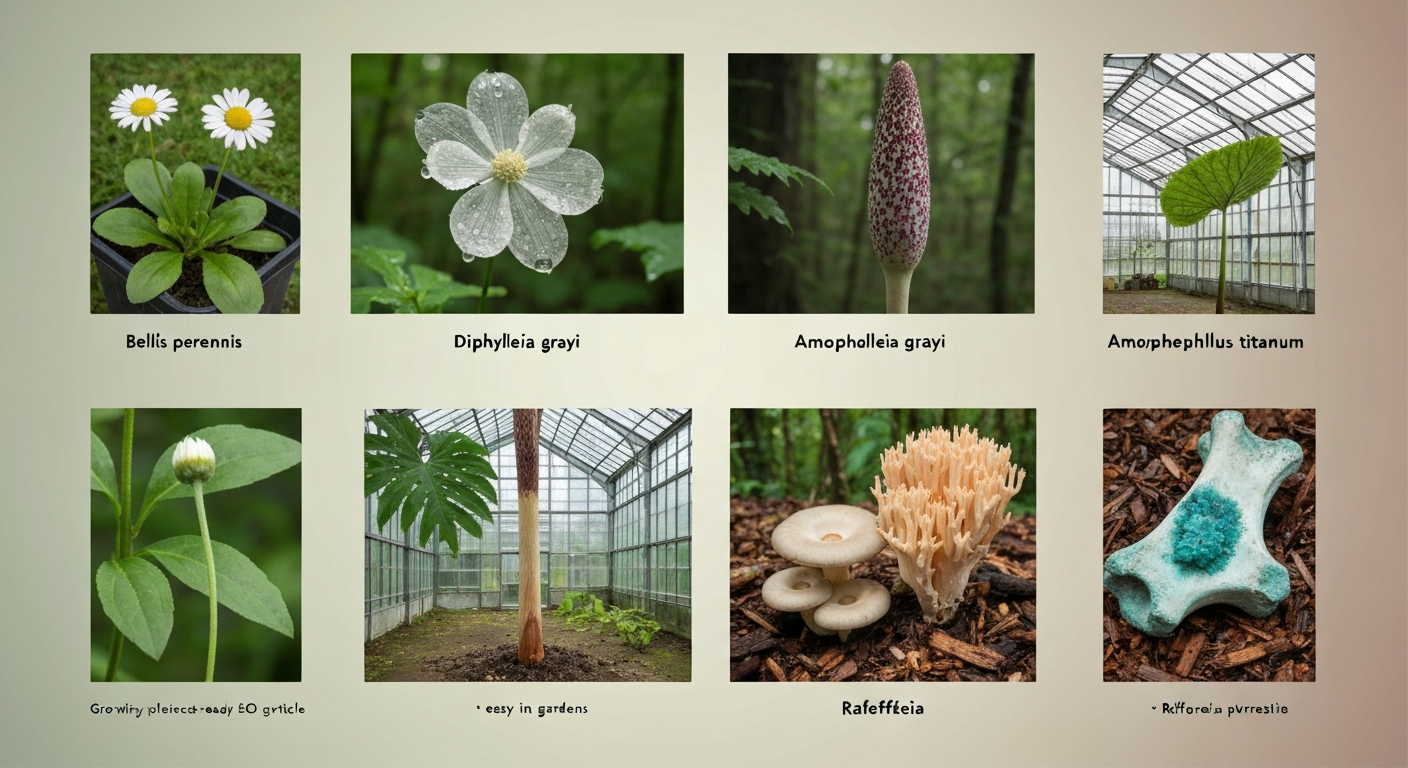
If you searched 'what type of plant is bone blossom grow a garden,' you were most likely looking up an item from the Roblox game Grow a Garden, where Bone Blossom is a limited-time virtual crop added on July 5, 2025. It is not a real plant. In the real world, the closest living things that share that evocative name are the skeleton flower (Diphylleia grayi), whose petals turn transparent as glass when wet, plus a handful of genuinely strange organisms that gardeners sometimes confuse with it: ghost pipe (Monotropa uniflora), corpse flowers (Amorphophallus titanum and Rafflesia), fungal fruiting bodies, and even mineral deposits like vivianite. This guide sorts all of them out and tells you exactly which ones you can actually grow in your garden and how. If you specifically want to know whether bone blossom can be grown in a garden, see the related guide on 'can bone blossom grow a garden' for a focused answer.
What Type of Plant Is Bone Blossom? Identification & Garden Care

What people mean by 'bone blossom' and what this guide covers
The phrase 'bone blossom' sits at the intersection of gaming, folklore, and botany. Most search traffic comes from players of Grow a Garden on Roblox, where Bone Blossom is a seasonal crop with specific growth timers and in-game uses. But once gardeners or students hear the name, they naturally wonder whether something like this exists in nature, and several real plants come remarkably close to the image it conjures: pale, ghostly, skeletal blossoms that look more suited to a Halloween garden than a summer border. This article covers the game context briefly, then moves entirely into the real world: what species go by 'bone blossom' or very similar names, how to identify each one, and which ones are genuinely grower-friendly.
Quick answer: which organisms are called 'bone blossom' and can you grow them?
Here is the short verdict on each candidate before we go deeper into any of them.
| Organism | Common name(s) | Real plant? | Home garden feasibility |
|---|---|---|---|
| Roblox Grow a Garden asset | Bone Blossom | No (virtual) | N/A |
| Diphylleia grayi | Skeleton flower, glass flower | Yes (flowering plant) | Yes, in cool shaded gardens |
| Bellis perennis | Bone flower, bonewort, English daisy | Yes (flowering plant) | Very easy, cool-season grower |
| Monotropa uniflora | Ghost pipe, Indian pipe | Yes (non-photosynthetic plant) | No, practically impossible at home |
| Amorphophallus titanum | Corpse flower, titan arum | Yes (flowering plant) | Possible with years of patience and space |
| Rafflesia spp. | Corpse flower, giant padma | Yes (parasitic plant) | No, not feasible outside specialist institutions |
| Fungal fruiting bodies | Spore blossoms (informal) | No (fungi, not plants) | Some species cultivable with kits or beds |
| Vivianite | Bone blue, mineral crust | No (mineral) | Not a plant, cannot be grown |
How to identify what you found: a first-pass field checklist
If you have found something in the wild or in a garden and wonder whether it is the 'bone blossom' plant you read about, run through these five quick observations before consulting a flora or app. Season, substrate, leaf presence, translucence, and smell will narrow the field considerably.
- Season: Diphylleia flowers in late spring to early summer (May to June in the Northern Hemisphere). Monotropa appears in summer through early autumn in cool temperate forests. Amorphophallus blooms unpredictably after years of tuber growth. Fungi fruit in autumn most commonly, though some appear year-round.
- Substrate: Is it rooted in forest soil under trees? That points to Diphylleia or Monotropa. Emerging from a thick tropical vine stem in Southeast Asia? That is almost certainly Rafflesia. Growing on disturbed ground or a garden bed? Likely Diphylleia, Bellis, or a cultivated Amorphophallus.
- Leaves: Diphylleia has large, parasol-like deeply-lobed basal leaves up to 30–40 cm across. Monotropa has NO green tissue at all, only scale-like white structures. Amorphophallus produces one enormous, highly divided leaf (or none, just a huge flowering spike). If there are no leaves whatsoever, mycoheterotrophy or parasitism is very likely.
- Translucence and color: Wet, transparent petals are the definitive field marker for Diphylleia grayi. No other common garden plant does this. Ghostly white waxy stems with a nodding single bell tip — that is Monotropa. Reddish-brown enormous bowl-shaped flower emerging from the ground with no stem or leaves — Rafflesia.
- Smell: Diphylleia has little to no scent. Monotropa is faintly sweet or odorless. Amorphophallus titanum produces a very strong rotting-meat odor at peak bloom. Rafflesia also smells of decomposition. Fungi vary enormously but often have a distinctly earthy or 'mushroomy' smell.
Skeleton flower (Diphylleia grayi): the most likely real-world 'bone blossom'
Identification and appearance
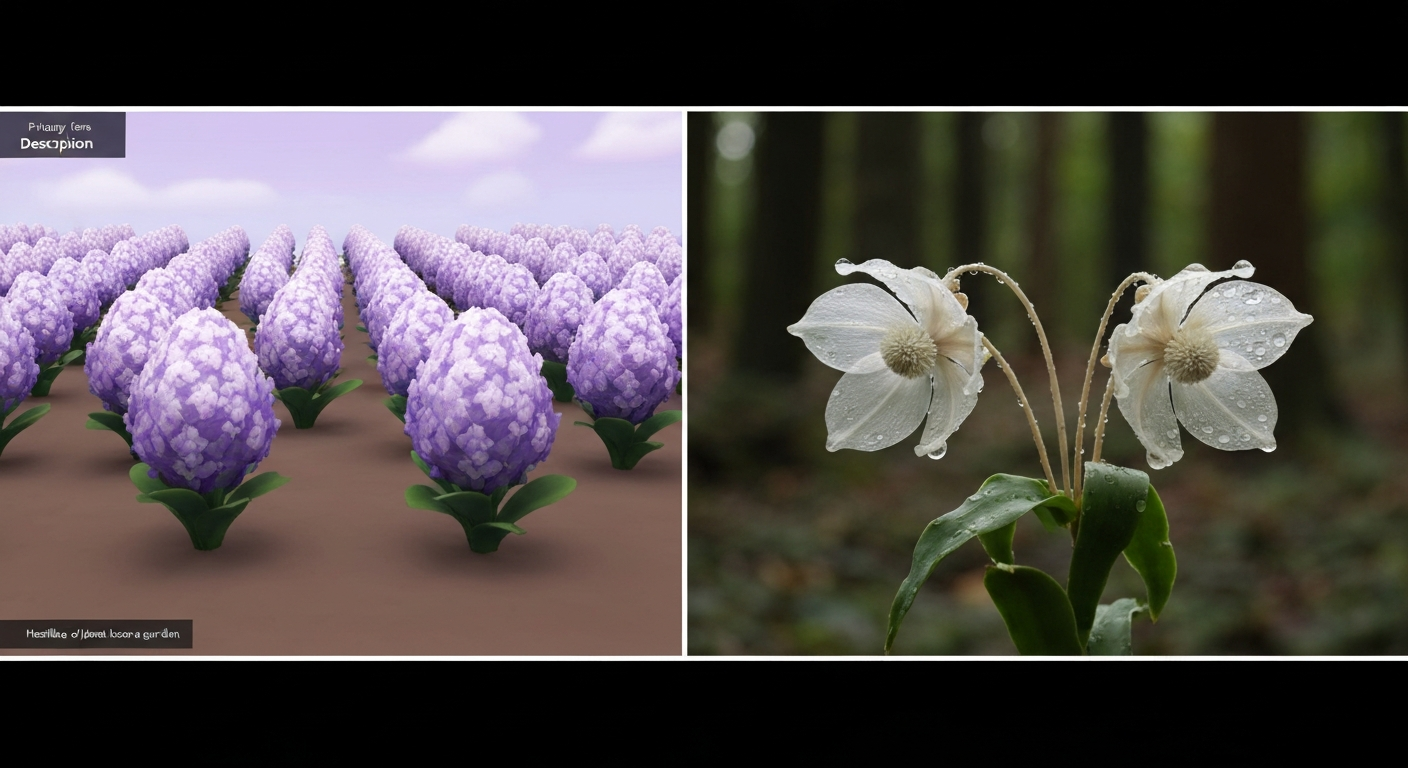
Diphylleia grayi is the skeleton flower most gardeners are actually looking for. It belongs to the barberry family (Berberidaceae) and earns every one of its evocative names. In dry weather the petals are white and opaque, about 1.5 to 2 cm across, arranged in loose cymes of six petals each. The moment rain hits them, the petals become completely transparent, revealing the flower's internal structure as if the flesh has melted away, leaving only a skeleton of veins. Glass‐like flowers in the rain - Frontiers in Ecology and the Environment (morphology of Diphylleia) reports that Diphylleia grayi petals turn transparent when wet because water fills air spaces between petal cell layers, eliminating light scattering. Dry out again and they return to white. Toji et al. (2023) confirmed in Frontiers in Ecology and the Environment that this transparency results from water filling air spaces between the petal cell layers, eliminating the light-scattering that makes white petals appear opaque.
The vegetative part of the plant is just as striking: huge, peltate (umbrella-shaped), deeply lobed leaves up to 30 to 40 cm across rise from rhizomes on thick petioles. The plant typically reaches 30 to 60 cm tall. Blue-black berries follow the flowers in midsummer. Taxonomically it is accepted as Diphylleia grayi by Plants of the World Online (Kew/POWO), World Flora Online, and GBIF, which also catalogue related species including D. sinensis from China and D. cymosa from the southern Appalachians in North America.
Natural habitat and behavior
In the wild, Diphylleia grayi grows in cool, moist, shaded montane forests of Japan, parts of China, and the Russian Far East. It prefers stream margins and north-facing slopes where the canopy is dense enough to filter direct sunlight but moisture remains consistently high. It is a rhizomatous herbaceous perennial that dies back completely in winter and re-emerges in spring, a pattern that has enormous implications for where and how you cultivate it at home.
Can you grow Diphylleia in a home garden?
Yes, and in the right climate it is actually not as demanding as its exotic reputation suggests. See the guide 'Can you grow skeleton flowers' for a focused walkthrough on cultivation, sourcing, and zone recommendations. If you garden in USDA zones 5 to 9 (or the RHS equivalent H4 to H2), have a shaded spot that stays consistently moist, and can provide humus-rich, well-drained soil, Diphylleia will reward you. The dealbreaker conditions are hot dry summers and heavy clay that waterlogged roots cannot escape. I have seen it thrive under deciduous woodland canopy in a garden in the UK Midlands, where summer temperatures rarely exceed 25°C and rainfall is reliable. It will not survive long in a sunny Mediterranean-style border or a south-facing Arizona bed without serious engineering. For gardeners in warmer zones, a north-facing sheltered position with regular watering and added leaf mulch is the closest workaround.
Diphylleia cultivation: soil, light, water, temperature, and where to plant it
Soil and light
Soil should be rich in organic matter with a slightly acidic to neutral pH (around 5.5 to 7.0). Mix in generous amounts of leaf mold or composted bark before planting. Good drainage is essential even though you want the soil moist: the roots should never sit in standing water. For light, deep to partial shade is ideal. Morning sun with afternoon shade works well in cooler climates. Full sun causes scorching and premature wilting even when watering is adequate.
Watering and temperature
Water consistently throughout the growing season. The soil should feel like a wrung-out sponge at all times. In dry spells, Diphylleia's leaves will droop dramatically within a day, so do not skip on water during the warmer months. The plant is reliably hardy to around -15°C (USDA zone 5) as a dormant rhizome, meaning you rarely need to provide winter protection once it is established in the ground. The main temperature threat is heat above 28 to 30°C combined with dryness, which causes leaf scorch and can kill the plant back prematurely.
Container versus in-ground planting
Planting in the ground is strongly preferred for long-term establishment. Rhizomes spread slowly and the plant looks most natural in a woodland-garden setting. Container growing is possible (use a deep pot, at least 30 cm, with the moisture-retentive but well-drained mix described above), but you will need to water containers far more frequently and be careful that pots do not heat up in summer sun. Containers do let you experiment with placement before committing to a spot, which is useful when you are still finding the coolest, shadiest corner of your garden.
Diphylleia propagation, seasonal care, and troubleshooting
Propagation
The two reliable methods are rhizome division and seed. Division is faster and more predictable: in early spring, just as new growth tips are visible, dig up a clump and cut the rhizome into sections with at least one visible growing point each. Replant immediately at the same depth they were growing before (roughly 5 cm below the soil surface) and water in well. Divisions typically produce flowering-size plants within one to two seasons.
Seed is slower and trickier. Fresh seed from ripe blue-black berries in late summer germinates better than stored seed. Sow in pots in a cold frame in autumn, allowing natural winter cold stratification to break dormancy. Germination tends to be uneven, sometimes taking two winters before seedlings appear. Expect three to four years from seed to first flower. I have tried surface-sowing stratified seed indoors and found the results disappointing compared to outdoor cold stratification, so patience and an unheated cold frame are your best tools.
Seasonal care calendar
- Early spring (March to April): Top-dress with leaf mold or composted bark as growth tips emerge. Divide crowded clumps now if needed.
- Late spring to early summer (May to June): Peak flowering. Keep soil consistently moist. Enjoy the transparency effect in rain.
- Midsummer (July to August): Berries develop. Continue watering. Add temporary shade cloth if a heat wave exceeds 28°C.
- Autumn (September to October): Collect berries for seed if propagating. Allow foliage to die back naturally; do not cut prematurely.
- Winter (November to February): Plant is dormant underground. Mulch with 5 to 8 cm of leaf mold in colder zones to protect from freeze-thaw cycles. No watering needed unless the soil is completely dry.
Common problems and fixes
| Problem | Likely cause | Fix |
|---|---|---|
| Leaves wilting and scorching at edges | Too much sun or insufficient water | Move to deeper shade; increase watering frequency |
| Petals not turning transparent | Normal — they only go transparent when thoroughly wet | Pour water directly over the flowers during dry weather to see the effect |
| No flowers after several years | Plant too young, or rhizome planted too deep | Allow 3–4 years from seed; check rhizome depth (max 5 cm under soil) |
| Root rot and yellowing foliage | Waterlogged soil or poor drainage | Improve drainage; add grit to heavy soil; raise planting level slightly |
| Slugs eating new foliage | Common in moist woodland settings | Use copper tape around pots; apply nematode treatments in spring |
| No germination from seed | Insufficient cold stratification or old seed | Stratify outdoors for a full winter; use only fresh seed |
Other 'skeleton flower' trade names and lookalikes in nurseries
Not everything sold as 'skeleton flower' at a nursery is Diphylleia grayi. The name has been applied loosely to other plants in the horticulture trade. Diphylleia cymosa, the American species native to the southern Appalachians, is sold under the same common name and behaves almost identically in cultivation, except it tolerates slightly warmer conditions and is easier to source in North America. Care requirements are the same: cool shade, consistent moisture, rich organic soil.
You may also encounter Diphylleia sinensis, the Chinese species, which is less common in commerce but available from specialist woodland plant nurseries. It shares the same translucent-petal trait. Occasionally, unrelated plants such as Epimedium (barrenwort) or Podophyllum (mayapple) end up near Diphylleia in nursery catalogs because they share the same woodland niche and the barberry family. They are completely different plants with very different flowers, though their cultural requirements overlap considerably with Diphylleia, making them excellent companions in a woodland bed. If you are specifically after the transparency effect, verify you have the right genus before buying.
Ghost pipe (Monotropa uniflora): the plant that looks like it belongs underground
What it is and why it looks the way it does
Monotropa uniflora, commonly called ghost pipe or Indian pipe, is one of the most striking things you can find in a North American or European forest and never expect to be a plant. It is entirely white to pale cream, sometimes flushed with pink, and grows as a waxy-looking cluster of nodding stems each tipped with a single bell-shaped flower. There is not a single green cell anywhere on it. It belongs to the heather family (Ericaceae), subfamily Monotropoideae, and is accepted as such by Kew/POWO across its circumboreal distribution. It earns ghost names because it appears to have no metabolic connection to sunlight at all.
The reason for that ghost-like appearance is that Monotropa uniflora is a mycoheterotroph. It does not photosynthesize. Instead, it extracts carbon and nutrients entirely through fungal partners, primarily members of Russulaceae (the genus of milk-caps and brittlegills), which are themselves in mycorrhizal relationship with surrounding forest trees. Monotropa uniflora is a non-photosynthetic mycoheterotroph that lacks chlorophyll and obtains carbon via fungal partners, primarily Russulaceae, as documented in the Integrated Metabolomics, Transcriptomics, and Ultrastructural Assessment of the Myco‐Heterotrophic Plant, Monotropa uniflora (PMC article). Research published in PMC confirms this multi-organism dependency through metabolomics and ultrastructural analysis. In effect, Monotropa is parasitizing the fungi that are, in turn, in a mutually beneficial relationship with trees. Remove the fungi, and the plant cannot exist.
Can you grow Monotropa at home? The honest answer
No, not practically. The University of Washington's plant propagation protocols for Monotropa uniflora document the constraints clearly: successful establishment requires the presence of the correct Russulaceae fungal partners, which themselves require living host trees and established forest soil ecology. You cannot replicate this by inoculating a pot. Every attempt I have read about or seen by home gardeners has failed. Transplanting wild specimens kills them almost immediately because the fungal mycelium network is severed. Seeds require the exact fungal hosts to germinate, so sowing them in even excellent woodland soil rarely produces seedlings.
The conservation and ethical note here is equally important. In some regions Monotropa uniflora is under pressure from habitat loss, and digging it from the wild is both ecologically harmful and in some jurisdictions illegal. If you find it growing in the wild, leave it alone and count yourself lucky. If you want to explore mycoheterotrophic plants for a garden project, the best realistic alternative is to cultivate the trees and fungi that support the ecosystem rather than the parasite itself.
Corpse flowers and large parasitic plants: how they differ from 'bone blossom'
Amorphophallus titanum and related species
Amorphophallus titanum (titan arum) holds the record for the world's largest unbranched inflorescence. A single bloom can exceed 3 meters tall and opens for roughly 24 to 48 hours, releasing a powerful odor of rotting meat to attract carrion beetle pollinators. It is native to lowland tropical rainforest in Sumatra. It has no commonly used 'bone blossom' name, but it shows up in conversations about unusual and macabre-sounding flowers frequently enough that gardeners researching the topic encounter it. The botanical connection to 'bone' names is loose, but the connection to striking, alarming blossoms is obvious.
There are dozens of other Amorphophallus species, many of which are far more manageable than the titan. Several are sold as tubers or seeds by specialist suppliers, and some like Amorphophallus konjac (konjac, voodoo lily) can be grown outdoors in temperate gardens in zones 6 to 10 or kept as fascinating container plants. For the titan arum specifically, Kew and Chicago Botanic Garden note that seed-grown specimens can take ten or more years to reach their first bloom, which requires a very large pot or in-ground space, warm humid conditions, and controlled dormancy cycles between growing seasons.
Rafflesia: the ultimate impossible garden plant
Rafflesia produces the world's largest individual flower, sometimes over a meter across, emerging directly from the tissue of Tetrastigma vine roots in Southeast Asian rainforests. It has no visible stems, leaves, or roots of its own. It is an obligate holoparasite. Research by the Royal Botanic Garden Edinburgh and Bogor Botanic Garden on ex-situ propagation of Rafflesia speciosa confirms what every attempt has shown: cultivating Rafflesia outside its native host-vine habitat is not feasible for ordinary gardeners, and even institutional experiments have achieved only limited success. If you want to see one, plan a trip to Borneo, Sumatra, or the Philippines. Do not attempt to collect or transplant one.
What is feasible: growing corpse-flower-type plants at home or in a greenhouse
The achievable end of the corpse-flower spectrum involves smaller Amorphophallus species and their relatives. Here is a practical summary for gardeners who want the drama without the decade-long wait or the tropical glasshouse.
- Amorphophallus konjac (konjac): Hardy to around zone 6 with mulch protection, or easily grown in large containers. Buy tubers in spring, plant at least 10 cm deep in rich, well-drained soil, provide part shade to full sun, and water generously once in growth. Can bloom in as little as two to three years from a decent-sized tuber. Yes, it does smell, but only for two to three days at bloom time.
- Amorphophallus bulbifer: Smaller species with attractive mottled stems. Good container plant. Produces small bulbils on the leaf that can be grown on as new plants.
- Dracunculus vulgaris (dragon lily): Not an Amorphophallus but produces a dark purple spathe and offensive smell for a day or two. Grows well in zones 7 to 10 in full sun and well-drained soil. Far easier than true corpse flowers.
- Propagation for Amorphophallus: divide offsets (smaller corms attached to the main tuber) in spring, or grow from seed if available. Seed takes longer but is viable. Store dormant tubers in dry, frost-free conditions over winter in cold climates.
- Legal and conservation notes: Many wild-collected Amorphophallus and Rafflesia materials are protected under CITES Appendix II or national legislation. Always buy from reputable nurseries with documented propagated stock, not from wild-collected sources.
Fungal 'spore blossoms': when mushrooms look like flowers
Fungal fruiting bodies, meaning the mushroom or bracket structures that fungi produce to spread spores, are sometimes called spore blossoms informally. Some species genuinely do look flower-like: the earth star (Geastrum), the bird's nest fungi (Nidulariaceae), and the stinkhorn family (Phallaceae) are all commonly mistaken for unusual plants by people who encounter them in leaf litter. They are not plants. Fungi are their own kingdom, more closely related to animals than to plants genetically speaking.
The practical upside is that many fungi are genuinely cultivable in a garden context, and some are easier to grow than any plant mentioned in this article. Oyster mushrooms (Pleurotus ostreatus) can be cultivated on straw bales or logs in a shaded garden corner. Shiitake (Lentinula edodes) thrives on inoculated oak logs. Wine cap mushrooms (Stropharia rugosoannulata) grow extremely well in wood-chip garden beds. If the spore-blossom aesthetic appeals to you but you want something you can actually cultivate, these are excellent starting points. For a focused answer on whether you can cultivate spore blossoms, see our can you grow spore blossoms guide. A basic log-inoculation kit produces results within six months, and the setup costs are modest.
Mineral 'growths' mistaken for bone blossoms: vivianite and related crusts
Vivianite is an iron phosphate mineral that forms as blue-green crystals, often on bone material buried in waterlogged or anaerobic conditions. It appears in archaeological sites, peat bogs, and anywhere rich in organic matter and iron-containing groundwater. It is not a plant, not a fungus, and cannot be grown. The confusion arises because vivianite crystals sometimes form elaborate, flower-like radiating clusters on buried organic material and can be strikingly beautiful. If you have found a blue-green crystalline deposit, especially on old bone material in wet ground, it is almost certainly a mineral rather than anything biological. It does not require watering, feeding, or seasonal care. Put it on a shelf and admire it.
Other mineral structures sometimes confused with plant or fungal growth include calcium carbonate (calcite) efflorescence on stone, iron ochre deposits in drainage channels, and actinomycete bacterial colonies in soil that can form white thread-like mats resembling fungal mycelium. None of these are garden plants. The definitive test: does it have cells? If you can crush it to a powder and it smells of nothing and shows no cellular structure under a hand lens, it is almost certainly a mineral or salt crust.
Practical identification flowchart for gardeners
Work through these questions in order to identify what you have found or are researching.
- Is it from a video game, specifically Roblox Grow a Garden? If yes: Bone Blossom is a virtual in-game crop added July 5, 2025. There is no real-world equivalent to cultivate.
- Does it have any green tissue (leaves, stems)? If yes and the flowers turn transparent when wet: almost certainly Diphylleia (skeleton flower). Go to the cultivation section.
- Does it have green tissue and small daisy-like flowers on low rosettes of slightly spoon-shaped leaves? Could be Bellis perennis (English daisy / bonewort). Very easy to grow as a cool-season plant.
- Is it entirely white or pale with no green tissue, growing in a shaded forest, with a single nodding bell flower per stem? This is almost certainly Monotropa uniflora (ghost pipe). Do not dig it. It cannot be cultivated.
- Is it a massive inflorescence (spadix and spathe, possibly over 1 m tall) with one enormous divided leaf, or no leaf at all while blooming, and does it smell of rot? Amorphophallus titanum or a related species. Cultivable but slow and space-demanding.
- Is it a giant bowl-shaped flower emerging from a vine root in Southeast Asian rainforest with no visible plant body, reddish-brown with white spots? Rafflesia. Not cultivable outside specialist institutions.
- Does it have a cap, gills, pores, or star-shaped structure and no true stem with internal vascular tissue? It is a fungus, not a plant. Some species are cultivable on logs, straw, or wood chips.
- Is it a blue, green, or crystalline crust on bone or rock, especially in wet or waterlogged ground? Very likely vivianite or another mineral. Not alive, not a plant, not growable.
Ethical, legal, and sourcing guidance
Several of the organisms in this article are protected, rare, or ecologically fragile. Here is what you need to know before you buy, collect, or attempt to cultivate any of them.
- Diphylleia grayi: Buy bare-root stock or pot-grown plants from specialist woodland plant nurseries. The plant is not on international protected lists, but always verify that the stock has been nursery-propagated and not wild-collected. Reputable sellers will state this. Avoid suspiciously cheap bulk lots from unknown sources.
- Monotropa uniflora: Do not collect from the wild under any circumstances. In many regions this is illegal, and even where it is not, transplanting kills the plant. If you see it, photograph it and leave it.
- Amorphophallus: Buy tubers from reputable specialist growers. Many species are CITES-listed; Amorphophallus titanum is included under CITES Appendix II, meaning trade is regulated but not prohibited when properly documented. Domestic nursery stock of common species like A. konjac is widely available and does not require CITES permits.
- Rafflesia: Under no circumstances attempt to purchase, collect, or cultivate from wild sources. The species are protected under Indonesian, Philippine, Malaysian, and international law. The only legitimate way to see Rafflesia is in its native habitat through guided ecotourism.
- Fungi: Most cultivated mushroom species (oyster, shiitake, wine cap) are available as licensed commercial spawn or inoculated kits without legal restriction. Wild mushroom collection laws vary by region; always check local rules before foraging.
- General nursery advice: seek out specialist woodland plant nurseries, alpine plant societies, and local fern or shade-plant groups for Diphylleia and related plants. These communities share propagated stock responsibly and can also guide you to the best-performing cultivated forms in your climate.
Quick-care checklists for gardeners
Diphylleia (skeleton flower) one-page care summary
| Care aspect | Requirement |
|---|---|
| Position | Deep to partial shade; sheltered from drying winds |
| Soil | Rich, humus-heavy, slightly acid to neutral (pH 5.5–7.0), well-drained but consistently moist |
| Watering | Keep soil like a wrung-out sponge; never let dry out in growing season |
| Hardiness | USDA zones 5–9; hardy to approx. -15°C as dormant rhizome |
| Fertilizer | Annual top-dress of leaf mold or well-rotted compost in spring is sufficient |
| Propagation | Rhizome division (spring) or cold-stratified seed (slow, 3–4 years to flower) |
| Pests and problems | Slugs (main pest); root rot if waterlogged; leaf scorch if too sunny or dry |
| When to see flowers | May to June in the Northern Hemisphere |
| Container growing | Possible; use deep pots (min. 30 cm), water frequently, avoid summer heat buildup |
Amorphophallus-type grower quick notes
| Care aspect | Requirement |
|---|---|
| Best species for home growers | A. konjac (zones 6–10), A. bulbifer (zones 7–10), Dracunculus vulgaris (zones 7–10) |
| Soil | Rich, well-drained; large deep pot or in-ground in warm climates |
| Position | Part shade to full sun depending on species |
| Watering | Generous while in active growth; cease entirely during winter dormancy |
| Temperature | Warm growing season required; store tubers frost-free in winter in cold zones |
| Propagation | Tuber offsets in spring; seed (slow) |
| Time to bloom | A. konjac: 2–3 years from decent tuber; A. titanum: 10+ years from seed |
| Smell warning | Blooms smell strongly of rot for 24–48 hours; plan placement accordingly |
Basic mushroom cultivation starter notes
- Choose a suitable species: oyster mushroom (Pleurotus ostreatus) on straw bales, shiitake (Lentinula edodes) on oak logs, or wine cap (Stropharia rugosoannulata) in wood-chip garden beds.
- Source: buy commercially produced spawn or inoculation kits from reputable suppliers. Do not collect wild mushrooms to try to propagate them — it rarely works and can result in misidentification.
- Setup: logs should be freshly cut hardwood (within a few weeks of felling). Drill holes at regular intervals, hammer in inoculated wooden dowels, and seal with beeswax.
- Timeline: shiitake logs typically produce first fruits 6 to 18 months after inoculation. Oyster straw bales can produce in as little as two to four weeks in warm humid conditions.
- Garden bed fungi (wine cap): spread spawn through wood chips in a shaded garden bed in spring. Expect fruiting in the same season under good moisture conditions.
Monotropa: do not dig guidance
- Do not dig, transplant, or attempt to pot up Monotropa uniflora found in the wild.
- Do not try to collect and sow seeds without established fungal hosts — germination will not occur.
- If Monotropa appears spontaneously in your garden, it means you already have the right fungal ecosystem; maintain it by avoiding soil disturbance, chemical fungicides, and unnecessary mulching that disrupts mycelium.
- Photograph and record any sighting — local botanical societies often want to know.
Where to go next for deeper reading
This article has covered the broad landscape of what 'bone blossom' might mean and which organisms genuinely deserve the name. If you want to go deeper on any specific thread, this site has dedicated guides that expand considerably on each one. The corpse flower guide goes into the full cultivation timeline for Amorphophallus titanum and explains what botanical gardens do differently from home growers. The skeleton flower guide provides a more detailed look at Diphylleia cymosa specifically, including which nurseries in North America and Europe consistently stock propagated plants. If the mycoheterotrophic biology of Monotropa fascinated you, the ghost pipe guide explores the fungal networks that make it possible. And if you are curious about whether vivianite really does grow on corpses (and what that process actually involves mineralogically), that is covered in depth in a dedicated article here as well. The spore blossom guide explains whether the in-game Grow a Garden spore blossom item has any real-world counterpart, and is worth reading alongside this one if the original search brought you here from the game.
FAQ
What do people mean by the query “what type of plant is bone blossom grow a garden”?
The phrase is ambiguous. In real‑world botany gardeners usually mean one of several living species nicknamed “bone” or “skeleton” (most commonly the skeleton/’glass’ flower Diphylleia spp., or less commonly Indian pipe/ghost pipe Monotropa uniflora, or even the common daisy Bellis perennis historically called ‘bone flower’). It can also be confused with tropical ‘corpse flowers’ (Amorphophallus titanum, Rafflesia) or with non‑plant materials (minerals like vivianite on remains). Additionally, in gaming communities “Bone Blossom” is a virtual crop in the Roblox game Grow a Garden — a completely fictional, non‑horticultural item.
Which real plants are most commonly called “bone blossom” or confused with that name?
Key candidates: 1) Diphylleia grayi (skeleton or glass flower) — white petals that turn translucent when wet; 2) Monotropa uniflora (Indian pipe/ghost pipe) — white, non‑green mycoheterotroph; 3) Bellis perennis (common/English daisy) — historical common name ‘bone flower’ in some sources. Also sometimes confused with large tropical ‘corpse flowers’ like Amorphophallus titanum and parasitic Rafflesia, though those are different plants with different cultivation needs.
How can I visually identify Diphylleia (skeleton or glass flower)?
Identification tips: basal umbrella‑like leaves (often two large leaves per stem), solitary white cup‑shaped flowers that become translucent (‘glass’) in rain, height usually 20–40 cm, prefers cool shaded woodland look. Native ranges: montane East Asia (D. grayi) and some congeners in North America/China. Bloom occurs in spring–early summer depending on climate.
Can Diphylleia be grown in a home garden, and what are the cultural requirements?
Yes — Diphylleia is feasible for woodland or shaded gardens in temperate climates. Key requirements: soil: rich, humusy, well‑draining but consistently moist (leaf mold or composted wood chips); light: deep shade to dappled shade; water: regular moisture, avoid drought; temperature/hardiness: likes cool, humid summer conditions — check specific species hardiness zones (many are cool‑temperate); placement: woodland border, under trees, or in large shaded containers; winter: mulched rest; fertilizer: light, balanced slow‑release or leaf‑mold feeding.
How do I propagate Diphylleia (skeleton flower)?
Propagation methods: division of clumps in early spring or autumn (best for established plants) and seed sowing. Seed: sow fresh stratified seed in cool, moist, shaded conditions—germination can be slow; division: lift small clumps carefully and replant immediately with root and soil intact. Avoid disturbing during active flowering or seed set.
What is Monotropa uniflora (ghost pipe) and can I grow it in my garden?
Monotropa uniflora is a non‑photosynthetic mycoheterotrophic plant that appears waxy white and lacks chlorophyll. It obtains carbon via specific mycorrhizal fungi linked to forest trees. It is generally NOT suitable for ordinary home gardening because it requires intact fungal networks and associated host trees. Reports of successful cultivation are rare and typically occur only under controlled institutional research conditions.
Can Bone Blossom Grow a Garden? ID & Growing Guide
Can 'bone blossom' grow in your garden? Disambiguates meanings, gives cultivation steps, risks, and legal tips.