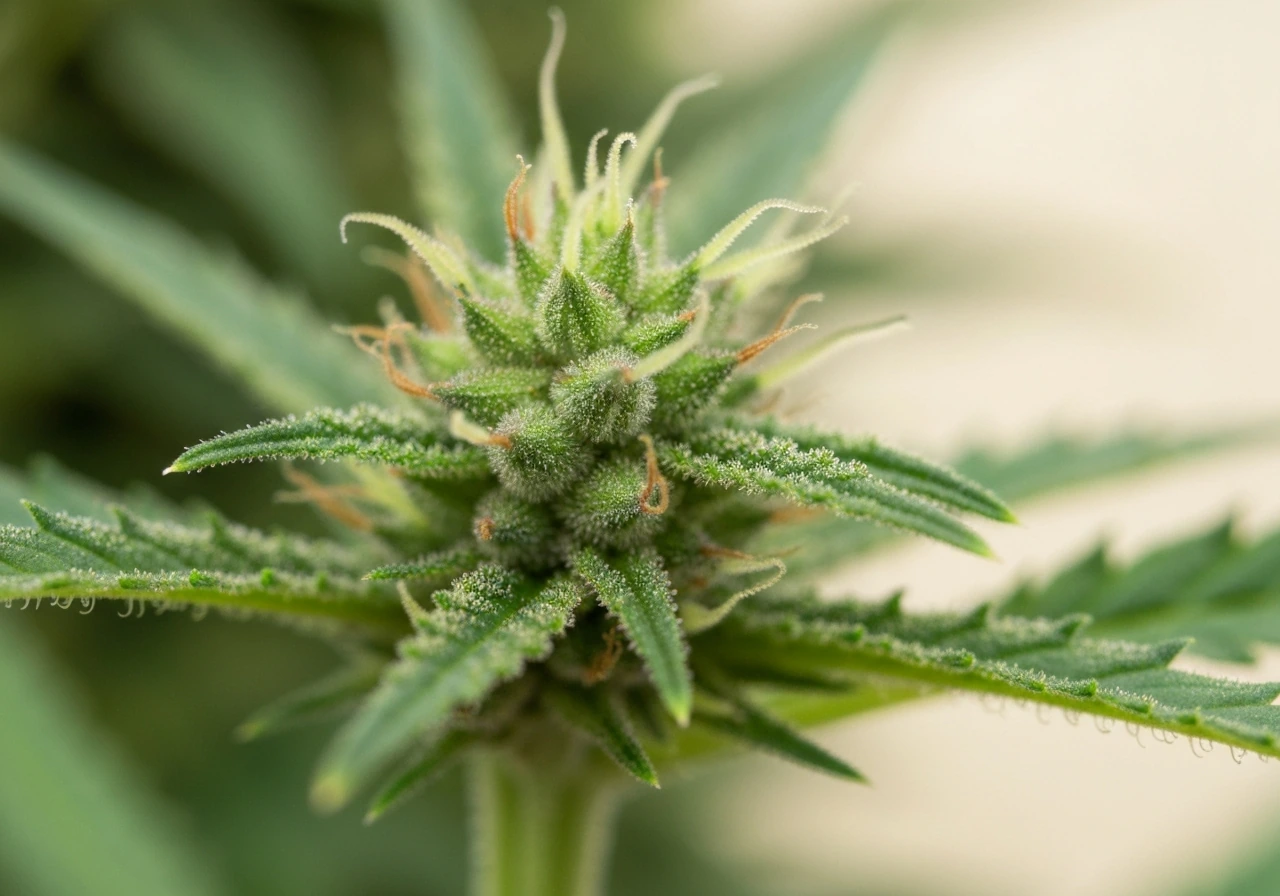
Yes, hops (Humulus lupulus) absolutely grow wild, and if you're in North America, Europe, or western Asia, there's a decent chance they're already within a few miles of you. In North America, most wild populations are escaped or naturalized from cultivation rather than truly native, but the plants behave exactly like wild ones: they come back from the roots every spring, spread aggressively through underground rhizomes, and colonize roadsides, riverbanks, and hedgerow edges with no help from anyone. If you're searching right now in July, you're at the ideal time: bines are fully extended, and early cone development is just beginning on female plants.
Do Hops Grow Wild? How to Find Wild Hop Vines

Marcus Weir
8 Jul 2026
Wild hop vs cultivated hop identification basics
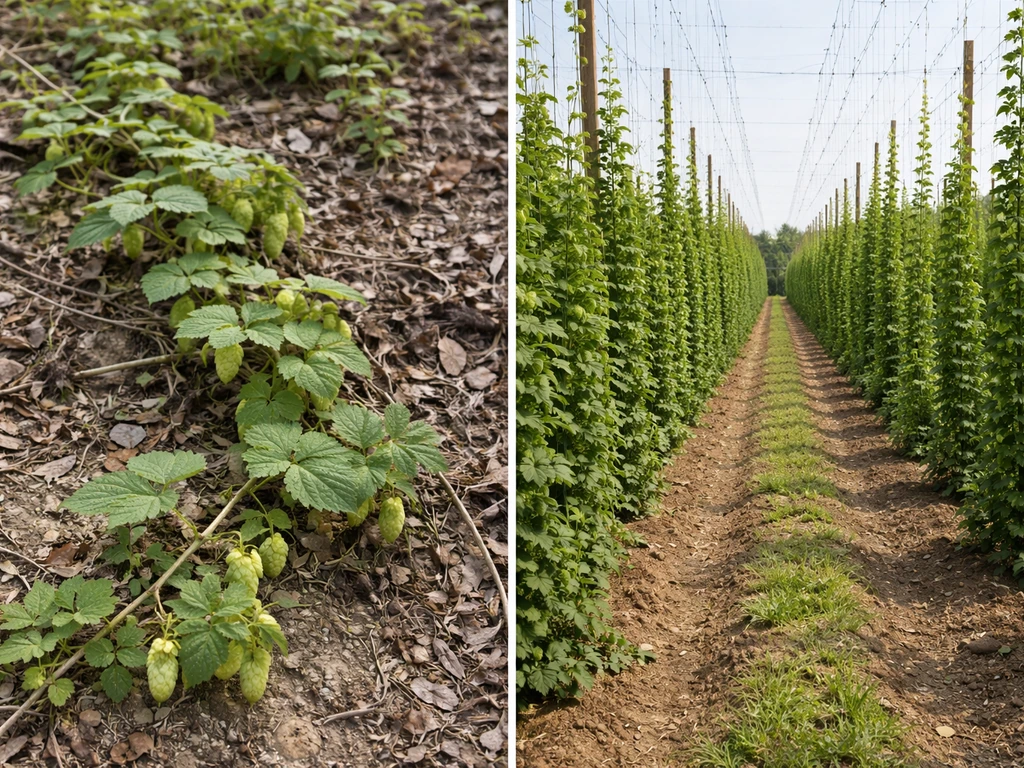
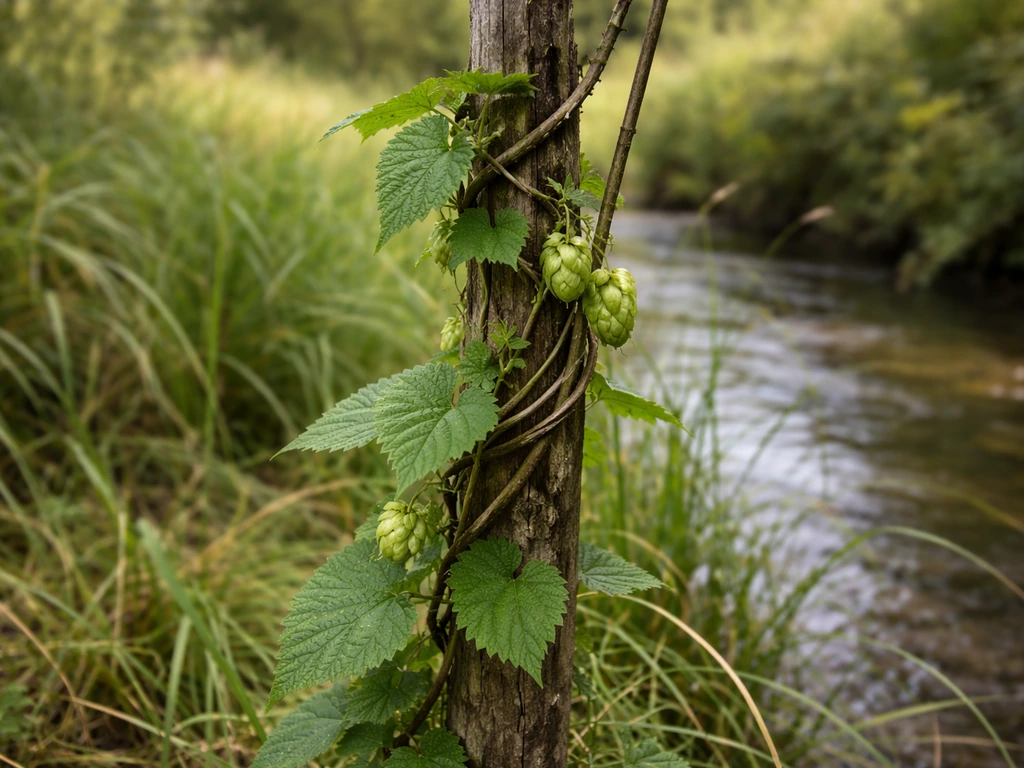
Visually, wild and cultivated hops are the same species, Humulus lupulus. The practical difference is context: cultivated hops grow in organized rows on trellised string systems on farms or in backyard gardens, while wild or naturalized plants scramble up whatever support is available, including chain-link fences, shrubs, tree branches, and old wooden structures. The plant itself looks nearly identical in both settings. What you will see in the wild is a more chaotic, less uniform growth habit with bines wrapping clockwise around multiple different supports and sometimes spreading horizontally when vertical support runs out.
There is one subspecies worth knowing: Humulus lupulus var. neomexicanus, native to the Rocky Mountain West of the US. If you're in Colorado, New Mexico, or the surrounding high-elevation areas, this is the true native wild hop variant you might encounter. Everywhere else in North America, what you're most likely finding is a naturalized European hop that escaped from cultivation at some point, sometimes decades or even centuries ago. Harvard's herbaria records confirm this distinction: the species is native to Europe and western Asia but now naturalized in many parts of North America.
The confusion species you most need to avoid is Japanese hop, Humulus japonicus. It looks similar from a distance but has leaves divided into 5 to 7 lobes rather than the typical 3 lobes of common hops. Japanese hop is an invasive annual in much of the eastern US and can colonize the same riparian corridors. If you're finding a hop-like vine in the eastern US but the cones look wrong and the leaves are deeply divided into more than 3 segments, you're probably looking at Japanese hop, not common hops.
Where wild hops grow by region and habitat
Wild or naturalized Humulus lupulus is recorded across much of the northern United States and southern Canada, through most of Europe, and across western Asia. In the US, the USDA PLANTS database shows it occurring in a wide band of states from the Pacific Northwest through the Midwest and into New England, with naturalized populations throughout. GBIF occurrence records back this up with map data showing distribution clusters that align with historically hop-growing regions.
In terms of specific habitat, hops are incredibly consistent. They almost always turn up in places that combine at least three of these conditions: moist soil, partial to full sun, nearby vertical structure to climb, and some form of disturbance. The classic locations are riverbanks and floodplain edges, hedgerows and fencerows, woodland margins, and thickets along railroad corridors or old farm boundaries. Minnesota Wildflowers and North Carolina Extension both specifically call out woodland edges, thickets, and fencerows as core habitat. If you live anywhere with this kind of landscape, hops are worth looking for.
| Region | Likely Population Type | Best Habitat to Search |
|---|---|---|
| Pacific Northwest (OR, WA) | Naturalized / escaped from commercial farms | Riverbanks, hedgerows, disturbed roadsides |
| Rocky Mountain West (CO, NM) | Native var. neomexicanus + naturalized | Streamside thickets, canyon edges, moist disturbed ground |
| Midwest (MN, WI, MI, OH) | Naturalized, well-established | Woodland edges, fencerows, floodplain margins |
| Northeast (NY, New England) | Naturalized, non-native per Go Botany | Riparian corridors, old farm hedgerows, disturbed areas |
| Southeast (NC, TN) | Sporadic, naturalized | Stream edges, shaded moist banks, forest clearings |
| Europe (UK, Central Europe) | Native or long-naturalized | Hedgerows, woodland edges, riverbanks, scrubby thickets |
How hops spread and why you'll find them there
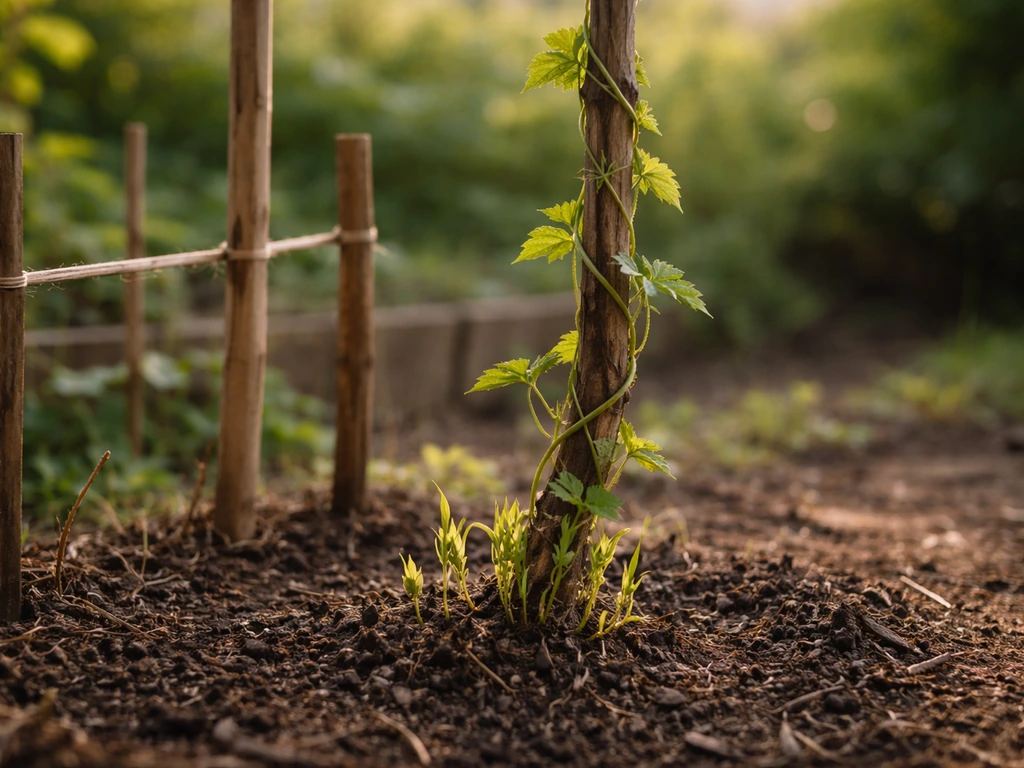
Understanding how hops spread makes their distribution totally predictable. The plant is a perennial that dies back to the ground every autumn and regrows from cold-hardy underground rhizomes each spring. Those rhizomes spread laterally over time, meaning a single plant established decades ago can now occupy a sprawling patch along a fencerow. Seed dispersal is wind-assisted, and since hops are dioecious (separate male and female plants), when both sexes are present and flowering in late summer, seed can travel some distance. That combination of rhizome expansion plus occasional seed dispersal explains why naturalized populations keep showing up along corridors like streams, roads, and old railways.
The other factor is human movement. Hops were cultivated commercially across much of the northeastern and midwestern US for well over a century, and abandoned or escaped plants from those operations have had generations to naturalize. Any area with a hop-growing history, which includes huge swaths of New England, New York, the Great Lakes region, and the Pacific Northwest, is particularly worth searching. Old farm boundaries, overgrown corners of fields, and stream edges near former agricultural land are exactly where you'd expect to find established populations today.
Hops also favor disturbed habitats, a fact Go Botany notes specifically. Road construction, clearing, or flooding that opens up sunny gaps with moist soil gives a rhizome or a seed the perfect conditions to establish. This is why utility corridors, roadsides, and stream banks that get periodically disturbed tend to produce hop sightings more reliably than undisturbed forest interiors.
How to spot wild hops in the field
In early-to-mid July, you're looking for a fast-growing, twining vine that has already climbed several feet up any available vertical support. If you mean the flushing in brewing, the timing affects growth because hops stop putting energy into vegetative growth as cone development takes over in late summer do buds still grow during flushing. Bines can reach 15 to 20 feet in a single season. The stem wraps clockwise around supports rather than clinging with tendrils, and it has stiff, downward-pointing hairs that give it a scratchy texture when you run your hand down the stem. That rough, almost sandpapery feel is one of the quickest tactile checks you can do in the field.
The leaves are opposite on the stem (meaning they attach in pairs at each node), with visible stipules: small leafy appendages right at the base of each leaf stalk. They are typically 3-lobed, roughly heart-shaped at the base, with coarsely toothed edges. In July, if you find a female plant, you may already see the early formation of pale green cone-like structures at the tips of the bines and in the leaf axils. Those cones are the definitive ID feature. By August and September, they develop more fully and you can part the bracts slightly to see the bright yellow lupulin glands: tiny, sticky, resinous granules with a distinctive herby-floral smell. Hop cones (strobili) develop blank" rel="noopener noreferrer">lupulin glands on or in the cone bract and bracteole region, which microscopic work uses to confirm the presence of lupulin structures. That smell alone, a mix of green grass and something almost citrusy or piney, is a strong confirmation in the field.
- Twining bine (not a tendril-climbing vine): wraps clockwise around supports
- Rough, scratchy stems with downward-pointing hairs
- Opposite leaves with visible stipules at each node
- Leaves typically 3-lobed with toothed margins
- Pale green cone-like structures (strobiles) forming at tips and leaf axils from mid-July onward
- Yellow, sticky lupulin granules visible between cone bracts when mature (August-September)
- Distinctive herby, resinous, slightly floral scent when you crush leaf or cone material
One important timing note: hops are a short-day plant, meaning flowering and cone set are triggered as day length shortens toward late summer. Cones won't be fully developed in early July. If you want the answer to when buds grow the most, watch for cone development starting in late summer as days get shorter. If you find what looks like a hop vine right now but don't see cones yet, that's completely normal. Mark the location and return in mid-August to early September for full confirmation. Harvest timing across most regions runs from mid-August through September, with the Pacific Northwest typically peaking around mid-August to mid-September.
The lookalike you genuinely need to avoid: dogbane
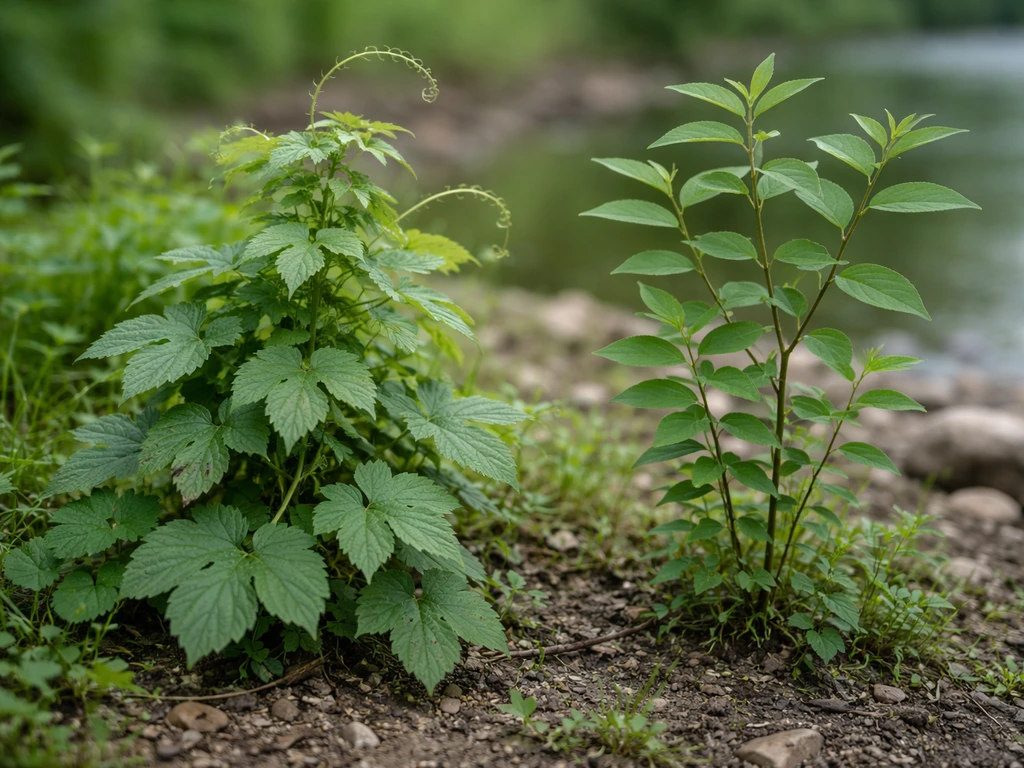
Dogbane (Apocynum cannabinum) shares enough surface traits with hops to cause confusion for beginners: it has opposite leaves, grows in disturbed riparian and edge habitats, and can grow tall. But dogbane is not a twining vine, it grows as a single upright or branching stem. Crush a dogbane leaf and you'll get milky white sap immediately, a dead giveaway. UMass Extension weed herbarium notes that dogbane (Apocynum cannabinum) produces milky sap when damaged, which is a quick confirmation check before further foraging blank" rel="noopener noreferrer">Crush a dogbane leaf and you'll get milky white sap immediately. Hops produce no milky sap. Dogbane leaves also have smooth margins (no teeth) and are 2 to 5 inches long with a more oblong shape. Dogbane produces narrow seed pods, not cone-like strobiles. If anything about the plant smells wrong or produces white sap, walk away from the dogbane ID and keep looking.
Best next steps for searching in your area
Start with a quick database check before you head out. The USDA PLANTS database lets you search by state or county to confirm whether Humulus lupulus records exist in your specific area. GBIF's occurrence map gives you a broader picture with actual recorded sightings, including naturalized populations. These two searches take about five minutes and tell you right away whether your region has documented hop populations. If there are no records in your county, that doesn't mean hops are absent, but it does mean your search will be more exploratory.
Once you've confirmed your region is plausible, the on-the-ground search strategy is straightforward. Drive or walk along stream corridors, old fence lines, and woodland edges in mid-morning when light is good. Look for tall twining vines on fence posts, shrubs, or low tree branches. Check roadsides near old farmland or any area with a history of agricultural use. Bridges and culverts over creeks are productive spots because the disturbed banks and moist soil create ideal conditions.
- Check USDA PLANTS and GBIF for county-level records before searching
- Target stream banks, hedgerows, old fencerows, and woodland margins in your area
- Look for the clockwise-twining bine habit: rough stems, opposite 3-lobed leaves
- If you find a candidate vine in July, mark it and return in mid-August to check for cone development
- Confirm identity by crushing a small piece: look for the resinous lupulin smell and yellow glands between cone bracts
- Verify no milky sap (rules out dogbane) and count leaf lobes (3 = common hop; 5-7 = Japanese hop)
- If you plan to harvest or rely on the plant, cross-reference with a regional flora or post photos to a plant ID community for confirmation
Common reasons people can't find wild hops (and how to fix it)
The most common reason is wrong timing. Hops die back to their roots each winter and don't emerge aboveground until early spring. If you searched in late fall or early spring and found nothing, the plants were simply dormant underground. You can also grow hops hydroponically, but it takes a different setup than traditional soil beds. July through September is the productive window for finding active bines and confirming cones. Searching in the wrong season is the single biggest source of false negatives.
The second issue is habitat mismatch. People expect wild hops in forest interiors or open fields, but they're almost never there. Wild hops need edge habitat: somewhere with access to sunlight and something to climb, plus moisture. Dense mature forest is too shaded. Open field centers are too exposed and dry. You're always looking for the transition zone, the margin where two habitat types meet.
A third problem is confusing Japanese hop for common hop in the eastern US. If you find a hop-like vine with deeply divided leaves of 5 to 7 lobes, that's likely Humulus japonicus, which is invasive but widespread in eastern riparian areas. It's not useful for brewing and not what most people are looking for. The leaf lobe count is your fastest field screen.
Finally, some searchers simply haven't found female plants. Since hops are dioecious, a population with only male plants will never produce cones, so you'd find the vine but no cone structures at all. If your goal is to confirm a hop vine, remember that cones are typically produced by female plants rather than by the fan leaves themselves. Male plants are still identifiable as hops by their other traits, but if you're specifically hoping to find cones for confirmation or foraging, you need a female plant. In established naturalized populations with both sexes, cones are the norm by late summer. In a sparse or newly naturalized patch, you might encounter only males.
One last thing worth mentioning: if you're also interested in the growth habits of hop bines beyond the vertical, the question of whether hops can grow horizontally is a genuinely interesting one tied to the same twining mechanics at play in wild populations. In practice, hops spread laterally too, especially when they run out of vertical support and switch to forming dense tangles across the ground-level area can grow horizontally. Wild bines do exactly that when they exhaust their vertical support, spreading laterally to form dense tangled mats, which is part of why naturalized patches can cover so much ground in a single season.
FAQ
I found hop-looking vines in July, but there are no cones. Does that mean it is not hops?
If you see a twining vine but no cones yet, don’t assume it is not hops. In most regions cones become easier to confirm starting in late summer, so mark the spot and recheck in mid-August through September (earlier only if you are in a warm climate and the plants are already far along).
Why might a wild hop patch have vines but never produce cones?
Yes, hops can be present without cones if the patch has only male plants. Since cones require female plants, you may see the typical twining growth and rough hairy stem but still get zero cone structures until a female is nearby.
What is the fastest field check to avoid confusing Japanese hop with common hops?
To tell common hops from Japanese hop quickly, focus on the leaf lobing. Common hops typically show 3 lobes, while Japanese hop leaves are much more deeply divided (often 5 to 7), and the vine is more likely in the eastern US riparian corridors.
What common look-alike mistakes should I watch for during quick ID checks?
Avoid relying only on the vine shape or leaf shape. Dogbane can look similar at a distance, but it gives itself away with milky white sap when you crush a leaf, and its leaves usually have smooth (non-toothed) margins.
Can hops grow in deep forest shade or open field centers?
In dense shade (mature forest interior) hops often fail to establish, even if the area otherwise seems moist. Your best odds are the edges, transition zones, and spots where sunlight reaches the vine and there is a nearby vertical structure to climb.
If the vine is not climbing, how do I search for hops that might be spreading horizontally?
If you only find cones but cannot locate a twining bine climbing, check nearby structures and ground-level tangles. When vertical support runs out, wild hops can spread horizontally and form dense mats, so cones might sit on tangling growth lower down.
How does day length and regional timing affect whether I will see cones when I search?
Early growth can look hop-like, but cone development follows day length, so timing matters. If you are outside the usual window for your region, you may only see vegetative bines, and the best confirmation approach is returning at the cone-setting stage.
What combination of traits should I use to confirm hops rather than guessing from one feature?
A practical approach is to scan for established habitat first, then confirm with at least two ID signals. Use cone presence (on female plants) plus tactile stem texture (scratchy, stiff downward hairs) and leaf arrangement (opposite leaves with stipules) before you commit to a positive ID.
If USDA or GBIF records are missing for my area, what is the smart next step on the ground?
Relying on databases helps, but absence of records in your exact county does not prove absence. In that case, widen your search radius along waterways, fence lines, and disturbed edges, and focus on hop-growing history near agriculture rather than undisturbed interiors.
Next Article
When Do Buds Grow the Most? Peak Timing and How to Boost It
Find the peak bud-growth window by plant type and learn how to spot swelling signs, then boost buds with light, water, a