Yes, Miracle-Gro can work well for magnolia trees, but the right product and timing matter a lot. For an established magnolia in the ground, Miracle-Gro Shake 'n Feed Flowering Trees & Shrubs (18-6-12) is the most practical choice: scatter it across the root zone out to the dripline in early spring, water it in, and reapply every three months through summer. The water-soluble 24-8-16 formula works too, especially for container magnolias, but it needs repeating every 7 to 14 days and is easy to overdo. Fertilizer spikes are the one Miracle-Gro format I'd skip entirely for magnolias. And for newly planted trees, hold off on any fertilizer for the first growing season: good mulch and consistent watering will do more good than nitrogen at that stage.
Is Miracle‑Gro Good for Magnolia Trees? When and How to Use

What magnolias actually need to thrive
Magnolias are not heavy feeders, which surprises a lot of gardeners who assume a big, impressive tree must need a lot of fertilizer. In reality, the primary nutrient most magnolias are missing in managed landscapes is nitrogen, and often only in modest amounts. Phosphorus and potassium deficiencies are less common unless a soil test specifically flags them. Before you reach for any fertilizer at all, it is worth doing a soil test through your local cooperative extension office: it costs very little and takes the guesswork out of whether you actually need to feed.
Magnolias prefer a slightly acidic soil pH in the range of 5.0 to 6.5. When pH climbs above that range, iron and other micronutrients become chemically unavailable to the roots even when they are physically present in the soil. This is the cause of interveinal chlorosis on young leaves (yellow tissue between green veins) that many magnolia owners mistake for a fertilizer problem. Adding more Miracle-Gro will not fix an iron deficiency caused by high pH. A soil acidifier or elemental sulfur addresses that root cause far better than any balanced plant food.
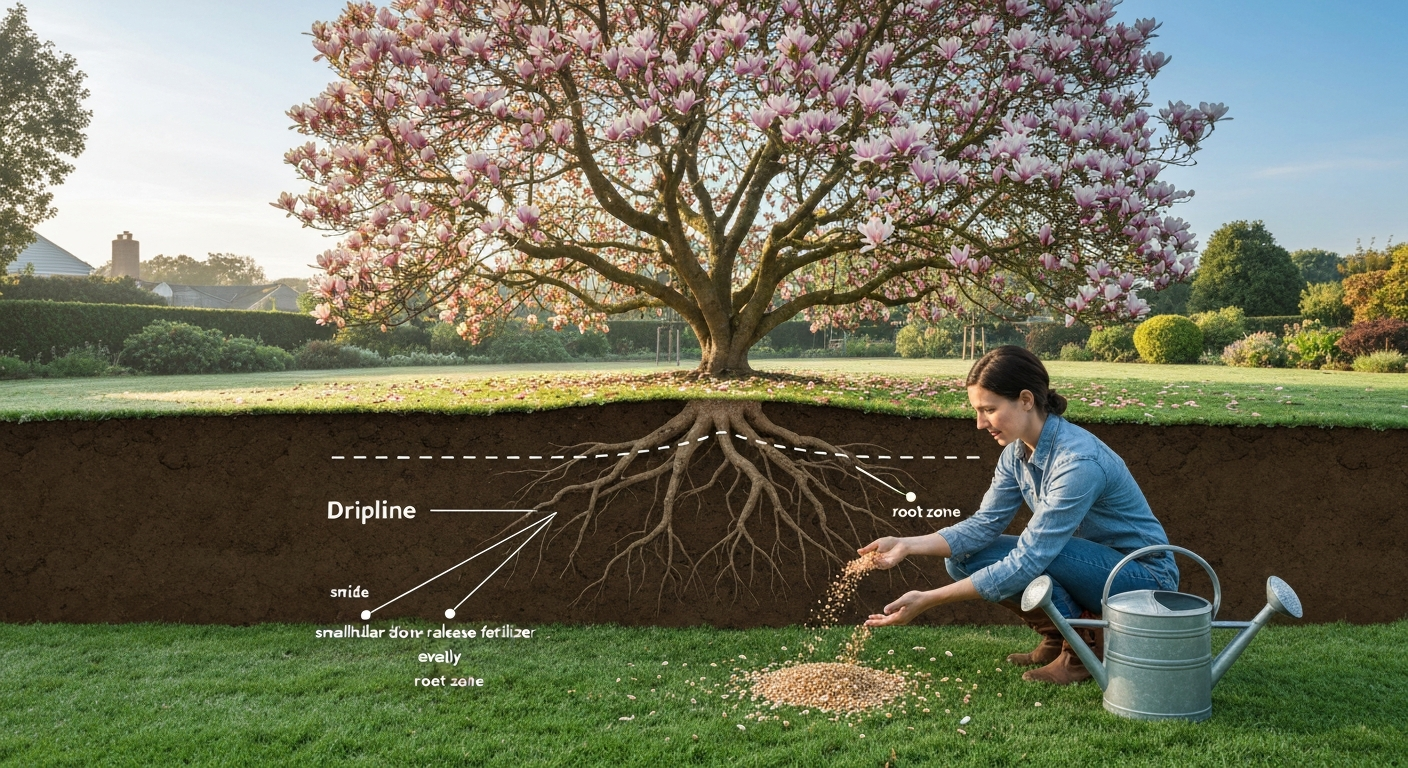
Magnolia roots are also notably fleshy and somewhat brittle compared to many other landscape trees, and they spread wide and shallow. This matters for how you apply fertilizer: you want nutrients distributed across the entire root zone, not concentrated in one spot. Feeder roots extend at least to the dripline (the outer edge of the canopy), and often well beyond it. Any product you apply needs to reach that whole zone to be effective.
Do not fertilize a newly planted magnolia
If you just planted your magnolia, put the fertilizer back on the shelf. Mississippi State University Extension specifically advises against fertilizing magnolias at transplanting. The reason is straightforward: a newly planted tree is under transplant stress. Its root system is reduced and cannot efficiently take up nutrients. Applying a fast-release nitrogen source at this point can actually scorch those fragile roots and set the tree back further. Controlled research by Gilman and colleagues (published in Arboriculture and Urban Forestry, 2000) confirmed that magnolias transplanted as young liners showed no measurable growth response to nitrogen during the first two years in sandy landscape soil.
What a newly planted magnolia needs instead is consistent moisture, a 2 to 4 inch layer of organic mulch pulled back a few inches from the trunk, and time to re-establish its root system. Once the tree shows a full season of healthy new growth, typically in year two after planting, you can begin a modest fertilizer program based on a soil test result.
The Miracle-Gro product lineup and how each one works
Miracle-Gro makes several product types that come up when gardeners search for fertilizers for trees and shrubs, and they do not all behave the same way. Understanding how each one releases nutrients helps you match the right format to the right situation.
| Product | NPK Ratio | Release Type | How It Works | Reapplication Frequency |
|---|---|---|---|---|
| Water Soluble All-Purpose Plant Food | 24-8-16 | Immediate / fast-release | Dissolve in water, apply to soil and foliage with watering can or hose feeder | Every 7 to 14 days |
| Shake 'n Feed Flowering Trees & Shrubs | 18-6-12 | Slow / continuous-release | Granules broadcast onto soil surface, watered in; microbes and moisture release nutrients gradually | Every 3 months |
| Tree & Shrub Fertilizer Spikes | Varies by product | Concentrated / localized | Driven into soil around dripline; releases from fixed points | Twice per year (spring and fall) |
The water-soluble formula delivers a quick nitrogen hit, which is useful when you need to see a fast response, but it leaches out of the soil quickly too. The granular Shake 'n Feed is slower and steadier, feeding over roughly three months, which aligns better with how landscape trees actually take up nutrients over a growing season. The spikes are the odd one out: they concentrate nutrients in a small number of spots around the dripline rather than spreading them across the full root zone. Extension specialists at UF/IFAS and elsewhere have flagged this as a problem for landscape trees, where even distribution is the goal.
The best Miracle-Gro products for established magnolias
For an established magnolia growing in the ground, Shake 'n Feed Flowering Trees & Shrubs is the most practical Miracle-Gro option. The 18-6-12 ratio is designed for flowering trees and shrubs, the continuous-release format reduces the risk of a nitrogen flush, and the three-month reapplication window means you only need to apply it two or three times across the growing season. Broadcast it evenly from a few inches out from the trunk all the way to the dripline, or a little beyond. Do not pile it against the trunk and do not let granules sit on foliage.
The water-soluble 24-8-16 formula can also be used on established in-ground magnolias, but it requires more discipline. The label directs reapplication every 7 to 14 days, which means it is easy to overfeed over a long season. If you use the water-soluble product, stick to the lower end of the frequency range and apply it through a watering can or hose-end feeder to the root zone, not just the foliage. On sandy soils especially, fast-release nitrogen leaches quickly and can end up in groundwater rather than in your tree.
Fertilizer spikes are not something I recommend for magnolias. The concentrated release in a handful of soil plugs does not match how magnolia feeder roots actually work. If you walk the full spread of a mature magnolia's canopy, you will realize pretty quickly why a dozen spikes cannot cover that zone effectively. Stick to surface broadcast methods.
Feeding magnolias in containers
Container magnolias are a different situation entirely. A potted tree has a fixed, limited volume of soil, which means nutrients deplete faster and roots cannot go looking for more. They genuinely do need more frequent feeding than their in-ground counterparts. The water-soluble Miracle-Gro is well suited here: mix it at the dilution specified on the label (the outdoor watering-can rate is 1.5 tablespoons per 1.5 gallons) and apply it to the container soil every 7 to 14 days through the active growing season from spring through late summer.
A few cautions for containers specifically. First, do not feed into dry soil: water the container first, then apply the fertilizer solution. Applying concentrated fertilizer to dry roots causes salt burn. Second, ease off in late summer and stop feeding entirely by early fall so the plant can harden off before any cool weather arrives. Third, if you are using Shake 'n Feed in a large container, work the granules lightly into the top inch of potting mix per the label directions and water thoroughly. Keep the rate conservative: container soil has less buffer capacity than garden soil, so it is easier to over-accumulate salts.
How to handle feeding for newly planted magnolias
As covered above, the general guidance is to avoid fertilizing at planting. But if you want to give a newly planted magnolia every possible advantage, the one approach that does have some research backing is a starter fertilizer with a higher phosphorus ratio applied at the time of planting to encourage root establishment, rather than a nitrogen-forward product. This is not a Miracle-Gro-specific recommendation: it applies to any brand. Even then, this is a situation where local extension advice varies and a soil test matters. On soils already high in phosphorus (very common in suburban gardens), adding more phosphorus at planting does nothing useful.
My own practice is to skip fertilizer entirely for the first full growing season and focus on two things: mulch and water. A 3 to 4 inch ring of organic mulch from just outside the trunk flare out to the dripline does more for a newly planted magnolia than any fertilizer. It moderates soil temperature, holds moisture, and feeds soil biology as it breaks down. In year two, once the tree has pushed out healthy new growth, run a soil test and then decide whether fertilizer is warranted at all.
When to feed and how to calculate the right rate
Timing matters as much as product choice. The most effective window for fertilizing magnolias is early spring, just as buds begin to swell and the tree is moving into active growth. Nutrients applied then get taken up during the tree's most vigorous growth push. A second application in early summer (around June) works well with a slow-release granular product. Avoid fertilizing in late summer or fall: late-season nitrogen encourages tender new growth that may not harden off before cold weather, which can damage or kill those shoots.
- Early spring (buds swelling, before full flush): first application of granular or water-soluble product
- Early summer (June, active growth continuing): second application if using slow-release granular every 3 months
- Late summer (August): last possible window for water-soluble product; skip in most climates
- Fall and winter: no fertilizer; let the tree prepare for dormancy
To calculate how much product to apply, work from the root-zone area rather than guessing. Measure the approximate radius from the trunk to the dripline in feet, then calculate the area in square feet using the formula: area = 3.14 x radius x radius. That gives you the square footage of the root zone. Then read the product label for the recommended rate per 1,000 square feet, and scale up or down accordingly. For example, if your magnolia has a canopy spread of 20 feet (radius = 10 feet), the root zone area is roughly 314 square feet. If the label recommends 1 pound of product per 100 square feet, you need about 3.1 pounds for that tree.
Research by Gilman and colleagues found that southern magnolias in sandy landscape soil responded well to moderate nitrogen rates around 4 to 8 pounds of actual nitrogen per 1,000 square feet annually, with the higher end producing measurable growth gains in trunk diameter and height by year three and four. Many general extension guides for landscape maintenance suggest a more conservative range of 1 to 2 pounds of actual nitrogen per 1,000 square feet per year. The conservative range is appropriate for most home garden situations, especially on heavier soils or in climates with significant rainfall. Sandy soils in warm, humid climates may benefit from the higher end of that range. A soil test is the best guide. To convert from actual nitrogen to product weight, divide the desired pounds of N by the nitrogen percentage shown on the label (as a decimal). For Shake 'n Feed at 18 percent N: if you want 1 lb of actual N per 1,000 sq ft, you need approximately 5.6 lbs of product per 1,000 sq ft.
Step-by-step application for in-ground magnolias
- Water the root zone thoroughly the day before or the morning of application so the soil is moist but not waterlogged
- Measure the root-zone area (trunk to dripline radius, calculate square footage as described above)
- Calculate the product amount from the label rate and your measured area
- Broadcast granules or apply liquid evenly across the root zone, from a few inches out from the trunk base to just past the dripline
- Keep product off the trunk, root collar, and foliage
- Water the area again immediately after application to move granules into the soil and prevent salt concentration
- Refresh mulch to a 2 to 4 inch depth across the root zone, keeping it pulled back 3 to 4 inches from the trunk
- Note the application date and schedule the next application based on the product type (3 months for Shake 'n Feed, 7 to 14 days for water-soluble)
Diagnosing nutrient problems vs. other issues
Not every yellowing magnolia leaf is a sign that the tree needs more fertilizer. Before you feed, look at the pattern of the discoloration. Uniform yellowing across older, lower leaves first points to nitrogen deficiency. Yellowing between the veins on new growth, with the veins themselves staying green, indicates iron or manganese deficiency, almost always tied to high soil pH rather than a lack of those nutrients in the soil. Older leaves yellowing between the veins while new growth looks normal suggests magnesium deficiency. These patterns behave differently and require different fixes.
| Symptom | Likely Cause | Fix |
|---|---|---|
| Uniform yellowing of older leaves first | Nitrogen deficiency | Apply nitrogen fertilizer (e.g., Shake 'n Feed) after confirming with soil test |
| Interveinal chlorosis on new growth (green veins, yellow tissue) | Iron deficiency from high pH | Lower soil pH with sulfur; apply chelated iron as a short-term fix |
| Interveinal chlorosis on older leaves | Magnesium or manganese deficiency | Soil test to confirm; Epsom salt (magnesium sulfate) for Mg; adjust pH for Mn |
| General stunted growth, small leaves | Compacted soil, poor drainage, or root damage | Improve drainage, aerate, or investigate root health; fertilizer will not help |
| Leaf scorch (brown leaf tips and margins) | Overfertilization or drought stress | Flush soil with deep watering; reduce or pause fertilizer; check irrigation |
Signs of overfertilization and what to do
Overfertilizing a magnolia is a real risk, particularly with fast-release water-soluble products. The first sign is usually leaf scorch: the tips and margins of leaves turn brown and crispy, similar in appearance to drought stress. You may also see white salt crust on the soil surface near where granules were applied. In severe cases, the whole tree looks wilted and stressed even when the soil is moist.
If you think you have overfed, the fix is water. Deep, repeated watering flushes excess soluble salts down through the root zone and out of the area where feeder roots are concentrated. Water slowly and thoroughly on multiple consecutive days. Pause all fertilizer applications for at least six weeks. If the tree is in a container, drench it until water runs freely from the drainage holes multiple times in a row. Check that drainage is not blocked. Going forward, stick to the calculated rate based on root-zone area rather than guessing, and follow the label frequency guidance rather than doubling up.
Practical alternatives to Miracle-Gro for magnolias
Miracle-Gro is convenient and widely available, but it is not the only good option. Slow-release fertilizers formulated specifically for acid-loving trees and shrubs (look for products designed for azaleas, camellias, and rhododendrons) often suit magnolias well since those species share similar soil pH preferences. Products with sulfur-coated urea or polymer-coated nitrogen release nutrients more steadily than a standard water-soluble feed and reduce the risk of nitrogen leaching on sandy soils.
Organic amendments are another strong option, especially for building long-term soil health rather than just delivering a quick nutrient hit. Composted pine bark fines, aged leaf compost, and cottonseed meal all acidify slightly as they break down, which suits magnolias, while improving soil structure and biology. Holly-tone by Espoma (4-3-4) is a popular organic granular option for acid-loving trees and shrubs and is gentle enough to use around newly established plants with less risk than synthetic formulas.
A quick note on Miracle-Gro and similar flowering trees and shrubs
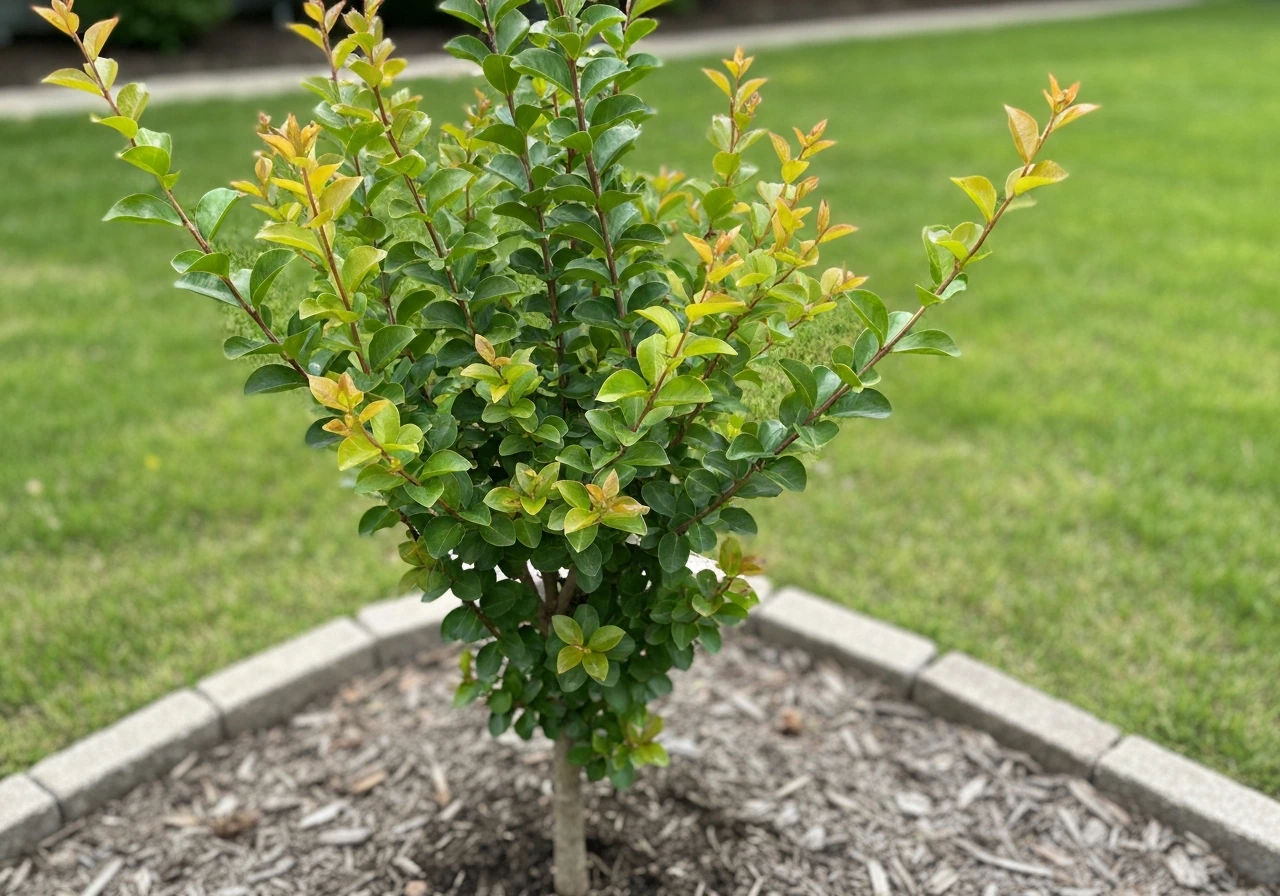
Magnolias are not unique in how they respond to Miracle-Gro. Dogwood trees, which share similar landscape roles and fleshy root systems, also benefit from moderate nitrogen with an emphasis on avoiding fast-release formulas during transplant stress. Oleanders are generally tougher and more salt-tolerant, so they handle water-soluble fertilizers more forgivingly than magnolias or dogwoods. For more on whether Miracle-Gro is good for oleanders, see is miracle grow good for oleanders. Crepe myrtles have their own feeding considerations: they actually bloom better with relatively low nitrogen and respond well to a balanced slow-release formula applied in spring. Overfeeding crepe myrtles with high-nitrogen products (like the water-soluble 24-8-16) tends to produce lush vegetative growth at the expense of flowers. The principle across all these flowering trees and shrubs is the same: match the product to the species, test your soil, and err on the side of less rather than more. If you're troubleshooting a related issue, like poor flowering on crape myrtle, see the guide on why won't my crepe myrtle grow for specific causes and fixes.
Environmental and safety notes
Miracle-Gro water-soluble plant foods are not classified as hazardous under OSHA GHS criteria according to the manufacturer's Safety Data Sheet, but that does not mean unlimited use is harmless to the broader environment. Fast-release nitrogen fertilizers applied at excessive rates, or applied before rain events, can run off into storm drains and waterways where excess nitrogen causes algae blooms and depletes oxygen. This is a particular concern on sandy soils or on sloped sites. Applying granular products to dry soil without immediate watering also increases runoff risk. Following label rates, applying to moist soil, and watering in immediately are not just best practices for plant health: they reduce the environmental footprint of your fertilizing routine.
Decision checklist: when to use Miracle-Gro, when to choose something else
Use this checklist to figure out your next step before you buy or apply anything.
- Use Miracle-Gro Shake 'n Feed Flowering Trees & Shrubs if: your magnolia is established (2+ years in the ground), showing pale or stunted growth, and a soil test confirms nitrogen is needed
- Use Miracle-Gro water-soluble (24-8-16) if: you have a container magnolia and can commit to feeding every 7 to 14 days through the growing season
- Skip Miracle-Gro fertilizer spikes: they do not distribute nutrients evenly across the magnolia root zone
- Skip all Miracle-Gro fertilizers if: your magnolia was planted within the last 12 months (focus on mulch and water instead)
- Choose an acid-forming alternative (Holly-tone, sulfur-coated slow-release, or organic compost) if: your soil pH is already at or above 6.5, or if your tree shows interveinal chlorosis suggesting a pH-driven micronutrient problem
- Run a soil test first if: you are not sure whether your magnolia actually needs feeding, or if it has not responded to fertilizer in previous seasons
- Regardless of fertilizer choice: apply 2 to 4 inches of organic mulch across the root zone (pulled back from the trunk), water before and after any fertilizer application, and avoid all fertilizer after late summer
FAQ
Short answer: Is Miracle‑Gro good for magnolia trees?
Yes—used correctly, some Miracle‑Gro products can be appropriate for magnolia trees (established, newly planted in some cases, and containers). The key is matching product type, rate, timing and application to the tree’s size, soil test results, root zone distribution and planting status. Quick‑release water‑soluble feeds suit containers and spot feeding; granular, continuous‑release products (Shake ’n Feed or tree & shrub formulations) can work for landscape magnolias when broadcast across the root zone and used at conservative rates. Avoid pushing high, concentrated applications (spikes or over‑application) without soil/tissue test guidance.
Which Miracle‑Gro products are appropriate for magnolias and when should each be used?
Water‑soluble (All‑Purpose 24‑8‑16): good for container magnolias and short, corrective feeds. Follow label rates and feed outdoor containers per label (every 7–14 days) at diluted strength. Granular continuous‑release (Shake ’n Feed Flowering Trees & Shrubs 18‑6‑12): suitable for established landscape magnolias as a maintenance feed applied across the root zone every ~3 months per label, at conservative rates informed by soil test. Tree & Shrub spikes: generally avoid for magnolias—extension literature warns spikes concentrate nutrients in small points and may miss most feeder roots; if used, follow label and prefer distributed broadcast methods. Always follow the product label and adjust based on soil tests and local extension recommendations.
What exact application timing should I follow for magnolias?
Established magnolias: apply fertilizer in early spring when new growth begins (best for uptake), and if using a slow/continuous feed product you can reapply per label (e.g., Shake ’n Feed ~every 3 months) or make a second lighter application in early summer if growth is slow. Avoid heavy late‑season high‑nitrogen feeding after late summer which may produce tender growth susceptible to winter damage. Newly planted magnolias: many extension guides recommend not applying routine high rates at planting; instead rely on good backfill, watering and mulch. If you choose to fertilize at planting (to aid early growth in poor soil), use low amounts of a slow‑release, balanced fertilizer and avoid concentrated placement against roots or trunk. Containers: feed with water‑soluble per label every 7–14 days (outdoor containers) or use a controlled‑release product blended into potting mix at planting.
What rates should I apply (practical numbers)?
Follow product label for precise measures. As general guidance: - Water‑soluble (miracle‑gro all‑purpose): mix and apply per label—do not exceed labeled frequency; container directions are designed for small root volumes. - Shake ’n Feed (18‑6‑12, feeds up to ~3 months): apply a thin even layer across the root zone; label gives amounts by plant size—use label amounts and do not overapply. - Landscape N targets: many extension programs recommend maintenance N roughly 1–2 lb N per 1,000 ft2 per year for beds; research on magnolia showed growth responses at higher rates (~4–8 lb N/1,000 ft2 in sandy soils over multiple years). If you lack a soil test, err on the low side (close to 1 lb N/1,000 ft2) and increase only with tissue/soil test evidence. Convert product N percentage to pounds applied using label math before applying.
Step‑by‑step application instructions for established landscape magnolias (granular/Shake ’n Feed):
1) Do a soil test first if possible. 2) Clear excess mulch and debris from the soil surface but keep existing mulch ring. 3) Calculate product amount from label and your target N rate. 4) Broadcast granules evenly across the root zone from near trunk outward to and beyond the dripline if feasible (do not pile at trunk). 5) Lightly rake or work granules into top 0–1 in of soil if label allows (many label directions say surface application is fine). 6) Water thoroughly to move nutrients into the root zone. 7) Replace mulch keeping 2–4 in depth and pulled a few inches from trunk. 8) Repeat per label timing or follow extension recommended schedule.
Step‑by‑step for newly planted magnolias and for container magnolias:
Newly planted (in ground): 1) Prefer no fertilizer at planting unless soil test shows deficiency or poor soils—focus on good backfill, watering and mulching. 2) If you decide to feed, use a small amount of slow‑release, balanced fertilizer worked lightly into backfill or applied as a band across the root ball at low rate—do not place concentrated fertilizer against roots or trunk. 3) Water regularly to encourage root establishment. Container magnolias: 1) Use a high‑quality potting mix and controlled‑release fertilizer in the mix or apply water‑soluble feed per label every 7–14 days. 2) Use diluted strength for large plants and monitor growth. 3) Repot into a larger container when rootbound and refresh potting media with slow‑release or organic amendments.
What to Feed Crepe Myrtles to Make Them Grow Fast
Step-by-step crepe myrtle feeding plan: right fertilizer, soil prep, timing, NPK, and fixes for slow growth.