Ghost pipe (Monotropa uniflora) grows in moist, deeply shaded forest understories where the soil is rich in undisturbed humus and the right mycorrhizal fungi are present underground. You won't find it in your garden bed, a meadow, or a sunny trail edge. It shows up in old-growth and mature second-growth woodlands, often in dense stands of conifers or mixed pine-hardwood forest, and it appears above ground for only a brief window each year. If you know the right ecosystem type, the right season, and what to look for on the forest floor, you have a real shot at finding it.
Where Do Ghost Pipes Grow? Habitat, Range, and When to Look

Marcus Weir
2 Apr 2026
What ghost pipe actually is (and why location is everything)
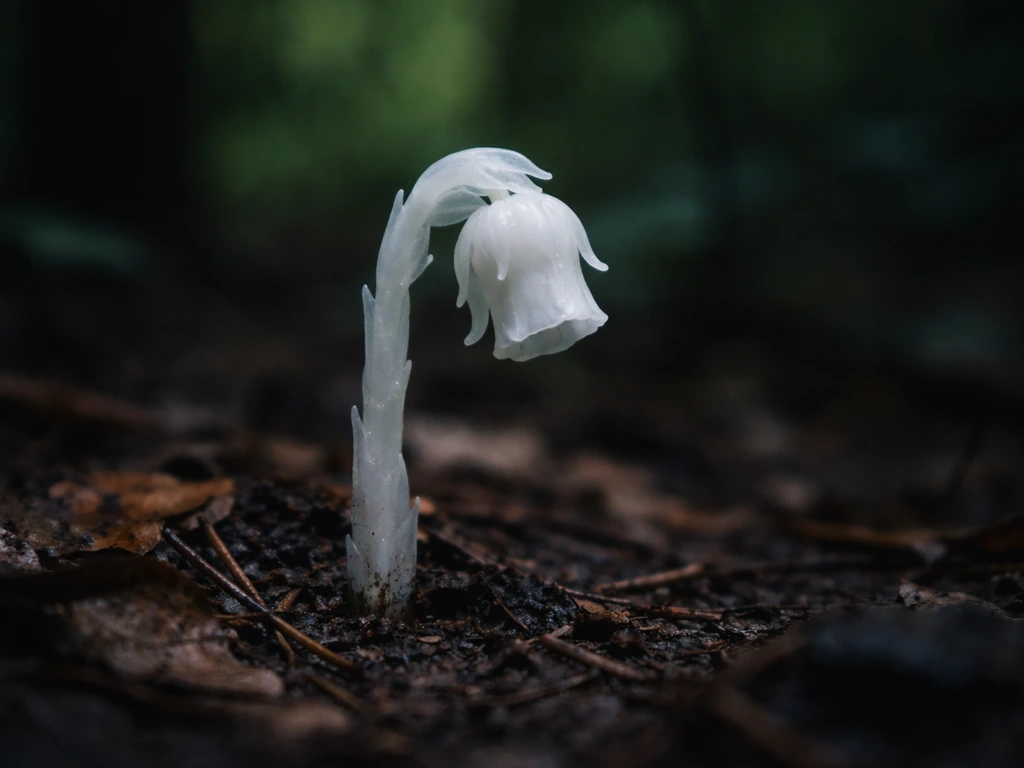
Ghost pipe is Monotropa uniflora, a flowering plant with zero chlorophyll. It cannot photosynthesize at all, which is why it looks the way it does: waxy white, almost translucent, with no green anywhere on it. Instead of making its own food from sunlight, it taps into mycorrhizal fungal networks underground, specifically fungi in the family Russulaceae, and steals carbon that those fungi are already exchanging with the roots of nearby trees. It is technically a mycoheterotroph, meaning it is parasitic on fungi rather than on a host plant directly. Because of that, its presence is completely tied to where intact, undisturbed fungal communities exist in the soil.
You may also see it called Indian pipe, ghost plant, or corpse plant, and botanists occasionally list a related scrub form, Monotropa brittonii, particularly for populations in northern Florida and the southeastern coastal plain. For practical searching purposes, the habitat requirements are essentially the same across those closely related forms. The naming matters mostly so you aren't confused when a field guide uses 'Indian pipe' and a blog calls it 'ghost pipe': they're almost certainly talking about the same plant.
Location matters more for this plant than for almost anything else you'd go looking for in nature. Because it depends entirely on a living fungal network, you can't find it in disturbed ground, cleared land, or young secondary forest that hasn't developed a full fungal community yet. No fungal network means no ghost pipe, period. That's why people often search for years in seemingly suitable-looking woods and come up empty. The forest has to be the right kind of forest, and the underground community has to already be thriving.
Native range: where in the world does ghost pipe grow
Monotropa uniflora has what botanists call a multicontinental distribution. It's native across much of North America, parts of Central America and South America, and also appears in Asia. Within North America, its core range covers a broad swath of the continent: it's common throughout the eastern United States and Canada, appears across the Pacific Northwest, and shows up in Mexico in both coniferous and mixed conifer-broadleaf forest types. The range isn't continuous, though. There are documented distribution gaps where large stretches of apparently suitable land have no populations, which researchers think reflect historical dispersal limits and the highly specific underground partnerships the plant requires.
One important caveat: California is a notable exception to the 'widespread' framing. Despite being widespread through much of North America, Monotropa uniflora is considered rare in California and carries a California Rare Plant Rank of 2B.2. If you're searching in California, your target should be limited to the state's intact coastal and montane forest habitats, and your expectations should be adjusted accordingly. Plant hardiness zone data places the species in a rough range of 6A through 8B, which maps to most of the temperate northern tier of the continent.
Where to actually look: regions and ecosystem types
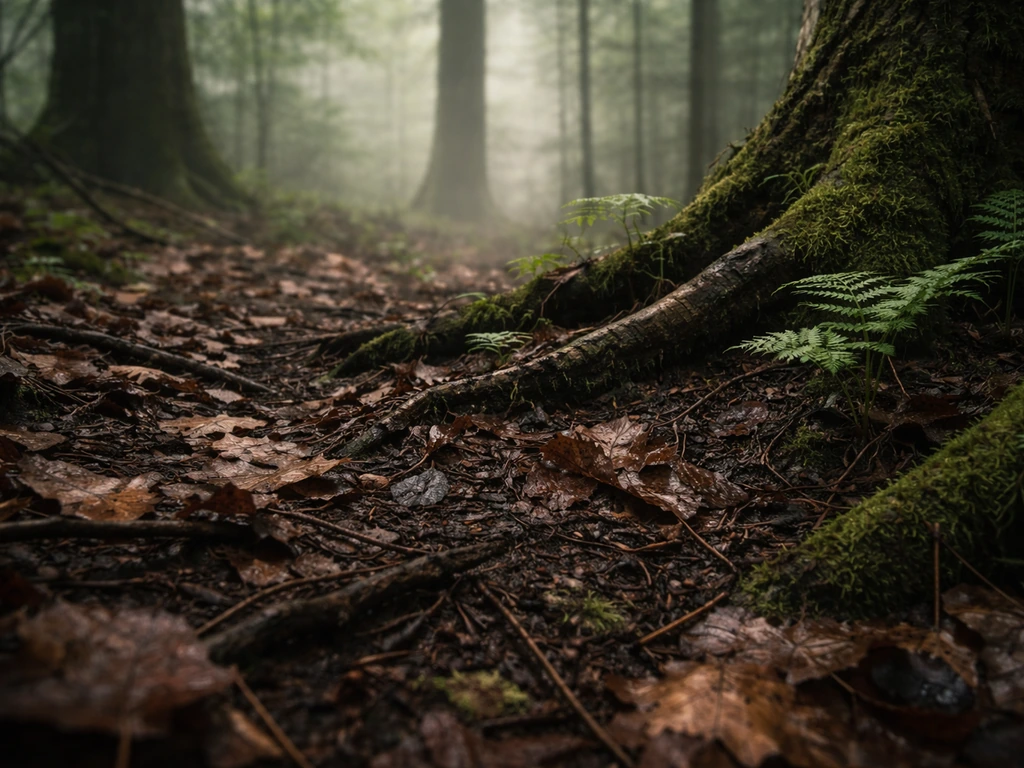
The single most useful frame for finding ghost pipe is this: look for old, moist, shaded forest where the ground is deeply layered with decomposing leaf litter and nobody has disturbed the soil in a long time. That rules out a lot of places immediately and narrows your search considerably.
Eastern United States and Canada
This is the heart of ghost pipe country. From New England south through the Appalachians and into the Gulf Coast states, mature mixed hardwood forest and pine-hardwood forest are the primary habitats. Look for it in the understory of older beech-maple, hemlock, or pine-dominated stands where the canopy is dense enough to keep the ground in near-constant shade. Research in eastern Massachusetts found that ghost pipe is associated with a genuine diversity of Russulaceae fungi, which makes sense: the more diverse and intact the fungal community, the more likely you are to find it. Ravines, north-facing slopes, and stream-adjacent forest are especially productive because moisture levels stay consistently high.
Pacific Northwest
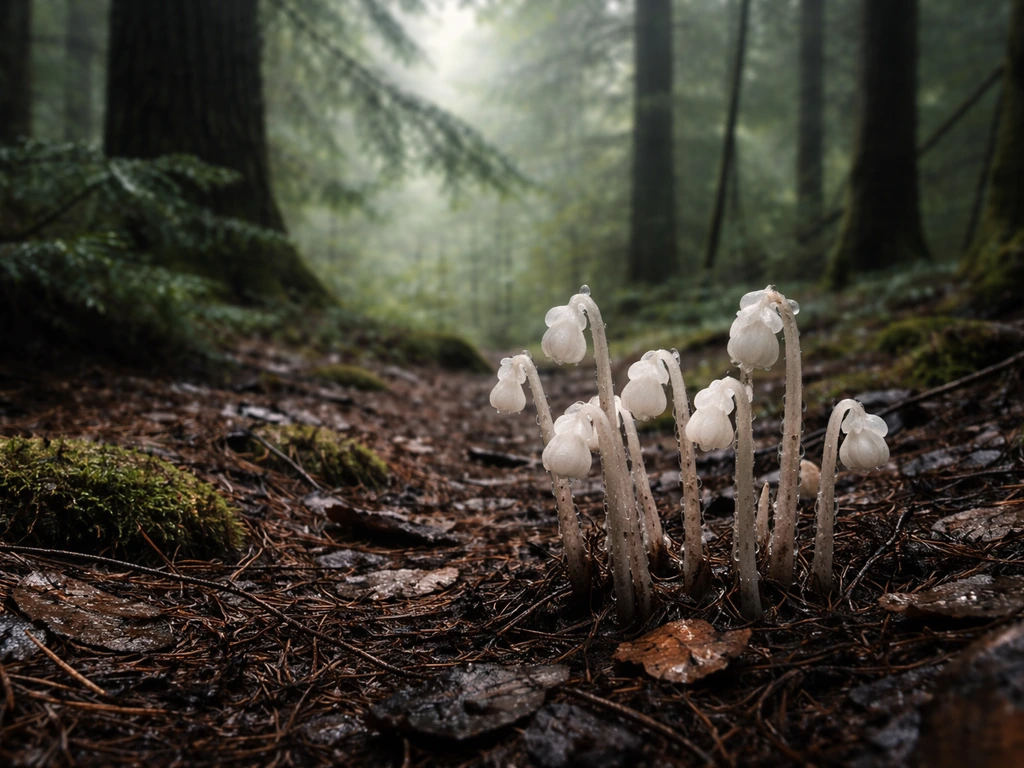
Ghost pipe is well established in the Pacific Northwest, particularly in the wet, shaded understories of coniferous forest in Oregon, Washington, and into British Columbia. Western Oregon is a documented location, and Mount Rainier National Park has historical records of Indian pipe in deep moist woods below 2,500 feet elevation. In the Pacific Northwest, look in dense Douglas fir or mixed conifer stands with heavy understory shade and a thick duff layer on the forest floor. The timing in this region skews toward late spring and early summer compared to the eastern states.
The Southeast and Gulf Coast
In Louisiana, Mississippi, and surrounding states, ghost pipe is associated specifically with the humus of moist pine-hardwood forest in deep shade. Look in older longleaf or loblolly pine stands mixed with hardwoods, especially in low-lying areas or near creek drainages where moisture accumulates. This is also where you're most likely to encounter the closely related Monotropa brittonii in northern Florida's scrub habitats.
Midwest, Mountain West, and California
In the Midwest, populations are more scattered, appearing in mature forested ravines and woodland preserves rather than open agricultural landscapes. In the Mountain West, elevation and forest type matter a lot: stick to lower-elevation (below roughly 2,500 feet) moist conifer forest rather than high-altitude sparse forest. In California, the search is genuinely difficult given the plant's rarity there, but coast redwood forest, mixed evergreen forest in the North Coast Ranges, and similar moist, heavily shaded habitats are the most realistic targets.
Soil, moisture, light, and forest floor conditions
Ghost pipe has very specific habitat requirements that flow directly from its biology. Here's what to look for when you're evaluating a forest site:
- Shade: Deep shade is non-negotiable. Ghost pipe thrives in forest understories where direct sunlight rarely reaches the ground. If you can see open sky overhead, you're probably in the wrong spot.
- Moisture: The soil needs to be consistently moist, not just seasonally wet. Look for areas near streams, on north-facing slopes, or in low spots where moisture doesn't dry out quickly between rain events.
- Soil type: Rich, undisturbed humus derived from years of decomposing leaf litter and wood is the substrate. You're looking for that dark, spongy, fragrant forest floor, not compacted or sandy soil.
- Forest age and integrity: Mature or old-growth forest is strongly preferred because the mycorrhizal fungal community takes many years to develop. Avoid recently logged, burned, or otherwise disturbed areas.
- Tree association: Pine-hardwood mixes, hemlock stands, beech-maple forest, and Douglas fir-dominated conifer forest are all documented associations. The common thread is a forest type that supports diverse Russulaceae fungi in the soil.
- Elevation: Generally found below 2,500 feet in most of its range, though local terrain can push this higher or lower depending on the climate zone.
One thing that surprises people when they first go looking: ghost pipe doesn't need soil nutrients the way normal plants do. It needs the fungal community. That means fertilized or heavily composted ground is actually irrelevant. What matters is whether the underground network is intact, which is why you simply cannot grow it by transplanting or by amending soil at home. If you've ever wondered about whether you can grow moondew nectar, you'll know that some plants have very particular environmental dependencies that make cultivation nearly impossible outside their native habitat, and ghost pipe is one of the most extreme examples of that.
When ghost pipe appears above ground: the seasonal window
Ghost pipe is only visible above ground for a short period each year, and the window shifts depending on your region. Broadly speaking, the flowering period runs from June through September, but that's the full national range. In practice, most populations within a given area appear for just a few weeks.
| Region | Typical Above-Ground Window | Notes |
|---|---|---|
| Eastern US (mid-Atlantic, New England) | Late June to August | Pennsylvania records June–August; Adirondacks typically late July into August, sometimes late June |
| Pacific Northwest | Late spring to early summer | Earlier than eastern states; look from May into July depending on elevation and year |
| Southeast / Gulf Coast | June to August | Timing similar to eastern states; moisture-dependent years can shift this |
| Midwest | June to August | Scattered populations; timing mirrors eastern US broadly |
| California (rare populations) | June to September | Extended iNaturalist-documented range; highly location-dependent |
The plant emerges when soil temperatures and moisture conditions are right, not strictly by calendar date. In drought years, it may appear later or not at all in a given patch. In wet years, it can push up earlier. In the Adirondacks specifically, it typically begins blooming in late July and continues into August, with occasional early appearances in late June. The bottom line: if you want to find ghost pipe this season, plan your forest walk for June through August depending on where you live, and go after a period of adequate rainfall rather than during a dry stretch.
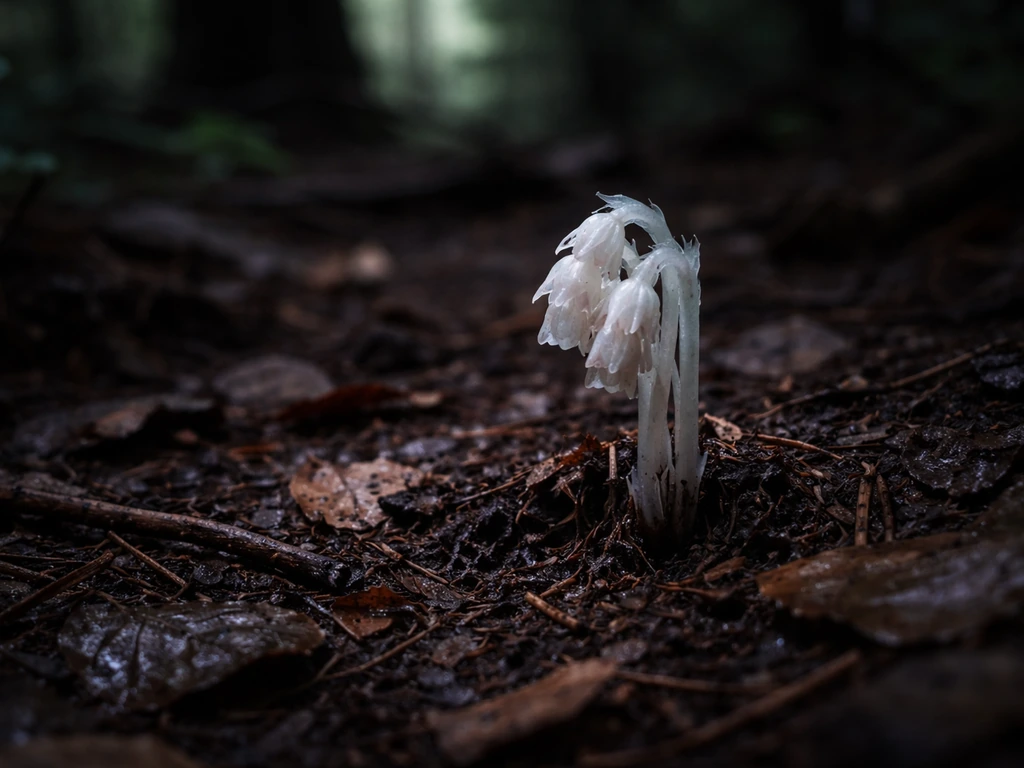
The timing question also connects to what stage you'll be observing. Young plants have the nodding (downward-drooping) single flower that gives the plant its pipe-like silhouette. As the plant matures, the flower becomes erect. By the end of the season, both the stem and the flower structures turn brown and papery. If you arrive late in the window, you may find brown, spent stalks rather than the iconic white ones, but that's still a confirmed location for future years.
How to scout safely and responsibly
Permissions and access
Before you go anywhere, sort out land access. State and national parks, national forests, and nature preserves are generally good places to look because they tend to have mature, undisturbed forest. Most of them also have rules about not collecting plants or disturbing the ground, which actually works in ghost pipe's favor. Check whether the land requires a permit or has trail restrictions. Private timber land and private nature reserves exist too, and those require explicit permission from the landowner. Don't assume that because you can walk somewhere legally, you can disturb or remove anything you find there.
Leave it alone: the ethics of finding ghost pipe
This is the most important practical point in this whole guide: do not pick, dig up, or attempt to transplant ghost pipe. The plant almost never survives removal from the wild because its entire existence depends on that underground fungal network. Digging it up doesn't just kill the individual plant, it physically disrupts the mycorrhizal threads that the plant was connected to, potentially damaging a network that supports other plants and fungi in the same patch for years to come.
Illinois Extension puts it plainly: take photos but do not remove plants from the wild. The Virginia Native Plant Society adds that gardeners should not collect ghost pipes from wild populations at all. This isn't excessive caution. It's just the biology of the plant.
This same logic applies to general ground disturbance around the patch. Don't dig nearby to 'investigate the roots,' don't trample the immediate area heavily, and don't clear away leaf litter to get a better photo angle. The duff layer and undisturbed soil are part of what makes the location viable. Treat it the way you'd want someone to treat a rare find in your own garden. Interestingly, the principle of leaving certain plants undisturbed in their native habitat applies to some outdoor-adapted plants like mother of thousands too, where removal can disrupt established ecological relationships.
What to look for in the field
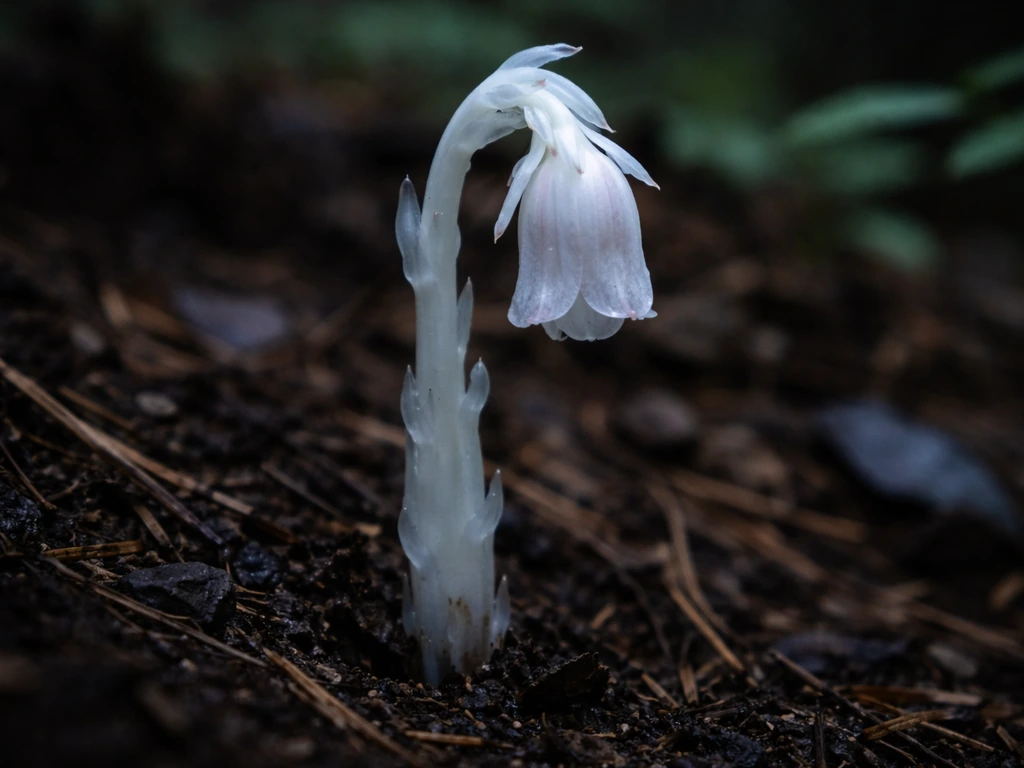
When you're scanning the forest floor, you're looking for something that doesn't look like it belongs. Ghost pipe is entirely white or pale cream, with no green anywhere. The stem is fleshy and unbranched, covered in small oval scale-like structures instead of normal leaves. The single flower at the top is bell-shaped and nodding when young, giving it the silhouette of an old-fashioned tobacco pipe pointing down at the ground. The whole plant typically stands 4 to 10 inches tall, and it often grows in clusters of several stems emerging from the same general spot on the forest floor.
A useful field checklist for confirming you've found the real thing:
- Entirely white or waxy pale coloration with no green parts whatsoever
- Single, bell-shaped (campanulate) terminal flower on each stem, nodding downward if young, erect if mature
- Stem covered with small oval scale-like structures rather than true leaves
- Fleshy, unbranched stems growing from forest floor humus, often in small clusters
- Flowers turn brownish as they age and as the season progresses
- Located in deep shade under a closed tree canopy, not in openings or disturbed ground
The main lookalikes you might encounter in similar habitats are other Monotropa species and some white-flowering understory plants, but the combination of waxy all-white color, scale-leaves, and that single nodding pipe-shaped flower is distinctive enough that a side-by-side comparison with a field guide photo usually settles any doubt quickly. Photographing the stem scales and the flower angle is the fastest way to document a positive ID.
Recording your find
If you find ghost pipe, record the GPS location, the forest type, the approximate canopy coverage, and the date. Submitting the observation to iNaturalist with photos is genuinely useful for tracking population data. Note whether the flowers are nodding (young) or erect (mature), and whether you see multiple stems or just one. These details help build a clearer picture of population health over time. If you find it in a spot that doesn't match the typical habitat description, note that too. Unusual locations occasionally turn up in botanical records and are worth documenting.
One last practical note: if your interest in unusual plants extends beyond ghost pipe, it's worth knowing that some plants with equally specific growth requirements exist in the realm of fiction and game design. For instance, readers curious about whether you can grow mallowsweet in Hogwarts Legacy or who enjoy puzzles like what Mary Mary Quite Contrary grew in her garden often end up on this site alongside people searching for real-world botanical answers.
Ghost pipe sits firmly in the real-world category, but it's genuinely strange enough that the curiosity is the same. And if you've ever considered bringing unusual plants indoors, remember that some plants simply refuse to cooperate with indoor conditions, similar to how morning glory growing inside requires very specific management. Ghost pipe makes morning glory look easy by comparison.
The forest is its only viable home, and the best thing you can do after finding it is leave it exactly where it is.
Common myths about ghost pipe worth clearing up
- Myth: Ghost pipe is a fungus. It is a flowering plant, not a fungus. It looks unusual because it lacks chlorophyll, not because it's structurally related to mushrooms or mold.
- Myth: You can grow it at home if you get the soil right. You cannot reliably cultivate ghost pipe because it requires a living, intact, species-specific mycorrhizal network that doesn't exist in garden soil.
- Myth: Finding it means the forest is unhealthy. The opposite is true. Ghost pipe is a sign of a mature, intact forest with a functioning underground ecosystem.
- Myth: It only grows in the eastern US. Ghost pipe has a multicontinental distribution including the Pacific Northwest, Mexico, Asia, and other regions.
- Myth: Picking it is fine because it's just a wildflower. Picking ghost pipe disrupts the fungal network it depends on and almost always kills the plant immediately. The same applies to understanding the value of beneficial plants in a garden ecosystem: removing something that looks simple can have consequences you don't immediately see.
FAQ
If I find moist, shaded forest but no ghost pipe, does that mean it will never grow there?
Even if the above-ground habitat looks right, a patch can be empty because the required underground fungal partnerships are patchy. If you find no plants on the first visit, try again in the same season after a soaking rain, and revisit different parts of the same old woodland rather than assuming the whole forest is unsuitable.
What’s the most common reason people go at the right time and still miss ghost pipe?
Yes, it can be missed. The plant often appears for just a few weeks, and drought or unusually wet weather can shift emergence. Plan for multiple visits over a June to August window and focus on the densest duff and deepest shade spots.
If ghost pipe needs rich humus, can I improve my chances by amending my garden soil or adding compost?
Do not rely on soil type alone. Ghost pipe can be present only where the correct Russulaceae-associated fungal network is intact, so adding compost or using a “better” garden substrate usually does not help. The plant’s carbon supply comes through fungi, not from the soil’s nutrients.
Can ghost pipe survive in recently logged or heavily trampled forest areas?
That combination is unlikely. Heavy disturbance usually breaks the fungal network and also reduces the stable, moist duff layer ghost pipe depends on. Sites that have been logged, bulldozed, graded, or heavily trampled are common reasons for false negatives.
How do I choose the best microhabitats within a known ghost pipe region?
Yes. Even in regions where it’s known, it can occur at elevations or microsites you might not expect, like north-facing slopes, ravines, and stream-adjacent woods where moisture stays high. Narrow your search to consistent shade and continuously moist forest floor rather than just “near water.”
If I only see one white pipe, is that likely a mature plant, or could it indicate a bigger patch?
Look for clusters emerging from the same general spot and note whether stems are nodding (younger, not fully up) or erect (more mature). Multiple stems often indicate the fungal network is active in that patch, even if you only see a few flowers.
Can I use “spent” stalks to locate ghost pipe for future sightings?
Ghost pipe can be present without being in bloom. In some cases you may find brown, papery spent stalks later in the season, and those locations can be productive next year. Record the exact spot and revisit during early summer timing for your region.
What’s the safest way to confirm an ID if I’m not 100% sure it’s ghost pipe?
Treat identification as a documentation task, not a collection task. Photograph the stem scales and the flower’s angle, then log details like date and forest type. If you are unsure, compare against other white Monotropa-like plants rather than assuming all white woodland “pipes” are the same species.
What should I do legally and ethically after I find ghost pipe on public or private land?
Yes, but only through observation and data collection. Many parks, preserves, and forests have rules against collecting or disturbing plants, and private land requires explicit permission. You can usually photograph and record GPS, but you should never dig or clear duff for better views.
If ghost pipe is documented in one spot, does that mean it will be nearby too?
Not necessarily. A single reported record does not guarantee nearby sites have it, especially because the range has gaps and the fungal partnerships are highly specific. If you want to expand beyond a known point, search within the same forest type and moisture conditions, not just at the same latitude or elevation.
How should my search strategy change in California compared with the eastern United States?
In California, the practical implication is to reduce your search scope and expectations. Because it’s rare there, focus on intact coastal or montane forests with deep shade and stable moisture, and understand that many otherwise suitable woods may still have no populations.
Does weather during the week before I go matter for finding ghost pipe?
Yes, if you’re planning a hike, it helps to time visits after adequate rainfall and to avoid dry spells. Temperature and moisture thresholds can delay or prevent emergence in a specific patch, so checking local weather patterns the week before your visit can change your odds a lot.
Next Article
Is Miracle-Gro Good for Mandevilla? How to Feed It Safely
Yes, Miracle-Gro can feed mandevilla safely. Get correct NPK choice, dilution, schedule, and signs to avoid burn.