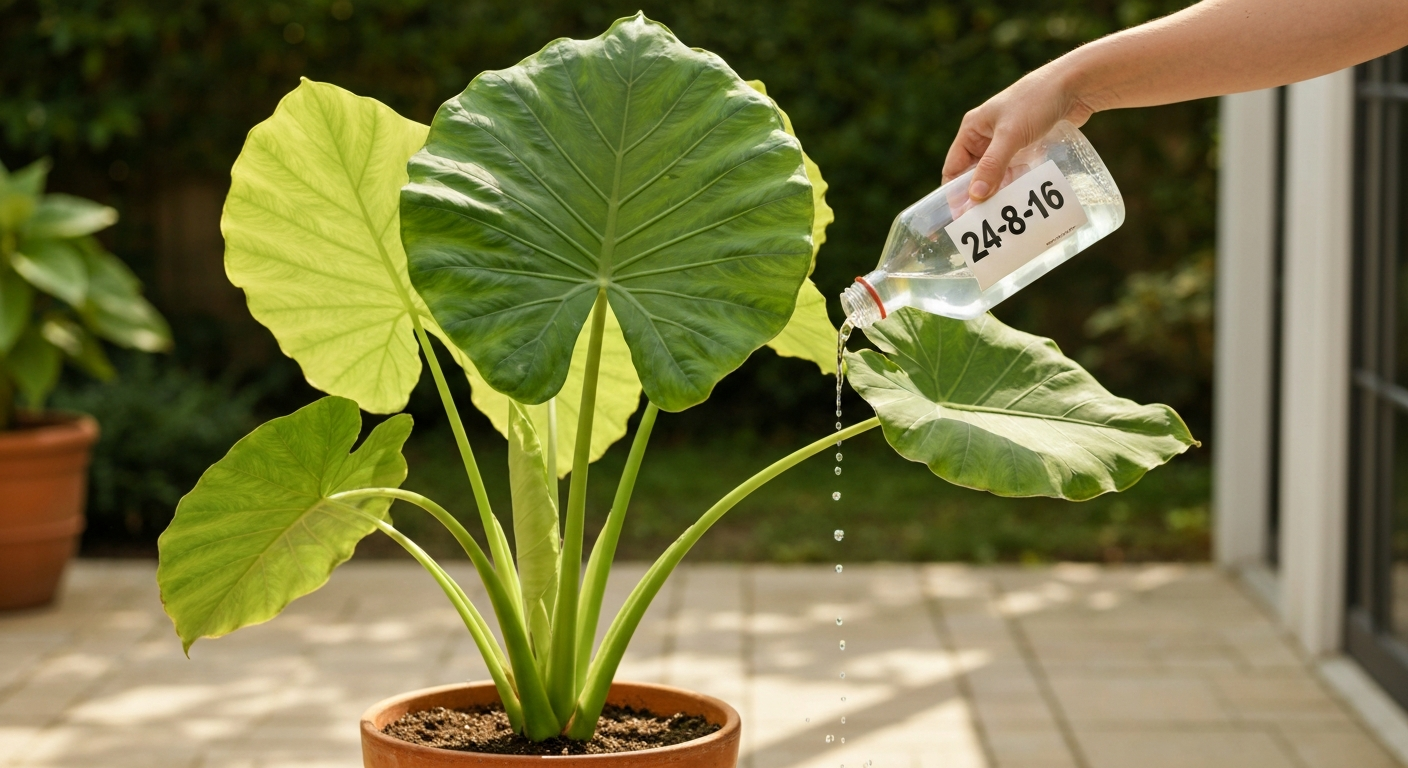
Yes, you can use Miracle-Gro on elephant ears, and it works well when you choose the right product and apply it at the right time. See our detailed guide is Miracle Grow good for elephant ears for product recommendations, timing, and tips to avoid fertilizer burn. The water-soluble All Purpose formula (24-8-16) is the fastest-acting option and suits both garden beds and containers during the active growing season. The granular Shake 'N Feed (12-4-8) and Osmocote slow-release pellets are better choices if you want a lower-maintenance routine or if you've had salt buildup problems in pots before. The main risks are fertilizer burn from over-application and salt accumulation in containers, both of which are easy to avoid once you understand the basics.
Can I Use Miracle Grow on Elephant Ears: Safe Guide

Who this guide is for (and a few quick safety notes)
This guide is written for home gardeners growing elephant ears in beds or borders, container growers managing plants on patios or indoors, and students or curious learners who want to understand why fertilizer choices actually matter for large-leafed tropicals. Whether you bought a single Colocasia from a garden center or you're managing a whole collection of Alocasia in pots, the advice here scales to your situation.
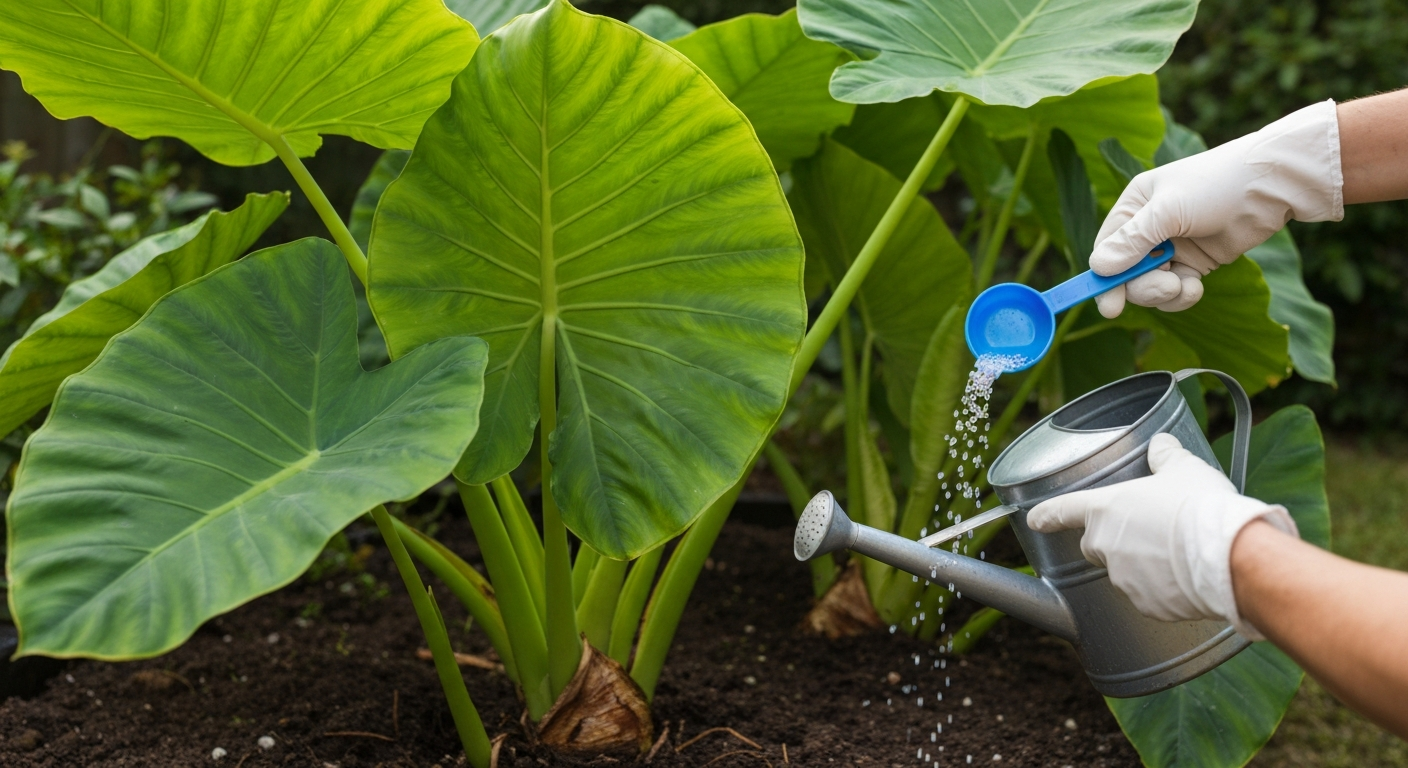
A few safety points worth knowing before you start: Miracle-Gro Water Soluble All Purpose contains urea (30-60% by weight) and ammonium sulfate (10-30%), so treat it like any chemical fertilizer. Wear gloves when measuring bulk product, avoid inhaling the dust, store it in a cool dry place, keep it away from children, and never rinse leftover solution into a storm drain, stream, or pond. These are manufacturer instructions from the product's safety data sheet, not just generic caution.
Elephant ear types: Colocasia, Alocasia, and Xanthosoma
All three genera get called 'elephant ears,' but they're not identical in how they grow or what they need. UF/IFAS groups the large‑leaf aroids commonly called elephant ears as Alocasia, Colocasia, and Xanthosoma and notes they generally prefer rich, consistently moist (but well‑drained) soils, plenty of water, and regular fertilization during the active growing season Elephant Ears — Gardening Solutions (UF/IFAS). Knowing which one you have matters because their light tolerance, hardiness, and moisture requirements differ, and those differences affect how aggressively you should fertilize.
| Genus | Common names | Light preference | Water needs | USDA hardiness zones | Soil preference |
|---|---|---|---|---|---|
| Colocasia | Taro, dasheen, elephant ear | Full sun to part shade | High (tolerates wet/boggy) | Zones 8-11 (perennial); grown as annual elsewhere | Rich, loamy, consistently moist |
| Alocasia | Upright elephant ear, African mask | Bright indirect to part shade | Moderate (well-drained, not waterlogged) | Zones 9-11 (perennial); container elsewhere | Well-draining, organically rich |
| Xanthosoma | Arrowleaf elephant ear, malanga | Part shade to filtered sun | Moderate to high | Zones 8-11 (perennial); annual elsewhere | Rich, loamy, well-drained |
Temperature is a shared concern across all three. Elephant ears are warm-season plants that stop growing when soil temperatures drop below about 60°F and go fully dormant (or die back) once frost hits. In zones 8 and colder, most gardeners dig the corms in fall, store them indoors, and replant after the last frost date in spring. All three genera want fertile, organically rich soil with a pH in the 5.5-7.0 range. Drainage matters more for Alocasia than for Colocasia, which is genuinely happy sitting in boggy conditions.
What nutrients actually do for elephant ears
Elephant ears are foliage machines. A healthy Colocasia can push out leaves the size of a dinner tray in a single growing season, and that growth demands a lot of nitrogen. Nitrogen (the N in N-P-K) drives leaf and stem production, which is why a high-nitrogen fertilizer like Miracle-Gro's 24-8-16 works so well during peak growth. Phosphorus supports root and corm development, especially important when you first plant a corm or divide a clump. Potassium helps regulate water movement through the plant and builds disease resistance, which matters because elephant ears are susceptible to root and corm rot when conditions aren't right.
The corm (the starchy underground storage organ) is where the plant banks energy for dormancy and re-emergence. Overfeeding late in the season pushes soft, lush growth that doesn't harden before cold weather, which can damage corms in marginal zones. The goal is to feed hard during active growth, then taper off as the season winds down.
Which Miracle-Gro products actually work for elephant ears
Three product types from the Miracle-Gro/Scotts family are well-suited to elephant ears, and they each fill a slightly different role. I'll walk through each one so you can pick based on your setup.
Miracle-Gro Water Soluble All Purpose Plant Food (24-8-16)
This is the classic blue powder, and it's the most flexible option. The 24-8-16 NPK ratio is nitrogen-forward, which is exactly what large-leafed tropical foliage plants need during their growth flush. It dissolves completely in water, so nutrients reach roots immediately. The tradeoff is that you're applying it every 7-14 days outdoors, which means more frequent attention and a higher chance of salt buildup in containers if you're not leaching regularly. One 5 lb container feeds roughly 2,000 square feet, so it's economical for larger beds.
Miracle-Gro Shake 'N Feed All Purpose (12-4-8)
Shake 'N Feed is a granular continuous-release product with a gentler 12-4-8 ratio. You sprinkle it on the soil surface and water it in; it releases nutrients slowly over about 3 months. For elephant ears in garden beds, this is my preferred low-maintenance approach during the middle of summer when I don't want to think about a feeding schedule. For containers, use it carefully at the label rates because granules sitting on pot media can cause localized salt concentration if you're also applying liquid feeds on top.
Osmocote Smart-Release (various formulations: 14-14-14, 15-9-12, 18-5-12)
Osmocote uses polymer-coated prills that release nutrients based on soil temperature, which ties nicely to elephant ear growth: faster release when it's warm and the plant is actively growing, slower release as temperatures cool. Research on controlled-release fertilizers shows nitrogen leaching reductions of 19-89% compared with repeated water-soluble applications, which is a meaningful benefit in containers and in garden beds near water features. For elephant ears in large pots, this is the product I reach for first.
| Product | NPK | Release type | Reapplication frequency | Best for | Main caution |
|---|---|---|---|---|---|
| Miracle-Gro Water Soluble All Purpose | 24-8-16 | Immediate | Every 7-14 days (outdoor) | Fast growth pushes, new plantings, in-ground beds | Salt buildup in containers; must leach pots regularly |
| Miracle-Gro Shake 'N Feed | 12-4-8 | Continuous/slow (up to 3 months) | Every ~3 months | Mid-season topdress, low-maintenance beds | Don't combine with heavy liquid feeding in same pot |
| Osmocote Smart-Release | 14-14-14 / 15-9-12 / 18-5-12 | Controlled-release (temperature-driven) | Every few months (label-specific) | Container growing, large pots, near-water plantings | Water in thoroughly after applying to activate prills |
As a general rule, look for fertilizers with an NPK ratio that emphasizes nitrogen first (the first number should be the largest) with moderate potassium for elephant ears during the growing season. Avoid very high phosphorus mid-season since established plants with developed corms don't need a phosphorus push the way a newly transplanted seedling does.
Exact application timing and rates
Water-soluble (Miracle-Gro 24-8-16)
For outdoor garden use with a watering can, mix 1 tablespoon per gallon of water, or use the large-end measuring scoop: 1.5 tablespoons per 1.5 gallons. Apply directly to the root zone, not on leaves if you can avoid it. Reapply every 7-14 days during active growth. For container plants indoors or on a sheltered patio, drop the rate to half a teaspoon per gallon and apply every two weeks. This lower dose for pots is important: containers have a fixed media volume and limited drainage compared with garden beds, so salt accumulates faster.
Granular slow-release (Shake 'N Feed 12-4-8)
For containers, follow these label-based rates: a 6-inch pot gets 1.25 teaspoons; an 8-inch pot gets 1 tablespoon; a 10-inch pot gets 1.5 tablespoons; a 12-inch pot gets 3 tablespoons; a 14-inch pot gets 5 tablespoons. Sprinkle evenly on the surface and water in immediately. Reapply every 3 months. For in-ground beds, topdress around the base of the plant and work lightly into the top inch of soil, then water well.
Osmocote controlled-release
For containers, a common label guidance example is about 4 tablespoons per 3-gallon pot. For in-ground topdressing, rates are typically around half a cup per 10 square feet depending on the specific formulation. Always water in thoroughly after applying to activate the polymer coating. Because release is temperature-driven, you'll get more nutrient delivery on hot July days than in a cool spring week, which naturally aligns with elephant ear growth patterns.
Step-by-step feeding schedule by season and situation
At planting (spring, after last frost)
- Amend planting holes or container media with compost or aged organic matter before adding the corm.
- If using Miracle-Gro Potting Mix, hold off on fertilizing for the first 30 days since the mix already contains a starter charge.
- If using a different soil or planting in the ground, apply a half-strength water-soluble dose (half a teaspoon per gallon for containers; half a tablespoon per gallon for beds) at planting to give the emerging root system a gentle phosphorus and nitrogen boost.
- For slow-release: apply Osmocote or Shake 'N Feed at planting according to pot or bed size rates and water in well.
Active early growth (4-8 weeks after planting)
- Switch to full-rate water-soluble applications: 1 tablespoon per gallon for garden beds, half a teaspoon per gallon for containers.
- Apply every 7-14 days for in-ground plants; every 2 weeks for containers.
- Water the root zone before applying fertilizer solution if the soil is dry, to prevent concentrated salt contact with roots.
Peak summer growth (June through August)
- Continue the every-7-to-14-day water-soluble schedule for garden beds.
- For containers: leach the pot every 4-6 weeks by applying water equal to twice the pot volume and allowing full drainage before resuming feeding.
- If you prefer lower maintenance, apply Shake 'N Feed or Osmocote in early June at label rates and let the slow-release do the work through the summer.
- Watch leaves: pale yellow-green new growth usually signals nitrogen deficiency; dark tip burn on older leaves often signals salt stress or overfeeding.
Container-specific routine
- Use the lower half-teaspoon-per-gallon rate for water-soluble feeds every two weeks.
- Apply slow-release granules at the pot-size rates from the label every 3 months.
- Flush the pot (see the section below on preventing salt buildup) every 4-6 weeks if using water-soluble feeds.
- Check for roots circling out of drainage holes: a pot-bound elephant ear will show fertilizer burn symptoms faster because there's less media to buffer salt.
Pre-dormancy (late summer into fall, zones 8 and colder)
- Begin tapering off nitrogen-heavy feeds about 6 weeks before your average first frost date.
- Stop all fertilizing once nighttime temperatures consistently drop below 55-60°F.
- In zones 8 and colder, allow foliage to die back naturally, then dig corms and store in a cool dry location (around 50-55°F) in barely damp peat or sawdust.
- Do not fertilize stored corms.
Year-round container plants (indoors in cold climates)
- Reduce feeding significantly in winter: half a teaspoon per gallon once a month is sufficient when light levels are low and growth slows.
- Resume full schedule when the plant shows active new leaf production in spring.
- Move outdoor container plants inside before first frost; do not fertilize for 2-3 weeks after the move while the plant adjusts.
How to avoid fertilizer burn and salt buildup
Salt buildup is the most common fertilizer-related problem I see in container elephant ears, and it's almost always caused by applying water-soluble fertilizer too frequently without flushing. Soluble fertilizer salts concentrate in pot media because containers have a limited leaching volume. This shows up as brown, crispy leaf margins, wilting despite moist soil, or a white crusty deposit on the pot rim and media surface.
Dilution and frequency rules
- Always use the lower container rate (half a teaspoon per gallon) for potted plants, not the outdoor garden rate.
- Never apply water-soluble fertilizer to dry soil. Water the plant first, wait an hour, then apply the fertilizer solution.
- Do not fertilize a stressed, wilting, or recently repotted plant. Wait until it shows active growth.
- Avoid applying granular and water-soluble fertilizers simultaneously in the same container.
How to flush a container
Flushing (also called leaching) removes accumulated salts from pot media. To do it: take the pot to a sink or outdoors and apply water equal to roughly twice the pot volume. Let it drain completely between pourings. As a practical example, a 6-inch pot holds about 10 cups of media, so pour approximately 20 cups of plain water through it, allowing full drainage. Do this every 4-6 weeks if you're using water-soluble feeds, or every 4-6 months if you're relying mainly on slow-release granules. Resume fertilizing on the normal schedule the following week.
When to repot or replace soil
If you see persistent brown leaf tips and margins, crusty white deposits on the pot, or stunted growth despite correct watering, the media may be too salt-loaded to recover with flushing alone. At that point, the best move is to repot into fresh media. Shake off the old mix from roots gently, rinse the roots with plain water, and replant into a well-draining container mix. Wait two to three weeks before resuming fertilizing. Acceptable electrical conductivity (EC) for container media is roughly 1.6-3.0 mS/cm on a saturated media extract, or 2.5-5.0 mS/cm on a PourThru test. If you have access to an inexpensive EC meter, it's a practical way to know when flushing versus repotting is the right call. Greenhouse Management includes an interpretation table with typical acceptable EC ranges by extraction method (examples: 1:2 ≈0.6–1.5 mS/cm; saturated media extract ≈1.6–3.0 mS/cm; PourThru ≈2.5–5.0 mS/cm) in its article How to conduct onsite soil testing for pH, EC, Greenhouse Management (Paul Fisher et al. table) How to conduct onsite soil testing for pH, EC — Greenhouse Management (Paul Fisher et al. table).
Controlled-release fertilizers as a lower-risk alternative
If you've had burn problems before, switching from water-soluble to controlled-release (Osmocote or Shake 'N Feed) is a straightforward fix. Research comparing these product types shows that controlled-release fertilizers generate lower salt peaks in container media and reduce nitrogen leaching substantially compared with repeated soluble applications. This is especially relevant if you're growing Alocasia indoors, where the combination of low airflow, limited pot drainage, and frequent feeding is the most common setup for salt damage.
Troubleshooting: when feeding isn't fixing the problem
If your elephant ear isn't responding to fertilizer the way you'd expect, a nutrient-delivery problem is usually not the real issue. Here are the most common causes I've seen and what to check.
| Symptom | Likely cause | What to do |
|---|---|---|
| Yellowing older leaves with green veins | Iron or magnesium deficiency (often pH-related) | Test soil pH; adjust toward 5.5-6.5; consider chelated micronutrient supplement |
| Pale, washed-out new leaves | Nitrogen deficiency | Apply water-soluble 24-8-16 at full rate; check that you haven't stopped feeding too early in the season |
| Brown leaf margins and tips, white crust on pot rim | Salt buildup from over-fertilizing | Flush container with 2x pot volume of plain water; consider switching to slow-release |
| Wilting despite moist soil, soft black corm tissue | Root or corm rot (Pythium, Phytophthora, Fusarium) | Improve drainage immediately; do not fertilize a rotting plant; remove affected tissue and treat with a registered fungicide if needed |
| No new leaves in mid-summer, healthy-looking older leaves | Pot-bound roots or waterlogged soil | Check drainage holes; consider upsizing the pot; reduce watering before resuming fertilizing |
| Leaves curling inward, no yellowing | Underwatering or low humidity (not a fertilizer issue) | Increase watering frequency; mist if indoors |
| Stunted growth despite fertilizing, no visible damage | Soil pH too far out of range, blocking nutrient uptake | Test soil pH; amend accordingly |
Root and corm rot deserves specific attention because it's one of the most damaging problems elephant ears face. Oomycetes like Pythium and Phytophthora, as well as Fusarium species, are documented causes of rot in Colocasia and Alocasia, and they thrive in waterlogged, poorly drained conditions. No amount of fertilizer helps a plant with rotting roots. If you suspect rot, stop fertilizing, improve drainage, and address the underlying moisture problem first. Healthy, well-drained soil is the single best disease prevention measure you can take.
Mulch, planting tips, and a few things worth knowing
Mulching around in-ground elephant ears helps retain the consistent moisture these plants love while moderating soil temperature and reducing weed competition. A 2-3 inch layer of shredded bark, wood chips, or straw works well. Elephant ears will generally push through a moderate mulch layer as they emerge in spring, though very thick or compacted mulch (more than 4 inches) can slow or deflect emerging shoots. Keep mulch pulled back a few inches from the base of established plants to prevent moisture accumulation directly against the stem, which can encourage crown rot.
When timing your first feeding in spring, the '30-day rule' from Miracle-Gro's own planting guidance is a useful anchor: if you're using Miracle-Gro Potting Mix, it already contains nutrients and you don't need to add fertilizer for the first month. If you're planting into unamended garden soil or a neutral mix, you can start a gentle half-strength application at planting and move to full rates once you see the first new leaf unfurling, which typically happens 2-4 weeks after soil temperatures reach 65°F or warmer.
Quick-reference: common mistakes and how to avoid them
| Mistake | Why it's a problem | Better approach |
|---|---|---|
| Using outdoor (1 tbsp/gal) rate in containers | Causes salt buildup and root burn in limited media volume | Use indoor/container rate: 1/2 tsp per gallon |
| Fertilizing in fall past the growing season | Pushes soft growth that damages corms before dormancy | Stop feeding 6 weeks before first frost date |
| Applying granules without watering in | Granules sit dry and can burn roots or fail to activate | Water immediately and thoroughly after applying any granular product |
| Stacking water-soluble and slow-release in the same pot | Doubles salt load; unpredictable nutrient levels | Pick one delivery method per container and stick with it |
| Fertilizing a plant with root rot or waterlogged soil | Adds salt stress to already compromised roots | Fix drainage and root health first; wait 2-3 weeks before resuming feeding |
| Never flushing container media | Accumulated salts mimic drought stress and damage roots | Flush with 2x pot volume of plain water every 4-6 weeks if using water-soluble feeds |
FAQ
Short answer: can I use Miracle‑Gro on elephant ears (Colocasia, Alocasia, Xanthosoma)?
Yes — Miracle‑Gro products can be used on elephant ears. Use them carefully: water‑soluble feeds (e.g., Miracle‑Gro Water Soluble All Purpose 24‑8‑16) give quick nitrogen boosts for rapid leaf production, while slow/controlled‑release products (Shake ’N Feed 12‑4‑8 or polymer‑coated Osmocote formulations) provide steadier, lower‑risk nutrition. Choose product and rate based on whether the plant is in the ground or a container and take precautions to avoid fertilizer burn and salt buildup.
What are the main types of “elephant ears” and their basic growth needs?
Common genera: Colocasia (taro/dasheen), Alocasia, and Xanthosoma. General needs: bright filtered light to part shade (many tolerate full sun if soil is very moist), warm temperatures (tropical/subtropical; most prefer >50–55°F/10–13°C), rich, consistently moist but well‑drained soil or potting mix, high organic matter, and regular feeding during active growth for large foliage. Hardiness ranges vary by species — some are hardy in warm temperate zones, others are strictly tender.
Which Miracle‑Gro products are appropriate and why (water‑soluble vs continuous‑release)?
Appropriate options: 1) Water‑soluble (Miracle‑Gro Water Soluble All Purpose 24‑8‑16) — fast‑acting N to quickly push foliage; use for short bursts during peak growth. 2) Slow/continuous‑release granular (Miracle‑Gro Shake ’N Feed 12‑4‑8) — feeds for up to ~3 months, lower peak salt risk, good for containers and landscape topdressing. 3) Osmocote/Smart‑Release polymer‑coated formulations (e.g., 15‑9‑12, 14‑14‑14) — predictable, long‑lasting release for container production or low‑maintenance beds. Choose soluble for immediate growth needs and CRF for steady feeding and lower leaching/salt problems.
What N‑P‑K ranges are recommended for elephant ears?
Elephant ears are foliage‑driven and benefit from higher nitrogen relative to phosphorus and potassium. Typical effective ranges: fast feed pulses ≈20–25% N (water‑soluble like 24‑8‑16 are commonly used); balanced slow feeds ≈10–15% N with moderate K (e.g., 12‑4‑8 or 15‑9‑12) are excellent for steady growth. Avoid excessive phosphorus unless a soil test indicates need.
Exact application timing and rates — garden (in‑ground) plants
Timing: begin feeding when new growth appears in spring and continue through the active growing season (spring–summer). Rates: - Water‑soluble 24‑8‑16: follow label; a common home use is 1 tablespoon per gallon of water applied every 7–14 days to beds (dilute as label directs). - Shake ’N Feed/CRF: topdress at label rate (examples: ≈½ cup per 10 sq ft is a ballpark for many granular CRFs — follow product label). Application tips: apply evenly around the root zone (but not piled against crowns), water in after application. Stop feeding when plants begin to senesce in fall or when temperatures drop consistently.
Exact application timing and rates — container plants
Timing: start ~2–4 weeks after planting (or after new flush emerges) and feed through the growing season. Rates: - Water‑soluble 24‑8‑16: indoor/containers often use ½ teaspoon per gallon every 1–2 weeks (or label equivalent). For outdoor container growth push, use the manufacturer’s pot/drench rates but reduce frequency for small pots. - Shake ’N Feed (12‑4‑8): use label pot rates (e.g., 6″ pot ≈1¼ tsp; 8–10″ pots use 1–1½ tbsp; 12″ pots ≈3 tbsp) and reapply about every 3 months. - Osmocote/Smart‑Release: follow label container topdress rates (e.g., tbsp per pot size) and water in. Containers need lower, less frequent soluble applications because salts accumulate more readily.
Is Miracle Grow Good for Elephant Ears? Complete Guide
Is Miracle-Gro good for elephant ears? Clear recommendation, feeding schedule, dosages, risks, and organic alternatives.