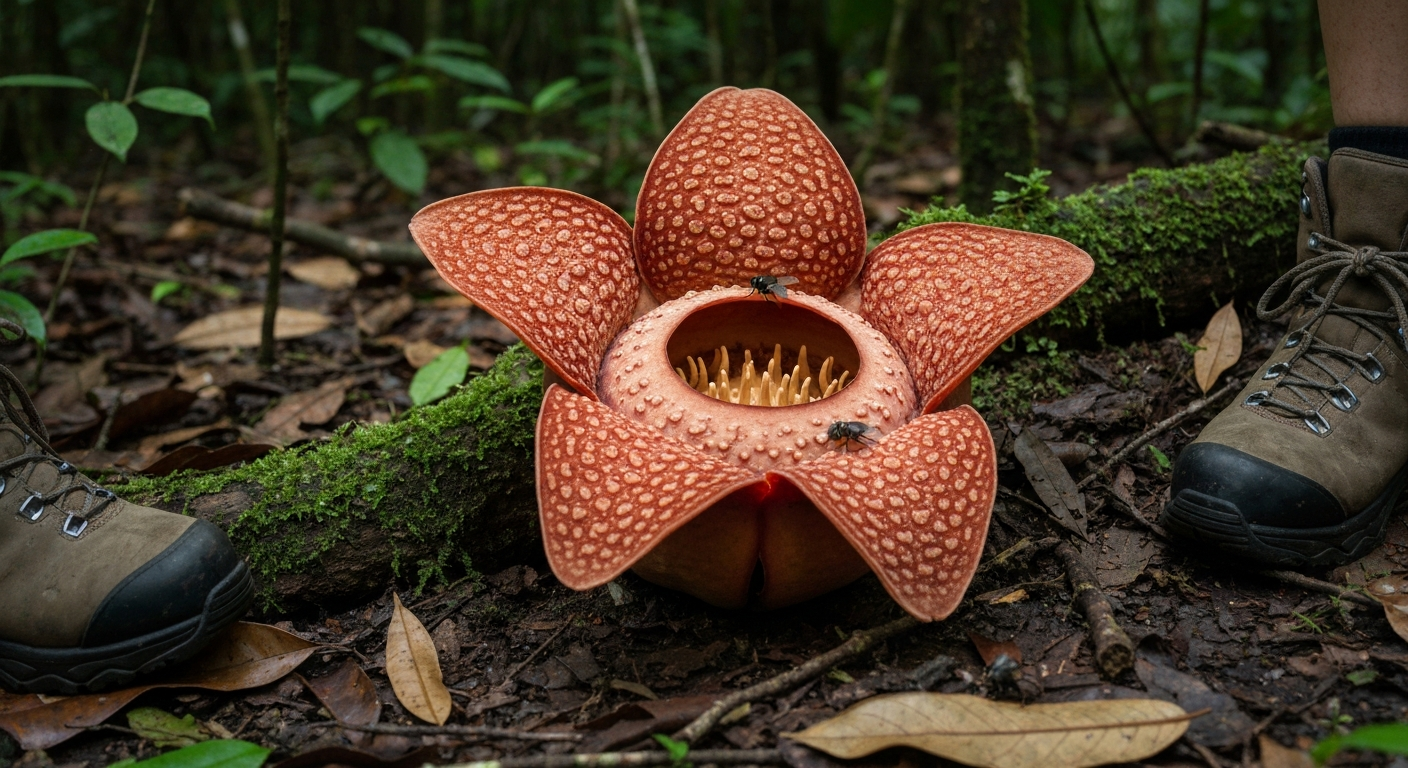
No, you cannot grow Rafflesia as a garden plant, and not just because it's rare. Rafflesia has no roots, no leaves, and no stem of its own. It lives entirely inside the tissue of a specific tropical vine, invisible until a bud pushes through the bark months or years into development. The flower you see in photos is literally the whole plant, and it lasts about four to seven days before collapsing. Even the world's best-resourced botanic gardens have only managed to coax a handful of blooms outside their native forest by painstakingly grafting infected vine tissue under near-rainforest conditions. For the home gardener, the realistic answer is: it cannot be done. What you can do, and what's genuinely worthwhile, is grow the host vine, support conservation efforts, or find a striking substitute species that gives you that dramatic tropical-flower experience without the ecological complications.
Can You Grow Rafflesia? Reality, Risks, and Alternatives

What 'rare in gardens' actually means for Rafflesia
When we describe a plant as rare in cultivation, we usually mean it's hard to source or fussy about conditions. Rafflesia sits in a completely different category. It isn't rare in gardens the way a difficult orchid is rare, it is functionally uncultivable by any ordinary definition of growing a plant. There is no seed packet to buy, no cutting to root in a glass of water, no pot of specialist compost that will keep it alive. Every recorded ex-situ bloom has come from institutions that transferred infected material from wild host vines, maintained those vines in climate-controlled greenhouses, and waited years for a bud to appear. Even then, many buds died before opening. If you've come across this question in the context of a gardening game or simulation, the rarity rating reflects exactly this: Rafflesia represents the extreme upper end of cultivation difficulty, which in the real world means 'not feasible outside a research institution. For how Rafflesia's cultivation difficulty is translated into game mechanics, see what rarity is Rafflesia in Grow a Garden. '
Rafflesia biology: what kind of plant are we actually talking about?
Rafflesia belongs to the family Rafflesiaceae and currently comprises more than 40 named species, most of them found across Southeast Asia, Borneo, Sumatra, the Philippines, peninsular Malaysia, Java, and Thailand. The genus is famous for producing the world's largest individual flowers, with Rafflesia arnoldii reaching up to one metre across and weighing as much as ten kilograms. But the headline size is almost secondary to the biology, which is genuinely unlike anything else in the plant kingdom.
Rafflesia is what botanists call an obligate holoparasite. That means it has completely surrendered every vegetative structure, roots, stems, leaves, and chlorophyll, and lives entirely as thread-like tissue woven through the inside of a host vine. Think of it less like a plant and more like a fungal mycelium that happens to be a flowering plant. The only moment Rafflesia becomes visible is when a bud pushes through the host's bark, swells over many months, and finally opens into the famous five-lobed flower. That flower produces the rotting-meat smell that attracts carrion flies for pollination, then dies within about four to seven days. After that, the only trace of Rafflesia is its hidden endophytic tissue continuing to ramify inside the vine.
The full lifecycle from seed to flowering is long and poorly understood in most species. For Rafflesia arnoldii, field reconstructions estimate roughly 3.5 to 5 years from germination to first bloom. Once a bud is visible, published monitoring studies report bud development intervals of approximately 9 to 16 months before anthesis (the moment of opening), depending on species and individual bud size. Pre-flowering bud mortality is extremely high, many marked buds in large field studies never open at all, which explains why recruitment to flowering is so low even in healthy wild populations.
The host vine you actually can grow: Tetrastigma
Every known Rafflesia species depends on vines of the genus Tetrastigma (family Vitaceae, the grape family). Tetrastigma are large, woody, tendril-climbing vines native to tropical and subtropical Asia. They are the only recorded hosts for Rafflesia, and the relationship is not interchangeable, different Rafflesia species are associated with specific Tetrastigma lineages, and host compatibility strongly influences whether an infection can establish and develop at all. Research into host-parasite co-evolution in this group is ongoing, and we don't yet fully understand all the chemical or genetic signals that allow or block infection.
From a practical standpoint, Tetrastigma vines are the one element of the Rafflesia story you can actually cultivate. For a quick comparison of how uncommon certain ornamental vines are in cultivation and practical growing notes, see how rare is aurora vine in Grow A Garden. Several species, including Tetrastigma voinierianum (the lizard plant, sometimes sold as a houseplant in Europe and North America), grow vigorously in warm, humid conditions. In a tropical climate, Tetrastigma can be established in a sheltered garden bed with rich, free-draining soil and something sturdy to climb. Growing the host vine is the first and only realistic step a gardener can take toward any kind of Rafflesia project, and even then, having a healthy Tetrastigma gets you nowhere without infected propagation material sourced through a licensed institution.
What Rafflesia's natural habitat actually looks like
Rafflesia grows in mature tropical rainforest understory, deep shade, year-round warmth, and consistently high humidity. Soil measurements from documented Rafflesia sites in Kinabalu Park, Sabah, record a sandy-loam texture, slightly acidic pH of around 4.1 to 4.7, and relatively low soil moisture despite the surrounding humidity (roughly 15 to 28% volumetric water content). Organic matter levels are low at these sites too, which might seem counterintuitive in a rainforest but reflects the well-drained, leached nature of many Southeast Asian forest soils.
The microclimate is just as important as the soil chemistry. Consistent canopy cover moderates temperature swings and keeps relative humidity high without waterlogging. There is also growing evidence from microbiome research that the tripartite system, Rafflesia, its Tetrastigma host, and the microbial community living inside both, matters for normal development. Specific microbial cues may be required to trigger haustorium (the infection organ) formation and to sustain it through the years-long development process. Recreating this entire system outside its native forest is not currently something any level of home gardening equipment can achieve.
Why cultivation fails: the key biological barriers
There are several compounding reasons why Rafflesia resists cultivation, and they stack up in a way that makes casual growing attempts essentially pointless. Understanding each one also helps explain why even institutional efforts succeed only occasionally.
- No independent existence: Rafflesia has no vegetative body outside its host. You cannot pot it, water it, or feed it directly. Every nutrient and water molecule it uses is intercepted from the host's vascular cambium (the growing layer just under bark). There is nothing to keep alive independently.
- Host specificity: The parasite forms a haustorial connection with specific Tetrastigma host tissue. Not every Tetrastigma individual is compatible with every Rafflesia species, and the molecular signals controlling compatibility are not yet fully mapped.
- Endophytic invisibility: For most of its life, Rafflesia is completely invisible inside its host. You have no way of knowing whether an infection has established, is growing, or has died without destructive sampling of the vine.
- Seed germination remains unsolved: No reliable method exists for germinating Rafflesia seeds and establishing a new infection under controlled conditions. Seed inoculation experiments and tissue-culture attempts have generally failed or produced non-reproducible results.
- Microbial dependency: Recent genomic research suggests that specific microbial communities inside the host tissue may provide essential chemical signals for Rafflesia development. Strip those away — as you would in a sterile lab or greenhouse — and the parasite apparently cannot develop normally.
- Multi-year timeline with high mortality: Even when an infection is present and conditions are correct, bud development takes up to 16 months and most buds die before opening. A single failed bud represents years of effort.
- Flower longevity: Even a successful bloom lasts only four to seven days. The payoff-to-effort ratio is uniquely unfavorable.
What people have actually tried: a history of propagation attempts
Attempts to cultivate Rafflesia outside its native forest go back well over a century, driven by the same curiosity that brings readers to this question today. The consistent historical outcome has been failure, with only rare and hard-won exceptions. Early colonial-era botanical gardens attempted to maintain plants by transplanting entire sections of host vine from the forest, but transport damage, humidity loss, and the disruption of the underground root environment meant most transferred material died before flowering. Documentation of these early attempts is patchy, but the pattern is clear: high failure rate, no reliable method, and no reproducible success from seed.
The twentieth century brought more systematic attempts, including efforts at tissue culture and seed inoculation in laboratory settings. These have consistently disappointed. Rafflesia seeds are tiny and poorly understood, and no one has successfully induced a seed to penetrate Tetrastigma tissue and establish an endophytic infection under controlled conditions. The microbiome research published in the 2020s helps explain why: the missing piece may be a specific community of microbial endophytes that prime the host tissue for infection, signals that a sterile lab environment simply cannot replicate.
Controlled and experimental methods: what has actually worked
The one approach with a documented track record is the transfer of already-infected Tetrastigma material to a maintained host plant, typically through grafting. Bogor Botanic Garden in Indonesia has reported multiple ex-situ blooms of Rafflesia patma since 2010, achieved by grafting infected host-root and stem pieces onto healthy Tetrastigma plants maintained in greenhouse conditions. This is significant proof of concept, but it requires sourcing infected wild material (which involves permits and conservation protocols), skilled horticultural technique, and years of maintenance before any flower appears.
More recently, a 2026 report in the journal Sibbaldia documented successful propagation of Rafflesia speciosa material at the United States Botanic Garden using two specific techniques: rooting infected stem and root cuttings, and veneer or cleft grafting of infected tissue onto established Tetrastigma. This is genuinely exciting science, and it suggests that ex-situ conservation of at least some Rafflesia species is becoming more technically viable. But the word 'propagation' here means sustaining the infected host system, not growing Rafflesia from scratch. The infected material still had to originate from wild-collected stock with full institutional permissions.
| Method | Has it worked? | Who has achieved it | Practical barrier for home growers |
|---|---|---|---|
| Grafting infected Tetrastigma material | Yes, documented blooms | Bogor Botanic Garden (Indonesia), US Botanic Garden | Requires sourced infected material and institutional permits |
| Rooting infected stem/root cuttings | Yes, as part of ex-situ programs | US Botanic Garden (Rafflesia speciosa, 2026) | Requires infected wild-sourced material and permits |
| Seed inoculation onto Tetrastigma | No reliable success | Various research institutions | Infection establishment from seed unsolved |
| Tissue culture of Rafflesia | No reproducible success | Various laboratories | Microbial and chemical environment cannot be replicated in sterile culture |
| Transplanting whole infected wild vine | Rarely and briefly | Historical botanic garden attempts | Host damage in transit, humidity loss, permit issues |
| Direct sowing on soil near Tetrastigma roots | No documented success | Not recorded | Seed germination and host penetration process unknown |
The takeaway from the experimental record is blunt: if you are not working with an accredited botanic garden, a formal research permit, and sourced infected Tetrastigma material from a legitimate provenance, you have no viable starting point. The science is advancing, but it is firmly in the realm of institutional conservation botany, not home horticulture.
Legal, ethical, and conservation considerations
This matters more than most cultivation guides let on. Rafflesia is not just difficult to grow, in most of its native range, collecting, moving, or disturbing it is illegal. Indonesia formally protects Rafflesia under national wildlife legislation. The Philippines lists several native species under protected status. International trade in wild plant material from these countries is governed by CITES and the Convention on Biological Diversity, meaning that moving seeds, infected host material, or any part of a Rafflesia across national borders without formal research permits and phytosanitary clearance is a legal offense.
Beyond legality, the conservation situation is urgent. Recent syntheses estimate that most of the 40-plus named Rafflesia species meet criteria for Critically Endangered or Endangered classification, driven by habitat loss from deforestation, agricultural expansion, and, ironically, collection pressure from people wanting to see or possess the famous flower. Most of the world's largest flowers (genus Rafflesia) are now on the brink of extinction (Plants, People, Planet): recent syntheses conclude most of the ~40+ named Rafflesia species are threatened (many provisionally Critically Endangered or Endangered) and recommend urgent habitat protection, expanded protected areas, community-based conservation, and ex-situ work on hosts. Trampling of host vines and illegal collection of buds for traditional medicine represent documented threats to wild populations. Any attempt to source wild material for private cultivation, even with the best intentions, risks adding to this pressure.
The botanic-garden literature is consistent on the ethical framework: any ex-situ work with Rafflesia should follow a conservation-first model. That means (1) protecting in-situ habitat as the primary goal, (2) safeguarding Tetrastigma host populations within protected areas, (3) only conducting ex-situ propagation with fully documented permits and institutional oversight, and (4) ensuring that any ecotourism or community engagement around wild sites follows guidelines that prevent trampling and disturbance. If you genuinely want to help Rafflesia rather than simply grow it, supporting these habitat-protection initiatives is far more valuable than any propagation attempt.
What you can realistically do instead
If the goal is a dramatic tropical flower experience, several cultivable species deliver impressive results without the ecological complications. Amorphophallus titanum (the titan arum, also called 'corpse flower') produces an enormous inflorescence with a similar rotting-meat smell and can actually be grown from corm, though it still requires tropical conditions and years of patience. Stapelia and Orbea (carrion flowers in the succulent family) are much easier, grow happily in a pot on a warm windowsill, and produce star-shaped flowers with the same fly-attracting smell. Aristolochia species offer weird, trap-flower drama in a vine format that suits a trellis or pergola. If you're comparing how games rate plant scarcity, check the rarity of prickly pear in Grow A Garden for an example of how succulents are scored. For a temperate alternative and notes on cultivation, see the guide: is artichoke rare in grow a garden.
If the goal is specifically to be connected to Rafflesia biology, the most meaningful thing you can do is grow Tetrastigma. A few species are available through specialist tropical plant nurseries. Tetrastigma voinierianum in particular is sold as a houseplant in temperate countries and grows surprisingly fast in a bright, warm room. In tropical climates, several Tetrastigma species can be grown outdoors as large ornamental vines. You won't have Rafflesia in your Tetrastigma, but you will understand the host plant firsthand, which is a genuine foundation if you ever want to engage seriously with conservation or research in this area.
- Source a Tetrastigma voinierianum plant from a specialist tropical nursery. In temperate climates, grow it in a large pot in a warm, bright, humid spot indoors (a heated greenhouse is ideal). In tropical climates, plant it in sheltered garden ground with a strong trellis and partial shade.
- Provide consistently warm temperatures (ideally 20–28°C), high humidity (above 70% RH if possible), and well-drained but moisture-retentive soil with slightly acidic pH (around 5.0–6.0 is practical for cultivation; the wild extreme of 4.1–4.7 is not necessary).
- Keep watering consistent — Tetrastigma does not like to dry out completely, but standing water at the roots will cause rot. A bark-enriched potting mix works well in containers.
- Let the vine establish over at least one to two growing seasons before expecting significant size. These are large, vigorous plants in the right conditions.
- Do not attempt to inoculate the vine with Rafflesia seeds or material without institutional affiliation and proper permits. Beyond being illegal without appropriate licenses, it will not work.
- To see a real Rafflesia bloom, research legitimate ecotourism sites in Sabah, Sarawak, Sumatra, or the Philippines that operate with conservation guidelines. Guided visits at designated sites support local communities and habitat protection simultaneously.
Supporting Rafflesia conservation from wherever you are
The most impactful thing a gardener, student, or plant enthusiast can do for Rafflesia is support the habitat and host-vine conservation programs that give wild populations a future. Organizations like the Botanic Gardens Conservation International (BGCI) coordinate ex-situ programs and publish guidance on responsible engagement. Several Philippine and Indonesian conservation groups run community-based programs where local guides and landowners are economically incentivized to protect Rafflesia sites rather than clear or disturb them. Donating to, volunteering with, or simply amplifying the work of these programs has a real, measurable effect on species survival in a way that a private cultivation attempt simply cannot.
For students and researchers, the current frontier of Rafflesia science is genuinely exciting. Genomic work is steadily revealing how the parasite's stripped-down genome interacts with its host, and microbiome studies are beginning to identify the microbial cues that may be essential for infection establishment. If seed inoculation is ever going to become a reliable technique, it will come from this direction. Contributing to citizen-science monitoring programs at known Rafflesia sites, recording bud presence, flowering dates, and host vine condition, generates the long-term population data that conservation planning depends on.
Common myths worth clearing up
- Myth: You can grow Rafflesia from seeds ordered online. False. No commercial source of viable Rafflesia seeds exists, and even if seeds were available, no method exists to germinate them and establish infection in a host vine.
- Myth: Rafflesia is a fungus. It is not. It is a true flowering plant in the family Rafflesiaceae, just one that has lost all vegetative structures through extreme parasitic evolution.
- Myth: Any tropical vine will do as a host. No — Rafflesia is specific to Tetrastigma (family Vitaceae). Planting other tropical vines achieves nothing toward growing Rafflesia.
- Myth: Botanic gardens can share Rafflesia infected material freely. They cannot. Transfers require formal permits, phytosanitary documentation, and usually bilateral agreements between institutions in different countries.
- Myth: The smell attracts bees. The rotting-meat smell of Rafflesia flowers specifically attracts carrion flies and beetles, which act as pollinators. Bees are not involved.
- Myth: Growing Tetrastigma guarantees a chance at Rafflesia. Growing the host vine is the necessary first step in ex-situ programs, but without sourced infected material and institutional support, a healthy Tetrastigma will simply remain a healthy Tetrastigma — which is still a worthwhile plant in its own right.
FAQ
Can you grow Rafflesia (the parasitic “corpse flower”)?
Short answer: Almost never as a backyard houseplant. Rafflesia species are obligate endoparasites that live entirely embedded in Tetrastigma (a wild Vitaceae vine). Successful flowering requires a compatible, infected host, very specific microhabitat conditions, long development times (years), and usually specialized botanic‑garden or field‑conservation interventions. For most gardeners and students, direct cultivation from seed or tissue culture is not a realistic option.
Why is Rafflesia so difficult to cultivate?
Key biological barriers: (1) Rafflesia is an endoparasite with no exposed vegetative organs—only the flower emerges; (2) it forms deep haustorial connections inside Tetrastigma cambium to extract water and nutrients, so it cannot live independently; (3) seeds and tissues have proved extremely recalcitrant to germination and in vitro culture; (4) development from infection to flowering commonly takes multiple years and suffers very high pre‑anthesis mortality; and (5) successful establishment appears to depend on host genotype, local microbiome cues, and microclimate that are hard to replicate outside native forest.
What role does the host vine (Tetrastigma) play?
Tetrastigma is essential. Rafflesia seeds infect Tetrastigma roots or stems and establish internal endophytic tissue and haustoria. Host identity and compatibility strongly influence whether infection succeeds; some Rafflesia use multiple Tetrastigma lineages but many show host specificity. Protecting and cultivating suitable Tetrastigma is the only practical route to ex‑situ Rafflesia work.
Has anyone ever grown Rafflesia outside the wild?
Yes, but only under controlled, conservation‑grade conditions and usually by transferring infected host material. Repeatedly reported successes include grafting infected Tetrastigma onto healthy plants and rooting infected host cuttings in greenhouse settings. Institutions such as Bogor Botanic Garden and recent botanic‑garden reports (including a 2026 Sibbaldia paper) document ex‑situ blooms of Rafflesia patma and Rafflesia speciosa following grafting or infected‑tissue propagation. These programs are specialized, permitted, and not trivial to reproduce.
Can I grow Rafflesia from seed or tissue culture at home or in a school lab?
No reliable, repeatable seed or tissue‑culture protocol exists to produce flowering Rafflesia. Multiple scientific reviews and genomic studies conclude that seed inoculation and in vitro culture have generally failed or remain unreproducible. Attempts require advanced containment, host material, and often fail due to missing microbial or host cues.
What habitat and microclimate do Rafflesia and Tetrastigma need?
They occur in shaded tropical rainforest understory. Documented sites often have stable, humid but not waterlogged conditions, shaded dappled light, and specific soil characteristics that vary by region (e.g., sandy‑loam, slightly acidic soils reported in Kinabalu Park). Microhabitat includes intact forest floor with host roots and suitable mycobiome/endophyte communities—conditions difficult to mimic in temperate gardens.
Is Miracle-Gro Good for Mandevilla? How to Feed It Safely
Yes, Miracle-Gro can feed mandevilla safely. Get correct NPK choice, dilution, schedule, and signs to avoid burn.