
A beanstalk is not automatically a tropical plant. The word just means the climbing stem of a bean, and 'beans' span several genera with wildly different climate preferences. Some, like cowpea and mung bean, are genuinely tropical to subtropical. Others, like the common snap bean, sit comfortably in warm-temperate gardens. Runner beans and garden peas lean cool-temperate. Which category your bean falls into depends entirely on the species, not the word 'beanstalk.'
Is Beanstalk a Tropical Plant in Grow a Garden, Climate Guide

Marcus Weir
13 Aug 2026
What gardeners actually mean by 'beanstalk'
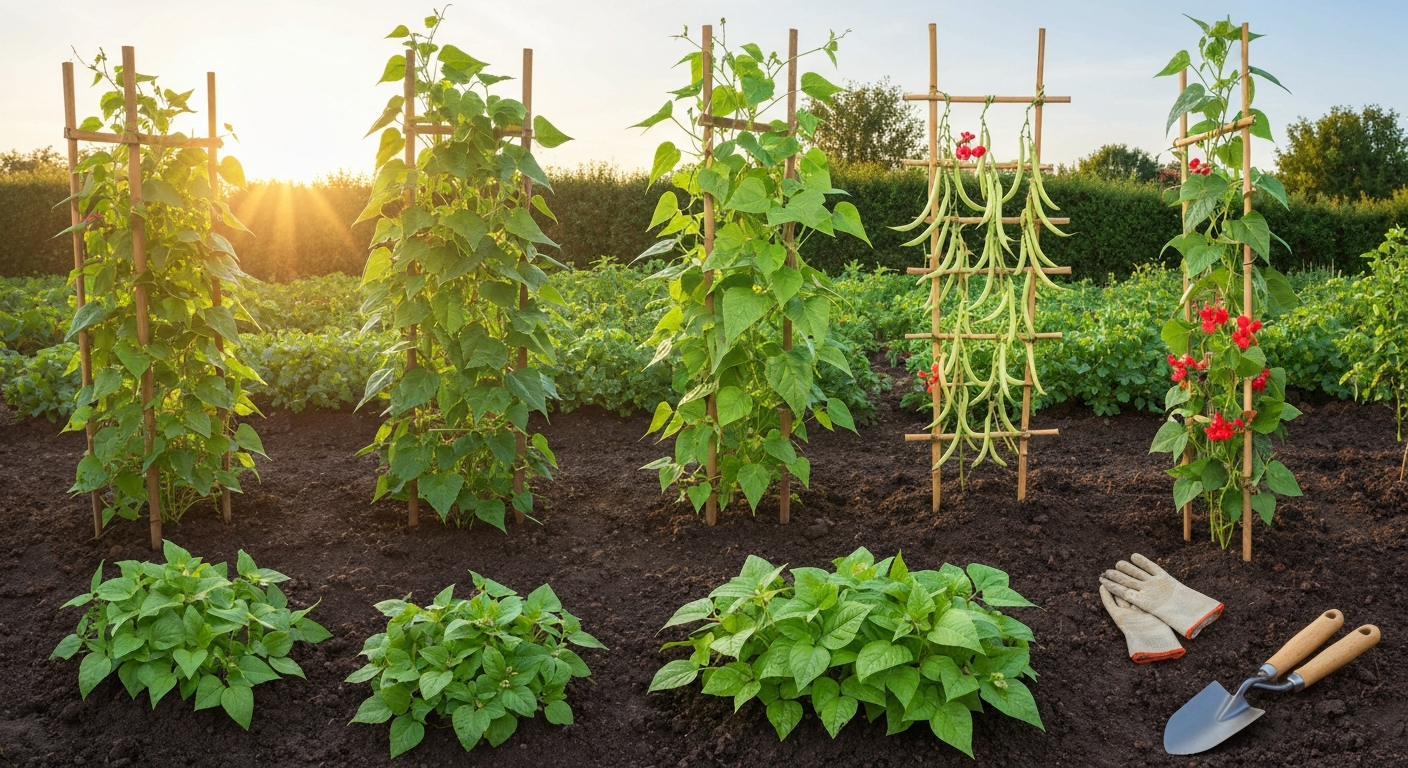
Botanically, a beanstalk is simply the vegetative stem of a bean plant. Merriam-Webster defines it exactly that way: the stem of a bean plant. In practical gardening terms, people use the word most often for the tall, twining stems of climbing or pole-type beans as opposed to compact bush varieties, but the word covers any bean stem. What matters for climate classification is not the stem itself but the species producing it.
Beans come in two basic growth habits: pole (climbing) and bush. Pole types produce the dramatic beanstalks most people picture and need a trellis, fence, or cane structure of at least 1.8 m (6 ft) to reach their potential. Bush types stay compact, rarely topping 60 cm (2 ft), and need no support. Both habits exist across tropical, subtropical, and temperate species, so growth habit alone tells you nothing about climate needs.
The main bean groups gardeners grow
- Phaseolus vulgaris: common bean — snap, shell, and dry types including kidney, black, and pinto
- Phaseolus coccineus: runner bean — a vigorous climber widely grown in cool temperate gardens
- Phaseolus lunatus: lima bean — warm-season, tropical to subtropical in character
- Phaseolus acutifolius: tepary bean — adapted to hot, dry, semi-desert conditions
- Vigna unguiculata: cowpea or black-eyed pea — tropical-subtropical African native
- Vigna radiata: mung bean (green gram) — tropical-subtropical South Asian origin
- Lablab purpureus: hyacinth or Indian bean — Afro-tropical, short-day flowering
- Glycine max: soybean or edamame — primarily temperate to warm-temperate East Asian origin
- Pisum sativum: garden pea — cool-season temperate Eurasian species
Common bean genera and their climate tendencies
All of these plants belong to the legume family Fabaceae, and they all fix nitrogen through root nodules, but their temperature tolerances are genuinely far apart. Understanding each genus gives you a reliable shortcut before you even look at a seed packet.
Phaseolus vulgaris (common bean) originates from Mesoamerica and the Andes. It is frost-sensitive and germinates best when soil temperatures are between 18 and 30°C (65–85°F). Below about 10°C germination almost stalls entirely. In practice this puts it firmly in the warm-season, frost-free category, but it is not so heat-demanding that it needs a year-round tropical climate. Many temperate gardeners grow it as a summer annual between their last and first frost dates.
Phaseolus coccineus (runner bean) is a useful outlier. It also comes from Central and South America, yet it has adapted well to cool, moist temperate summers. In the UK, for instance, runner beans are a garden staple. They are still frost-sensitive and should be planted out after the last frost, but they actually prefer cooler conditions for pod set than common beans do.
Vigna species (cowpea, mung bean) sit clearly in the tropical to subtropical column. Cowpea is native to Africa and performs best with soil temperatures at or above 15–21°C (60–70°F) for germination. Mung bean from South Asia likes 23–35°C for optimal growth. Both are drought-tolerant compared with Phaseolus, which makes them popular in tropical regions with distinct dry seasons.
Lablab purpureus (hyacinth bean) is one of the most clearly tropical species in this group. It originates from tropical Africa, is frost-intolerant, and flowers in response to shortening daylengths, a classic adaptation to tropical seasonality. In temperate gardens it is usually grown as a tender annual and rarely completes a full flowering-to-seed cycle before autumn frosts arrive.
Glycine max (soybean) bucks the tropical trend. Most modern cultivars were bred for temperate East Asian and North American conditions. It does grow in subtropical regions, but zone adaptation charts show that many commercial soybean varieties are optimized for temperate summers rather than equatorial heat. Pisum sativum (garden pea) is the coolest of all: a cool-season temperate crop that performs poorly in lowland tropical heat but can be grown at high-elevation tropical sites where temperatures drop enough at night.
| Species | Origin | Climate Category | Frost Tolerance | Optimal Soil Temp (°C) |
|---|---|---|---|---|
| Phaseolus vulgaris (common bean) | Mesoamerica / Andes | Warm-temperate to subtropical | None | 18–30 |
| Phaseolus coccineus (runner bean) | Central / S. America | Cool-temperate to subtropical | None (leaves) | 15–25 |
| Phaseolus lunatus (lima bean) | Mesoamerica / S. America | Tropical to subtropical | None | 20–30 |
| Phaseolus acutifolius (tepary bean) | SW USA / Mexico (arid) | Hot semi-arid / subtropical | None | 25–35 |
| Vigna unguiculata (cowpea) | Tropical Africa | Tropical to subtropical | None | 15–21+ |
| Vigna radiata (mung bean) | South Asia | Tropical to subtropical | None | 23–35 |
| Lablab purpureus (hyacinth bean) | Tropical Africa | Tropical to subtropical | None | 22–32 |
| Glycine max (soybean) | East Asia | Temperate to warm-temperate | None (seedlings) | 20–30 |
| Pisum sativum (garden pea) | Eurasia | Cool-temperate | Partial (vegetative) | 7–24 |
How to decide if your bean is tropical
Horticulturists and agroclimate researchers use a consistent set of criteria to classify a crop species as tropical, subtropical, or temperate. The most useful reference framework is the Köppen climate system, which defines a tropical climate as one where the coldest monthly mean temperature stays at or above 18°C year-round. When a crop species requires those conditions to thrive or even survive, it is a tropical species. When it tolerates colder winters but still needs a frost-free growing season, it falls into subtropical. When it can cope with cold winters and cool springs, it is temperate.
USDA Plant Hardiness Zones complement this by mapping average annual extreme minimum winter temperatures. Tropical conditions correspond roughly to zones 11–13, where frosts are rare or absent. Subtropical zones 9–10 see occasional light frosts. Temperate zones 5–8 experience regular hard freezes. Matching a species' zone range to your local zone is the fastest practical shortcut.
In practice, four questions get you to an answer quickly. First: where did this species originate, equatorial tropics, subtropical highlands, or temperate regions? Origin is a strong but not absolute predictor. Second: what is the minimum soil temperature for reliable germination? Species needing 22°C or more are signalling warm-climate adaptation. Third: can the plant tolerate any frost at any life stage? Universal frost intolerance points to tropical or subtropical. Fourth: what is the USDA hardiness zone range listed for the variety?
A simple checklist to classify any bean
Run through these five points for any bean variety you are evaluating. Score each answer honestly and you will have a reliable classification within a few minutes of reading the seed packet or species profile.
- Origin check: Is the species native to regions with coldest monthly means consistently above 18°C (tropical Africa, lowland South/Southeast Asia, lowland Central America)? Yes = likely tropical; High-elevation or arid subtropics = subtropical; Eurasia or temperate Americas = temperate.
- Frost tolerance: Does any authoritative source list the species as frost-sensitive at all growth stages, including seedling and flowering? Yes, totally intolerant = tropical or subtropical. Partial tolerance at vegetative stage only = possibly temperate.
- Germination temperature: Does the species require soil at 22°C or above for reliable germination? Yes = tropical to subtropical. Germinates from 10–15°C = leans temperate.
- Optimal growing temperature: Is the documented optimal temperature range 28°C or above? Yes = tropical. 20–28°C = subtropical to warm-temperate. Below 20°C = temperate.
- USDA zone fit: Is the species rated for zones 11–13 as its primary range? Tropical. Zones 9–10 as primary? Subtropical. Zones 5–8 as primary? Temperate.
A species scoring tropical on three or more of these five points is best treated as a tropical plant for growing purposes. Two tropical scores alongside two subtropical scores puts it in the subtropical column, meaning it will grow well in frost-free, warm climates but may not need year-round equatorial heat.
Growing beans in the tropics
If you are in a true tropical climate (consistently warm year-round, no frost), you have the widest variety choice of any gardener. For specific guidance on whether burning bud is a tropical plant, see Is burning bud a tropical plant in Grow a Garden. Cowpea, mung bean, yardlong bean, hyacinth bean, lima bean, and tepary bean all thrive. Phaseolus lunatus (lima bean) has Mesoamerican and South American origins and is typically a warm‑season, frost‑sensitive bean that performs poorly in cool, wet soils at sowing (blank" rel="noopener noreferrer">Genetic structure of Lima bean (Phaseolus lunatus L.) (Genetic Resources and Crop Evolution)). Common snap beans (Phaseolus vulgaris) also work well but can struggle to set pods during the hottest part of a humid tropical wet season when night temperatures stay above 30°C and humidity is extreme.
When to plant in a tropical garden
In regions with a defined wet and dry season, the best planting window for most beans is at the start of the dry season or just after the main wet-season rains taper off. This gives seedlings strong light and manageable moisture. In equatorial regions with two wet seasons per year (double-cropping zones), you can plant twice: once as the first wet season ends and again as the second wet season ends. Avoid sowing into waterlogged soils. Most bean roots are vulnerable to Phytophthora and Pythium root rots in saturated conditions.
Yardlong beans (Vigna unguiculata subsp. sesquipedalis) are particularly well-suited to humid tropical gardens. They climb vigorously to 2–3 m, produce prolifically in warm conditions, and tolerate the moisture swings of a tropical growing season better than most Phaseolus types. Sow seeds 2–3 cm deep, thin to one plant every 20–30 cm along a trellis, and expect first harvest around 60 days.
Variety choices and care notes for the tropics
- Cowpea / black-eyed pea: drought-tolerant, prolific in heat, sow direct 2–3 cm deep after any heavy rains settle
- Mung bean: fast-maturing (55–65 days), ideal for intercropping, prefers well-drained loamy soil
- Yardlong / asparagus bean: vigorous climber, harvest pods at 30–40 cm before they toughen
- Hyacinth bean: ornamental and edible, but note that mature dry seeds contain cyanogenic glucosides — always cook thoroughly
- Lima bean: needs good drainage; bush limas can be grown almost year-round in frost-free tropics
- Tepary bean: excellent for hot, dry microclimates within tropical or subtropical zones; resists heat stress better than common bean
In all tropical plantings, inoculate seeds with the appropriate Bradyrhizobium or Rhizobium strain before sowing. Inoculants are genus-specific: cowpea-group strains work for Vigna species, while Phaseolus types use different strains. Skipping inoculation in soils that have not recently grown the same species means the plants may miss out on nitrogen fixation for their entire life, leaning entirely on soil nitrogen instead.
Growing beans in subtropical gardens
Subtropical climates (broadly USDA zones 9–10, with occasional light winter frosts and hot summers) offer a long growing season but introduce one challenge that true tropical growers do not face: the risk of a light frost during an unexpected cold snap, particularly in winter or early spring. Most bean species are frost-tender at all stages, so timing is everything.
Timing and frost risk management
In subtropical gardens, the ideal planting windows for warm-season beans are late winter to early spring (February to March in the Northern Hemisphere subtropics) once night temperatures are consistently above 12°C, and again in late summer to early autumn (August to September) for a second crop that finishes before the winter cool sets in. The spring planting gives you the long, warm summer to grow heat-lovers like cowpea, lima, and mung bean. The autumn planting suits common snap beans, which appreciate slightly cooler temperatures for pod fill.
For frost risk management, keep a close watch on the 10-day forecast from late autumn onward. If an unexpected frost threatens, cover young plants overnight with horticultural fleece or a double layer of row cover fabric. Mature plants near harvest are especially worth protecting because losing a crop in the final two weeks is genuinely frustrating. I have lost a late cowpea planting to a surprise frost in November more than once, always wishing I had covered the row.
Best practices for subtropical bean growing
- Soil temperature check: wait until soil at 5 cm depth reads at least 18°C before direct sowing warm-season types
- Mulch heavily: subtropical summers can dry soil fast; a 7–10 cm layer of organic mulch keeps moisture consistent and root zones cooler during peak afternoon heat
- Water consistently but avoid waterlogging: beans need about 25 mm of water per week; uneven watering causes pod drop and hollow seeds
- Stake early: set up trellises or bamboo poles before plants need them; disturbing roots of climbing beans after they start winding causes setbacks
- Watch for root-knot nematodes: subtropical soils often harbor Meloidogyne species; rotating bean plots annually and incorporating organic matter suppresses nematode pressure
- Second crop timing: aim for pods to be maturing by mid-October (Northern Hemisphere) before night temperatures fall below 12°C and growth slows sharply
Growing beans in temperate gardens
Temperate gardeners are working with a shorter window and cooler baseline temperatures, but that does not mean you are limited to just a few varieties. The key tools are understanding your last and first frost dates, starting seeds indoors where necessary, and choosing fast-maturing cultivars that can complete their lifecycle within your frost-free window.
Common snap beans (Phaseolus vulgaris) are the backbone of temperate bean gardens. Most bush varieties mature in 50–60 days and many pole varieties in 60–70 days. Direct sow after the last spring frost when soil temperatures have reached 15–18°C (60–65°F). At 10°C, germination is unreliable and sluggish; at 18°C and above, seedlings emerge in 7–10 days. Sow seeds about 2–3 cm (1 inch) deep.
Season extension and starting indoors
For gardeners in zones 5–6 where the frost-free season might only span 120–140 days, starting climbing beans indoors 2–3 weeks before the last frost date buys meaningful extra production time. Use deep root trainers or 10 cm pots rather than shallow trays because beans dislike root disturbance at transplanting. Harden off seedlings over 7–10 days before moving them outside permanently. Transplant on a cloudy day or in the evening to reduce transplant shock.
Runner beans (Phaseolus coccineus) are the temperate climber of choice for gardeners in the UK and similar cool-summer climates. The Royal Horticultural Society recommends sowing or planting out after last frost and providing robust supports for stems that can exceed 3 m. Unlike common beans, runner beans actually set pods more reliably when temperatures are cool and moist, hot, dry summers cause blossom drop.
Low polytunnels and cold frames extend the season at both ends. Placing a cloche over direct-sown bean seeds in early spring when soil is hovering around 12–14°C can lift the root-zone temperature by 3–5°C and accelerate germination by a week or more. At the other end of the season, covering plants in late September can protect pods from early light frosts and extend harvest by 2–3 weeks.
Container growing to mimic tropical conditions
If you are in a temperate or even subtropical climate but want to grow genuinely tropical bean species (mung bean, hyacinth bean, yardlong bean), containers and greenhouses make it possible. A large container (30–40 litre minimum for climbing types) placed against a south-facing wall absorbs and radiates heat that can keep root zone temperatures 4–6°C above ambient. In a greenhouse or conservatory, yardlong beans and hyacinth beans will fruit in temperate summers that would otherwise be too cool and short.
Soil, spacing, and supports across all climates
Regardless of climate category, beans share some universal preferences. They prefer a well-drained, loamy to sandy-loam soil with a pH of 6.0–7.0. Overly acidic soils inhibit Rhizobium nodulation, so lime if your pH drops below 5.8. Most beans do not need heavy nitrogen fertilizing before planting because they fix their own, but a balanced starter fertilizer at low rates helps young plants before nodules form. Avoid excess nitrogen: it pushes leafy growth at the expense of pods.
Spacing depends on growth habit. Bush types do well at 10–15 cm between plants in rows 45–60 cm apart. Pole types need more room: 20–30 cm between plants at the base of a shared trellis or individual poles spaced 30 cm apart. For traditional garden structures like a wigwam (3–4 canes tied at the top), 3–4 seeds per pole at the base, thinned to the 2 strongest, works well.
Watering and fertilizing
Beans need consistent moisture most critically during flowering and pod fill. Letting the soil dry out completely during flowering is one of the most common causes of poor yields and hollow pods. Aim for about 25 mm per week either through rainfall or supplemental irrigation. Drip irrigation or soaker hoses are preferable to overhead watering because wet foliage overnight encourages fungal diseases like bean rust (Uromyces appendiculatus) and grey mold.
After plants are established and nodules are active (you can gently pull a root and look for pink or red interiors in the nodules, which indicates active nitrogen fixation), ease off nitrogen applications entirely. A mid-season side dressing of potassium-rich fertilizer (such as wood ash or a dedicated fruiting formula) supports pod development. Phosphorus is important at establishment for root and nodule development, so incorporating bone meal or rock phosphate before sowing helps long-season tropical varieties especially.
Pests, diseases, and troubleshooting
Warm and tropical climates face different pest pressures than temperate ones. For related internal guidance on a different topic, see the note titled "is fennec fox rare in grow a garden.". If you're concerned about wildlife interactions, see the note Is the black iguana rare in Grow a Garden for local occurrence and management tips. In tropical and subtropical gardens, bean fly (Ophiomyia phaseoli) is one of the most damaging insects, with larvae tunneling into stems near the soil surface and weakening or killing seedlings. Covering seed rows with fine insect mesh for the first 3–4 weeks after germination is a practical physical barrier. Spider mites thrive in hot, dry spells across all climates and cause stippled, bronzed leaves. Spray the undersides of leaves with water or insecticidal soap early in an infestation.
In temperate gardens, slugs are the primary seedling threat in cool, damp springs. Protecting newly germinated beans with copper rings or iron phosphate bait significantly reduces losses. Aphids (particularly black bean aphid, Aphis fabae) colonize the growing tips of runner beans and common beans in mid-summer; pinching out the growing tips once plants reach the top of their supports removes the most aphid-prone tissue and actually encourages more side shoots and pods lower down.
Common diseases across climates include bean anthracnose (Colletotrichum lindemuthianum) and bacterial brown spot, both of which spread through infected seeds. Always source certified disease-free seed and rotate bean crops so the same bed is not used for beans more than once every 3–4 years. In humid tropical conditions, powdery and downy mildew appear as seasons transition; improving airflow by spacing plants adequately and avoiding overhead irrigation helps significantly.
Harvest timing and seed saving
For snap and green beans, harvest when pods are firm, smooth, and snapping cleanly but before seeds inside start to bulge visibly against the pod wall. Most common bean varieties reach this stage 50–70 days from direct sowing. Picking frequently (every 2–3 days) is the best way to extend the harvest window because leaving mature pods on the vine signals the plant to stop producing and focus on seed ripening.
For dry beans and seed saving, allow pods to stay on the plant until they are papery and the seeds rattle inside. In wet climates, this can mean pulling entire plants and hanging them under cover to finish drying rather than leaving pods exposed to rain and humidity. Mold inside a drying pod ruins the seed. Once fully dry, shell beans and store in a cool, dry, airtight container. Well-dried common bean seed remains viable for 3–5 years; Vigna species seed can retain viability for similar periods if stored correctly. For more on whether favorited plants can develop mutations over time, see the Grow a Garden guide 'Can favorited plants get mutations'.
Choosing the right bean for your climate: a quick guide
The best way to choose a bean variety is to start with your climate, not your taste preferences. A gardener in tropical coastal Queensland has different constraints from one in temperate Scotland or subtropical Texas, even if all three want to grow 'beans. For a related question on plant rarity, see is blood hedgehog rare in grow a garden. ' Use this summary as a starting point and then refine by checking days-to-maturity against your frost-free season length.
| Your Climate | Best Bean Choices | Avoid or Manage Carefully | Key Timing Note |
|---|---|---|---|
| True tropical (no frost, hot year-round) | Cowpea, mung bean, yardlong bean, lima bean, hyacinth bean, tepary bean | Runner bean (prefers cool summers) | Plant at dry-season onset; avoid peak wet season for Phaseolus |
| Subtropical (zones 9–10, occasional frost) | Common snap bean, lima bean, cowpea, mung bean | Hyacinth bean (may not mature before cool season) | Spring and autumn crops; protect from surprise frosts |
| Warm temperate (zones 7–8) | Common snap bean, runner bean, soybean | Mung bean, yardlong bean (season too short at ground level) | Direct sow after last frost; start indoors 2–3 wks early |
| Cool temperate (zones 5–6) | Runner bean, bush snap beans (fast-maturing cultivars) | Lima bean, cowpea (need too much heat) | Start indoors; use cloches; pick fast-maturing varieties under 60 days |
Common myths worth busting
Myth: All climbing beanstalks are tropical. For related information on rarity and growing requirements, see the article titled "Is Firefly Fern Rare in Grow a Garden" (internal link). Not true. Runner beans are vigorous climbers and they prefer cool, moist summers in temperate Europe. For readers interested in a different topic, see an article on how rare is the axolotl in Grow a Garden for information about axolotl rarity and conservation. The climbing habit has nothing to do with climate preference.
Myth: You cannot grow tropical bean species in temperate climates. Also not true. With a greenhouse, polytunnel, or a warm south-facing wall and containers, you can successfully grow mung beans, yardlong beans, and even hyacinth beans in temperate summers. It just requires more management and the right microclimate.
Myth: Beans need lots of nitrogen fertilizer. Beans fix their own nitrogen from the atmosphere when inoculated with the right Rhizobium bacteria. Heavy nitrogen feeding actually suppresses nodule formation and wastes money. The one exception is at the very early seedling stage, before nodules are active, where a light phosphorus and potassium start helps establishment.
Myth: The bigger the beanstalk, the better the harvest. Vigorous, tall plants look impressive but yield is driven more by flowering conditions, consistent watering, and regular picking than by stem height alone. A compact bush bean watered consistently will often outproduce a neglected pole bean three times its size.
FAQ
What does 'beanstalk' mean in a garden context — is it a plant or a part of a plant?
In horticulture 'beanstalk' refers to the stem of a bean plant, especially a climbing or vigorous stem. It is not a separate species — 'bean' refers to several legume species whose stems (beanstalks) climb or trail.
Are beans (beanstalks) tropical plants?
Some bean species are tropical or subtropical, some are temperate, and others span climates. Classification depends on the species' origin, frost tolerance, and optimal germination/ growing temperatures rather than the word 'beanstalk' itself.
Which common garden bean species are tropical, subtropical, or temperate?
Typical classifications: Tropical/subtropical: Vigna unguiculata (cowpea/black‑eyed pea), Vigna radiata (mung), Lablab purpureus (hyacinth bean) and many landraces of these. Warm‑season/tropical‑to‑subtropical: Phaseolus lunatus (lima bean). Temperate to warm‑temperate: Phaseolus vulgaris (common snap/dry bean) is frost‑sensitive but grown worldwide in warm seasons; Phaseolus coccineus (runner bean) performs well in cool temperate summers. Temperate/cool‑season: Pisum sativum (garden pea). Some species (e.g., Glycine max — soybean) have cultivars for temperate and subtropical zones.
How can I tell if a particular bean should be treated as tropical for my garden?
Use operational criteria: 1) Frost tolerance — if it cannot survive frost, treat it as tropical/subtropical. 2) Minimum recommended soil/germination temperature — warm crops generally need ≥15–21°C (60–70°F). 3) USDA hardiness zones — crops that require frost‑free conditions are effectively tropical for gardeners in zones with winter minima above freezing (roughly zones 10–13). 4) Origin and crop literature — species native to the tropics usually need warmer, frost‑free conditions.
What soil temperature and planting timing guidelines should gardeners follow?
General rules: - Warm‑season beans (common snap beans, lima, cowpea, mung): sow when soil is consistently ≥60–70°F (≈15–21°C) and after last frost. - Runner beans: sow/plant out after last frost; they tolerate cooler summers. - Peas: sow in cool soils early spring (soil can be 40–50°F / 4–10°C). - For tropical climates (no frost) sow during warm wet season or year‑round per local advice. Always check variety days‑to‑maturity and local frost dates.
How do I grow tropical or warm‑season beans in temperate gardens (containers or greenhouses)?
Options: - Containers: use deep pots (at least 20–30 cm for bush types or larger for vigorous climbers), fertile potting mix, and place in the warmest, sunniest spot; insulated pots keep roots warmer. - Greenhouses/hoop houses: raise air and soil temps to mimic 20–30°C daytime; ventilate to control humidity. - Soil warming: use black plastic mulch or cloches to warm seedbeds in spring. These methods let tropical/subtropical beans germinate and fruit before cool weather returns.
Next Article
Is Black Iguana Rare in Grow a Garden? Real vs Game Guide
Is the black iguana rare in Grow a Garden? Facts, how to spot, attract, breed or obtain it, real and in-game.