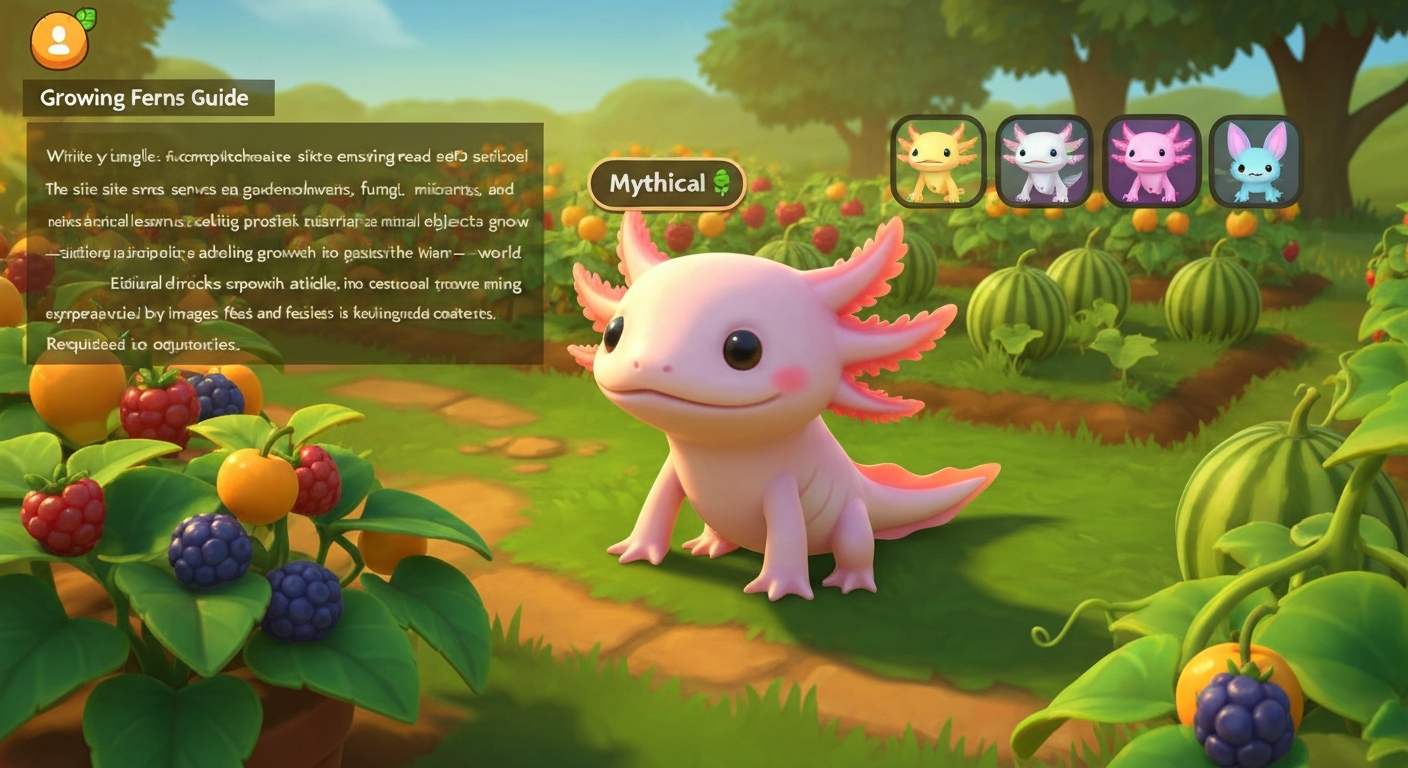
The axolotl in Grow a Garden has a 15% hatch chance from the Oasis Egg, making it the third most common pet in that egg pool. It is not the rarest pet you can pull from an Oasis Egg, but at 15% it is still far from a guaranteed drop, and because the Oasis Egg itself is tied to a limited seasonal event, getting your hands on enough eggs to hatch one reliably takes real effort.
How Rare Is the Axolotl in Grow a Garden: Rarity Guide Tips!

Marcus Weir
16 Jul 2026
What the axolotl actually is in Grow a Garden
Inside Grow a Garden, the axolotl is a classified Mythical-tier pet introduced during the Summer Mega Harvest update, which rolled out around June 28–29, 2025. It sits in your garden as a passive companion rather than an active tool, meaning you do not direct it to do specific tasks. Its standout mechanic is a passive ability that gives roughly a 6.76–6.79% chance (small rounding differences appear across community guides) that a Summer-type fruit stays in your garden after you collect it, effectively letting you harvest the same fruit twice on a lucky proc. The visual design pulls from the real axolotl's distinctive frilled gills and stubby limbs, and the in-game model comes in a wide range of cosmetic mutations including rainbow, shiny, and spectral variants documented across community wikis.
Because it is tagged as a Limited pet, the axolotl is not permanently available in the shop rotation. It showed up tied to a Summer or Mega Harvest seasonal window, which matters a lot for how you obtain one now. Players who missed the original event window rely almost entirely on the player trading market to get one.
How Grow a Garden measures rarity
Rarity in Grow a Garden works on a tiered label system combined with explicit percentage-based hatch probabilities assigned to each egg type. Pets carry tier labels such as Common, Uncommon, Rare, Mythical, and Legendary, and the axolotl sits at Mythical. But the label alone does not tell you everything, because the actual numeric probability matters more for planning your grinding strategy. Each egg type in the game has a fixed spawn table, and when you hatch one egg you are essentially rolling against those published percentages once.
The Oasis Egg is the specific egg that contains the axolotl. Its hatch table, reproduced consistently across community guides and publications including PC Gamer's pet reference, lists five possible outcomes with the following approximate probabilities:
| Pet | Hatch Chance | Rarity Tier |
|---|---|---|
| Meerkat | ~45% | Common |
| Sand Snake | ~34.5% | Uncommon |
| Axolotl | ~15% | Mythical |
| Hyacinth Macaw | ~5% | Rare |
| Fennec Fox | ~0.5% | Legendary |
So in practical terms, roughly 1 in every 7 Oasis Eggs you hatch should yield an axolotl over a large enough sample. That puts it well above the Fennec Fox at 0.5% (about 1 in 200 eggs) but below the two most common pets in the pool. If you are curious how the Fennec Fox's rarity compares in more detail, that creature sits in a very different difficulty bracket entirely. For a focused comparison, see is Fennec Fox rare in Grow a Garden for detailed odds and how the Fennec Fox's 0.5% rate stacks up against the axolotl.
Biome, season, and environment effects on axolotl spawns
The axolotl does not spawn freely in the open world the way some creatures in other games do. It comes exclusively from hatching Oasis Eggs, so there is no biome tile you can stand on or weather condition you can trigger to make one appear organically. The seasonal and environmental factor that matters most is egg availability, not spawn conditions. Oasis Eggs were distributed during the Summer Mega Harvest seasonal event, so the active window for acquiring them through normal shop channels was tied directly to that summer period. Outside of event windows, players source Oasis Eggs through trading with other players or any restocking events the developers announce in the official Discord. For related biome and plant classification questions, see the article on whether the Beanstalk is a tropical plant in Grow a Garden whether the Beanstalk counts as a tropical plant.
That said, the axolotl's passive ability specifically benefits Summer-type fruit, so placing one in a garden that has been optimized for summer crops is where it will have the most observable impact on gameplay. The pet itself does not become rarer or more common based on your biome setup, but building a summer-focused garden layout is the practical way to get value from the pet once you have it. If you also want to check whether Burning Bud is classed as a tropical plant in Grow a Garden, see the Burning Bud article for plant classification and biome tags.
Do color variants and mutations change the rarity?
This is a common source of confusion. Community wikis document a substantial mutation gallery for the axolotl, including rainbow, shiny, spectral, and other cosmetic variants, and players understandably wonder whether a rainbow axolotl is rarer than a standard one from an egg-hatch perspective. Based on every source I have been able to find, the answer is no: the Oasis Egg hatch table lists the axolotl as a single entry at 15%, and there is no published sub-table that assigns different hatch weights to cosmetic variants. The visual mutation you get appears to be determined after the axolotl is hatched (a post-hatch cosmetic layer) rather than being a separate item in the egg's spawn pool.
That does not mean all variants are equally easy to obtain. If mutations are assigned with their own probability on top of the base 15% hatch, a shiny or spectral axolotl could still be significantly rarer in practice. Community pages note the mutation gallery without listing per-variant probabilities, so you should treat rare-colored axolotls as likely harder to get than a standard one, while knowing no authoritative numeric figure currently exists for individual variant drop rates. This is similar to the question of whether mutations can affect pets obtained through favorited mechanics, which is an open area of community discussion as well.
What the developers have actually published
The canonical source for official Grow a Garden rates is the developer team's Discord server, specifically the #update channel where patch notes and event announcements are posted. Community trackers, wikis, and sites like PC Gamer's guide to Grow a Garden pets reproduce and mirror those announcements, which is how the 15% figure became widely established. There is no publicly accessible developer-published raw data file (no JSON dump or XML asset bundle) indexed on the web that I could find. What you are working with when you read community tables is a reflection of official Discord communications, filtered through community note-taking.
The practical takeaway: if you see the 15% figure on multiple independent community wikis and in mainstream gaming publications, that number is the best available public figure, but it ultimately traces back to developer statements in Discord. If a future patch changes the egg table, the official Discord #update channel is where you would see it first. Bookmark it or follow a community tracker that monitors it.
What the community has actually observed
Community evidence for the 15% figure is broad but not deeply rigorous. Multiple independent guide sites including growagardencalculator.net, TheriaGames, GameGeekFusion, and several Fandom-based wikis all reproduce the same Oasis Egg hatch table with the axolotl at 15%. That level of convergence across unrelated sites is meaningful: it suggests they are all working from the same source data (likely the official Discord announcements) rather than independently measuring hatch rates through experimentation.
The weaker side of this evidence base is the absence of large-scale reproducible player experiments. Community forums contain plenty of anecdotal posts where players report how many eggs they hatched before getting an axolotl, but those posts are not structured datasets. Someone reporting that they hatched 20 eggs without one is entirely consistent with a 15% chance, but it is also not evidence that the rate is lower. Without a shared CSV or spreadsheet with verified hatch logs, community anecdotes can confirm the general difficulty without pinning down an exact rate. Active trading on marketplace sites like TradeKitsune confirms axolotl supply and demand are real, but market value reflects perceived scarcity and seasonal availability, not the base hatch probability.
How to test axolotl spawn rates yourself
If you want to verify the 15% figure independently, or if a patch changes the egg table and no updated official source appears quickly, you can run your own sampling experiment. It will not be fast, but done carefully it will produce a defensible estimate. Here is how I would approach it.
- Fix your egg type: use only standard Oasis Eggs, not Premium variants, and do not mix the two in the same dataset. Record which type you are using.
- Control your setup: use the same account throughout. If the game offers any hatch-speed boosters or multipliers, either avoid them entirely or record exactly which stack you used for every hatch session.
- Set a pre-defined sample size before you start: for a rough estimate at ±5% margin of error (95% confidence), you need around 200 hatches. For ±1% you need closer to 4,900 hatches. Know upfront that 15 or 20 hatches prove nothing statistically.
- Log every hatch: create a simple spreadsheet with columns for date, timestamp, egg number, outcome (axolotl or not), server region, and any active boosters. Screenshot each result for audit purposes.
- Record what the egg cost or how you acquired it: bought from shop, traded for, or gifted. This matters if there are different egg quality tiers.
- Count and calculate: once you have at least 100 hatches, divide your axolotl results by total hatches to get an observed rate. Compare it to 15%. At low sample sizes expect wide swings.
- Share your raw CSV publicly and invite replication: one player's dataset is interesting but not conclusive. If two or three independent players run similar logs and converge near the same number, that is meaningful community evidence.
What to avoid: do not count hatches retroactively from memory, do not mix egg types mid-experiment, and do not post a result from fewer than 50 hatches as evidence of a rate change. Streak variance is brutal at low samples. Someone who hatches 10 eggs and gets 3 axolotls (30%) has not found a secret boost; they had a lucky run that would smooth out over a larger sample.
Practical ways to increase your chances of getting one
Since the axolotl is an Oasis Egg pet, every strategy for getting one comes back to either hatching more Oasis Eggs or acquiring one through trading. The Oasis Egg hatches in 4 hours and 10 minutes, so batch-hatching during an active event window is the core grinding method. If you can queue multiple eggs back to back during an event, your odds per session scale linearly with egg count. At 15% per egg, hatching 10 eggs gives you roughly an 80% cumulative chance of seeing at least one axolotl.
Trading is the other realistic path, especially outside active event windows. Marketplace trackers like TradeKitsune show active axolotl listings and give a rough sense of current demand. Knowing the trading landscape before you offer helps you avoid overpaying. Seasonal events are also worth monitoring: if the Summer Mega Harvest returns in 2026 or beyond, that is when Oasis Egg supply typically peaks, and hatch-grinding becomes most practical again.
How the axolotl compares to other rare creatures in Grow a Garden
| Pet | Egg Source | Hatch Chance | Tier | Limited? |
|---|---|---|---|---|
| Axolotl | Oasis Egg | ~15% | Mythical | Yes (Summer event) |
| Fennec Fox | Oasis Egg | ~0.5% | Legendary | Yes (Summer event) |
| Hyacinth Macaw | Oasis Egg | ~5% | Rare | Yes (Summer event) |
| Sand Snake | Oasis Egg | ~34.5% | Uncommon | Yes (Summer event) |
| Meerkat | Oasis Egg | ~45% | Common | Yes (Summer event) |
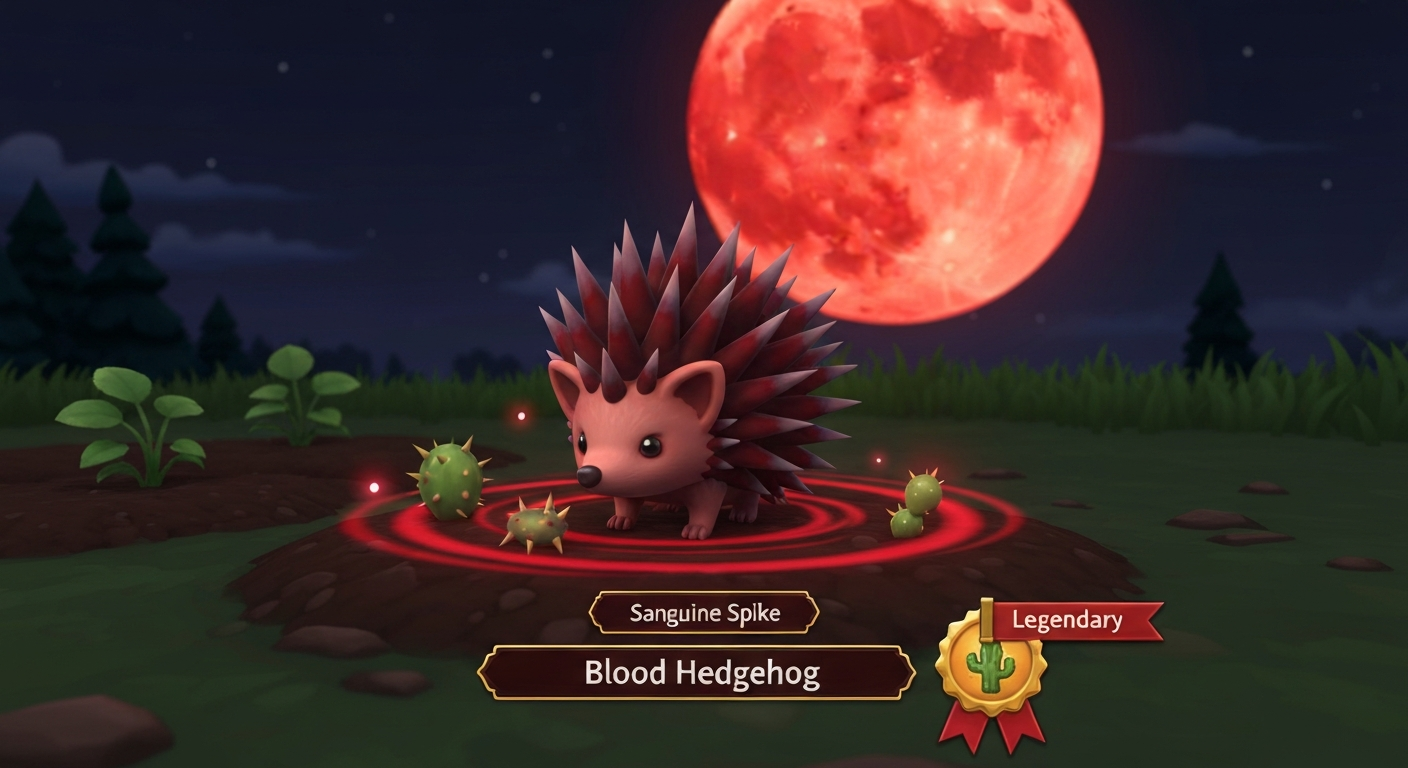
Among Oasis Egg pets, the axolotl sits in the middle of the difficulty range. Is the Blood Hedgehog rare in Grow a Garden? Check that page for a direct comparison of its hatch rates and how it stacks up against the axolotl. It is significantly easier to obtain than the Fennec Fox, which at 0.5% requires roughly 30 times as many eggs on average to appear. It is harder to get than the Hyacinth Macaw at 5%, and much harder than the Meerkat or Sand Snake. For information on whether the Firefly Fern is rare in Grow a Garden, see is Firefly Fern rare in Grow a Garden. If you are comparing across egg types entirely, the Black Iguana and Blood Hedgehog represent different egg pools and different rarity brackets worth checking if you are building a diverse pet collection.
A quick note on real axolotls vs. the game
If you landed here partly out of curiosity about real axolotls: yes, they are genuinely rare in the wild. The actual axolotl (Ambystoma mexicanum) is a critically endangered salamander native to lake systems near Mexico City, and its wild population has declined sharply due to habitat loss and water pollution. The game's axolotl is inspired by the real animal's iconic appearance, particularly those feathery external gills. The two rarity contexts are completely different, but if the game piqued your curiosity about the real creature, that connection is worth knowing.
Common myths and quick troubleshooting
- Myth: A specific biome or garden layout increases axolotl hatch chance. Not true. The hatch rate is fixed to the egg type, not your garden setup.
- Myth: Rainbow or shiny axolotls are separate entries in the egg table with their own hatch rates. No published source supports this; variants appear cosmetic and post-hatch.
- Myth: Hatching 20 eggs with no axolotl means the rate is wrong. At 15%, going 20 eggs dry happens roughly 4% of the time, which is unlucky but entirely within normal variance.
- Myth: Community wikis are the authoritative source. They mirror developer Discord announcements well, but the primary source for any official rate is the developer's #update channel.
- Troubleshoot: If you can't find Oasis Eggs in the shop, check whether the Summer Mega Harvest event is currently active. Outside that window, trading is your main acquisition route.
- Troubleshoot: If your axolotl's passive ability isn't triggering, confirm you are harvesting Summer-type fruit. The ability does not proc on non-Summer crops.
FAQ
Quick answer — how rare is the Axolotl in Grow a Garden?
Based on published community and press tables that mirror developer announcements, the Axolotl appears in the Oasis Egg with a hatch probability of about 15% per Oasis Egg. This 15% figure is the best available, convergent estimate from PC Gamer and multiple community wikis. It is not a developer data dump but is treated as the canonical public rate by trackers.
What does that 15% mean practically for players?
Each Oasis Egg hatched has roughly a 15% chance of producing an Axolotl (and ~85% chance of producing one of the other Oasis contents). If you hatch on average 100 Oasis Eggs you should expect about 15 Axolotls, recognizing random variation. Large sample sizes are needed to reduce sampling noise.
Evidence quality — how confident can we be in the 15% number?
Confidence is moderate: multiple trustworthy outlets (PC Gamer) and many community guides reproduce the same Oasis Egg table, pointing to a developer-disclosed rate originally posted to official channels (Discord) and mirrored by communities. No public raw developer asset file (JSON/datamine) appears available, and community hatch datasets are mostly anecdotal. For authoritative confirmation, check official Grow a Garden developer posts (Discord #update) or collect reproducible hatch data yourself.
Step-by-step tactics to obtain an Axolotl (practical acquisition guide)
1) Identify and collect Oasis Eggs — source eggs from in-game shops, event rewards, or trading. 2) Note hatch time (Oasis Egg reported ~4h10m) and any boosters you use; consistent conditions matter for verification. 3) Hatch Oasis Eggs repeatedly; treat each hatch as an independent 15% trial. 4) Use event windows or limited-time Premium egg offers if they increase odds (confirm via tooltip or dev posts). 5) Trade with other players if you prefer speed — marketplace listings show active Axolotl trade volume. 6) If the Axolotl was part of a seasonal event, try event-specific mechanics or guaranteed drops during events. 7) Document each hatch (screenshot timestamp + result) if you plan to verify rarity.
If color/mutation variants exist, do they change rarity?
Community sources document many cosmetic variants/mutations for the Axolotl (rainbow, shiny, etc.), but there is no authoritative evidence that visual variants have different base hatch probabilities. Current public guides list Axolotl as a single Oasis Egg entry — variants appear cosmetic or post-hatch labels rather than separate spawn weights.
How to verify the hatch rate yourself (evidence-based testing protocol)
1) Fix variables: only hatch Oasis Eggs (note Premium vs regular), use a single account or clearly logged set of accounts, and avoid mixing boosters unless recorded. 2) Record each hatch: egg type, timestamp, and outcome. 3) Decide a target sample size — for ±1.0% margin at 95% CI around a 15% rate you need ≈4,900 hatches; for ±2–3% smaller experiments (e.g., 500–1,000 hatches) give rough confirmation. 4) Upload raw CSV/Google Sheet with screenshots for each result and share replication steps. 5) Optionally, recruit other players to replicate and pool datasets. 6) Compare observed frequency to 15% using a simple binomial test or confidence interval.
Next Article
Is Blood Hedgehog Rare in Grow a Garden? Rarity Guide
Is the Blood Hedgehog rare in Grow a Garden? Clear answer, ID guide, breeding tips, comparisons and sources to verify.