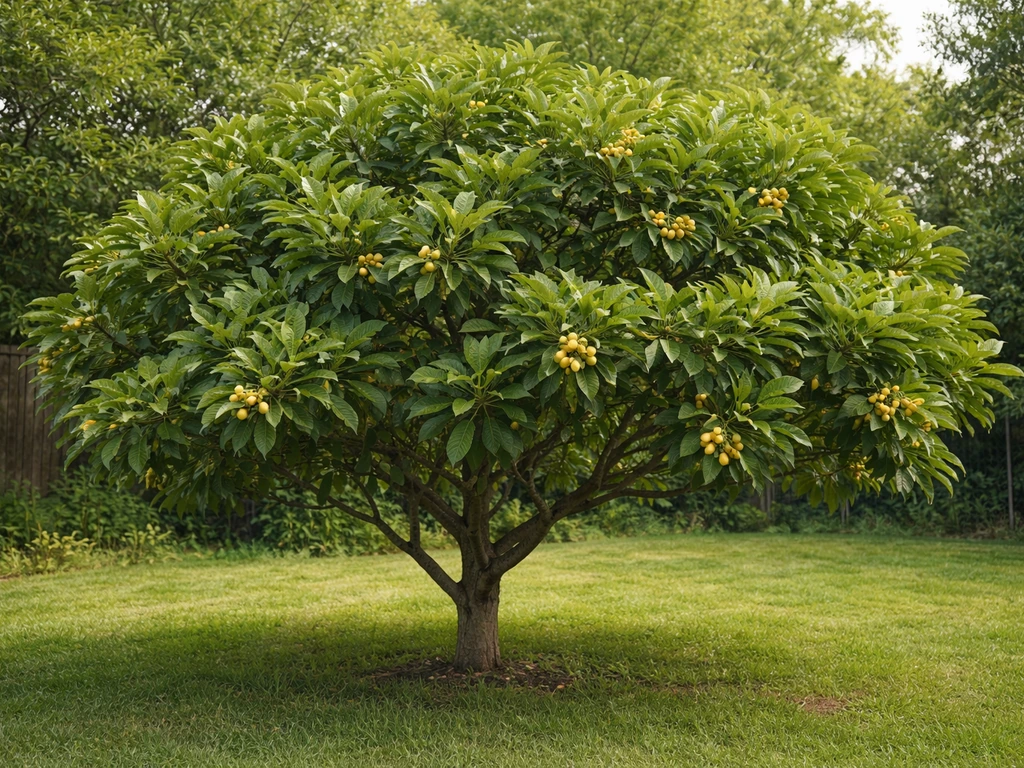
A loquat is a medium-sized evergreen tree with a dense, rounded canopy of large, dark green, deeply veined leaves. The leaves are glossy on top and fuzzy underneath, the small white flowers appear in fall in woolly clusters at branch tips, and the fruit ripens in late winter to spring as oval or pear-shaped, yellow-to-orange clusters with a distinctive dried calyx at the end. Orange tabby cats are much less common than other coat patterns, but availability varies by region and breeding orange clusters. If you can check those four things in order, you can confirm you have a loquat in about five minutes.
What Does a Loquat Look Like in Your Garden

Marcus Weir
4 May 2026
Quick visual ID: overall loquat tree shape
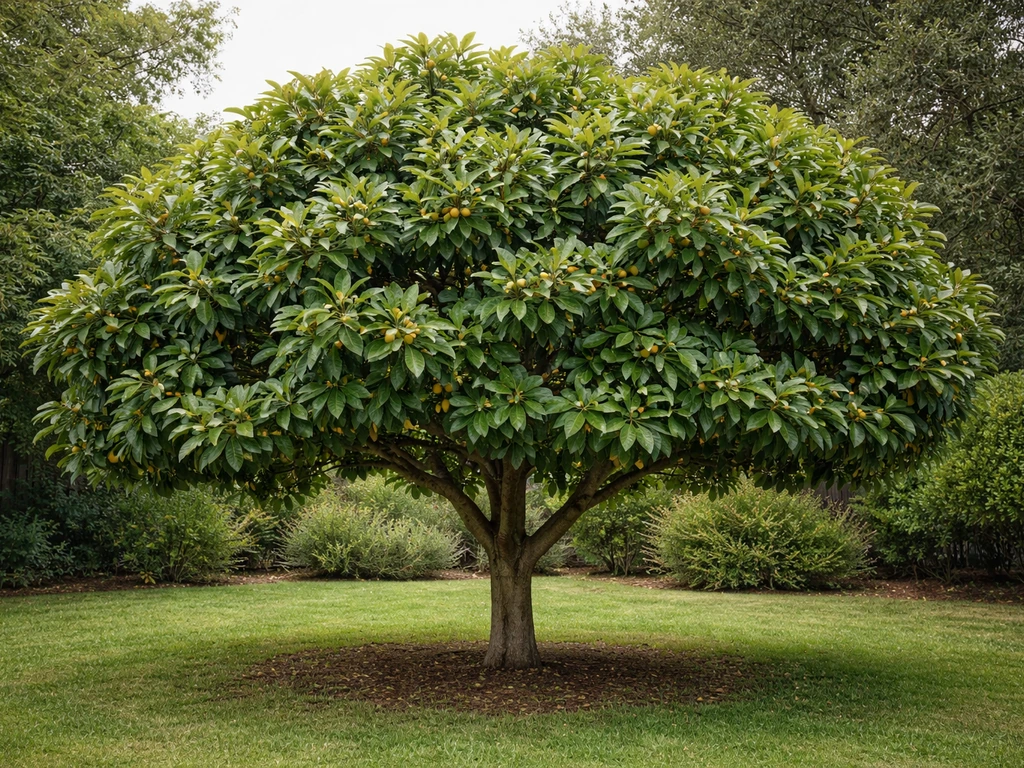
Stand back from your tree and look at its overall silhouette. Loquat (Eriobotrya japonica) has a naturally dense, rounded canopy that looks almost sculpted. The tree usually has a short, stocky trunk that branches relatively low to the ground, giving it a bushy, full appearance rather than the tall, narrow look you might associate with other fruit trees. In a sunny spot, expect a mature tree to reach around 15 feet tall with a spread of 15 to 25 feet. Oregon State University notes that Eriobotrya japonica can grow to about 15 to 30 feet tall and wide in sun, with narrower growth in shade reach around 15 feet tall with a spread of 15 to 25 feet. Give it more shade and it can push 20 to 30 feet in height, though it stays less productive. In a typical backyard garden, most loquats you encounter are in the 10 to 20 foot range. The canopy is thick enough that you often can not see through it, and the foliage stays dark green year-round since the tree is fully evergreen.
Leaves: what they look like and where to find them
Loquat leaves are one of the easiest identification features because they are unusually large and distinctive in texture. Each leaf is roughly 6 to 12 inches long and 1 to 4 inches wide, shaped like an elongated oval that is slightly wider toward the tip than the base (botanists call this inversely lance-shaped or inversely egg-shaped, but you can just think of them as big paddle-shaped leaves). The margins are coarsely toothed, usually in the upper half of the leaf. The leaf arrangement on the branch is alternate, and they tend to cluster near the branch tips, giving the tree a layered, whorled appearance.
Flip a leaf over and you will find one of the most reliable ID cues: the underside is covered in dense, soft brown hairs (called tomentum). Loquat leaves and stems are also described as tomentose, meaning they are covered in a dense layer of short, matted, wooly hairs tomentose leaves and stems. The top surface, by contrast, is dark green, glossy, and smooth. Young leaves are completely brown and fuzzy on both sides before they mature, which can be surprising if you have never seen it before. The deep, parallel veins running from the midrib to the margins give the leaf a wrinkled or quilted texture that you can feel even with your fingertips. The petiole (the short stem connecting the leaf to the branch) is only about a third of an inch long and also covered in hairs. These leaves are evergreen, so you can use them to confirm ID any time of year, which makes loquat easier to identify than many deciduous fruit trees that look bare half the year.
Flowers: color, cluster shape, and timing
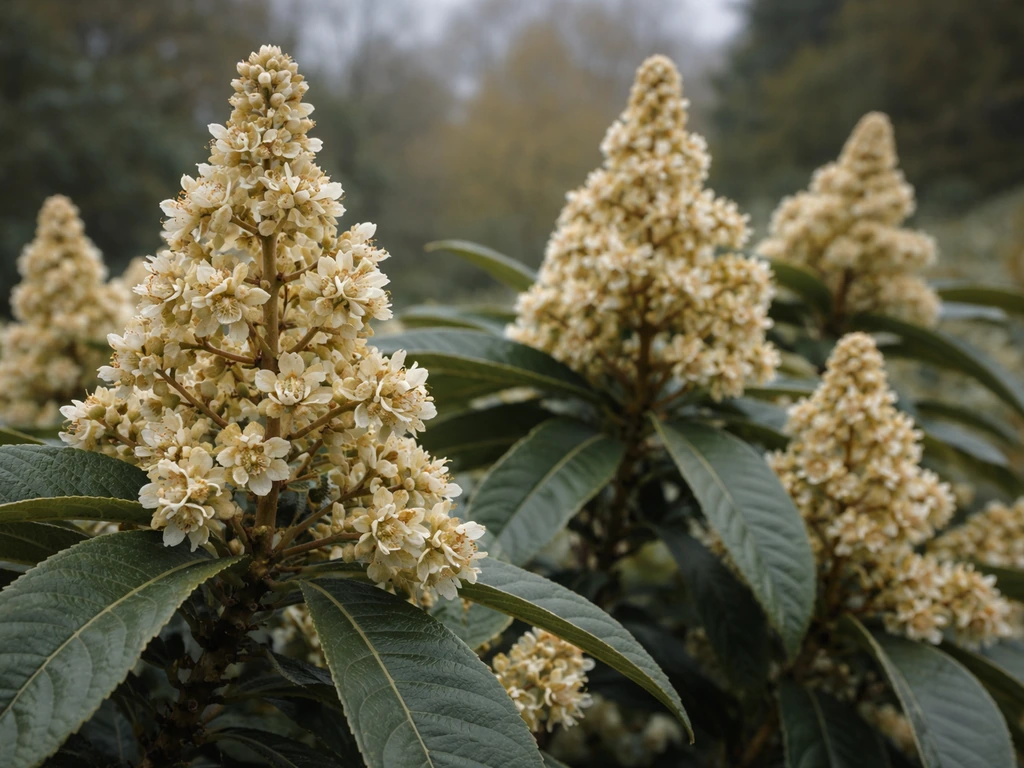
Loquat blooms at what feels like entirely the wrong time of year for a fruit tree. Expect flowers from October through February (later in cooler climates), with peak bloom in fall to early winter. This is actually one of the easiest ways to confirm you have a loquat: if your tree is producing white flowers in November while everything else in the garden is going dormant, that is a strong signal.
The flowers grow in stiff, upright, pyramid-shaped clusters called panicles at the ends of branches. Each panicle is about 4 to 6 inches (10 to 16 cm) long and contains anywhere from 6 to 30 individual flowers. The cluster itself, along with its stalks, is covered in the same rusty-brown woolly fuzz you see on the leaf undersides, making the whole inflorescence look a bit like a fuzzy brown cone until the flowers open. Each individual flower is small, about 1 cm across (roughly half an inch), with 5 white petals. They are strongly and sweetly fragrant, noticeably so from several feet away, especially in the evening. The scent is one of the most pleasant and distinctive things about loquat in bloom. In marginal climates, frost can damage or destroy the flowers and the developing fruit behind them, which is worth keeping in mind when tracking your tree's progress.
Fruit description: size, color, shape, and maturity stages
Loquat fruit develops through a relatively straightforward color progression that you can use to judge ripeness and confirm ID at different times of year. The fruit forms in clusters of 4 to 30 and stays attached in a visible bunch at the branch tips, which is easy to spot even from a distance.
| Stage | Color | Texture | What it tells you |
|---|---|---|---|
| Immature | Green | Firm, waxy skin | Just formed after flowering; not yet edible |
| Mid-stage | Yellow-green to yellow | Skin softens slightly | Several weeks from harvest |
| Ripe | Yellow to deep orange | Slightly downy or smooth skin, gives to gentle pressure | Ready to eat; some cultivars develop a red blush |
| Overripe | Orange-brown, shriveling | Very soft | Past peak; birds will find it first |
Each fruit is small but larger than a grape: roughly 1 to 2 inches long (2 to 5 cm) and weighing about 30 to 40 grams on average, though some cultivars can reach around 70 grams. The shape varies by cultivar from nearly round to oval to distinctly pear-shaped. One of the most reliable visual confirmation features is the dried calyx (the star-shaped remnant of the flower) that stays attached to the non-stem end of the fruit as it matures. This gives the fruit a small, crown-like tip and is something you will not see on most lookalike fruits. Skin can be smooth or lightly downy, and underneath the skin is pale yellow to cream-white flesh around 2 to 5 large brown seeds. Fruit ripens from late winter into spring, typically February through April depending on your climate.
Growth habit and what size to expect
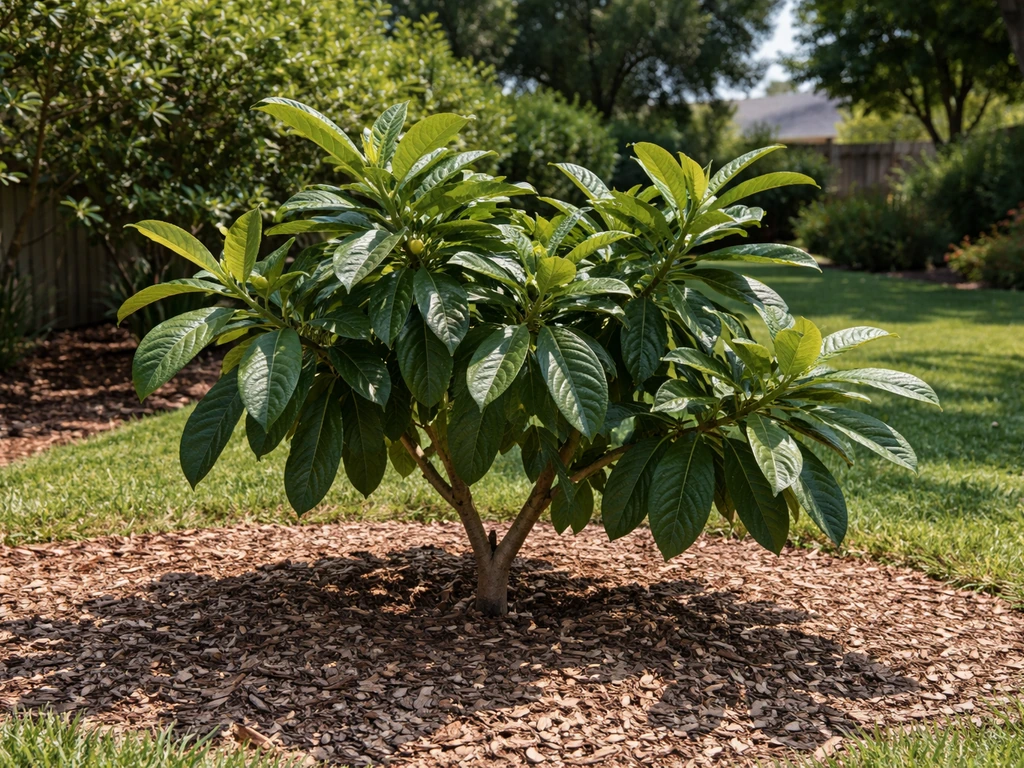
Loquat grows at a moderate pace and settles into a compact, self-contained shape without a lot of intervention. In a sunny garden with decent soil, you are looking at a tree that maxes out around 15 to 20 feet tall and spreads just as wide, sometimes wider. Some sources put the upper limit at 35 feet in ideal conditions, but most home garden trees stay well under 25 feet unless they are very old and untouched. The short trunk, low branching, and dense canopy make it a good shade tree as well as a fruiting one, and it holds its shape reasonably well without heavy pruning.
Young loquat plants look like large, glossy-leaved shrubs at first. The characteristic fuzzy new growth on branch tips and the large leaves are present from the start, making identification possible even on small plants. The tree is evergreen in zones 8b through 11 and can survive mild frosts, though the flowers and fruit are more sensitive to freezes than the tree itself. If you are in a colder zone and your plant drops leaves in winter, reconsider your ID.
Lookalikes and how to confirm you have the right plant
A few plants can cause confusion, particularly when you are looking at leaves alone. Here are the most common ones and how to separate them from loquat:
- Magnolia (especially Magnolia grandiflora): large, glossy evergreen leaves that look similar from a distance. Key difference: magnolia leaves are smooth on both surfaces (or have rust-colored fuzz only on the underside in some species), but the leaves are not toothed at the margins. Loquat always has coarsely serrated leaf edges. Magnolia flowers are enormous (6+ inches across) and white, nothing like loquat's small cluster flowers.
- Rhododendron and some Viburnum species: large evergreen leaves with similar texture. Check the margin: rhododendrons have smooth leaf edges, not toothed. Viburnum leaves are typically smaller and opposite (paired across the stem), while loquat leaves are alternate.
- Fig (Ficus carica): large leaves, but deciduous and deeply lobed, nothing like the lance-shaped loquat leaf. Easy to rule out when leaves are present.
- Other Eriobotrya species (less common in gardens): closely related and nearly identical. If you are in doubt, the fruit clusters in late winter and the distinctly fragrant fall flowers are the strongest confirming features for E. japonica specifically.
The single fastest confirmation method: flip a leaf over and look for dense brown fuzz on the underside, then check that the leaf margin is toothed (not smooth). Do both those things and you have effectively ruled out most lookalikes. If the tree is also flowering in fall with fragrant white woolly clusters, that is close to definitive. If it is producing the calyx-tipped orange fruit clusters in late winter, you have confirmed it.
A garden checklist: what to inspect today and next steps
Use this checklist in order when you are standing in front of your plant. It takes about five minutes and covers the full identification from canopy to fruit.
- Look at the overall shape: is the canopy dense and rounded, with a short trunk and low branching? If yes, continue. If the tree is columnar or sparse, reconsider.
- Pull down a mature leaf and measure it roughly: does it run 6 to 12 inches long? Is it glossy and smooth on top?
- Flip the leaf over: is the underside covered in soft brown or grey hair? Are the veins deeply impressed and parallel? Is the margin toothed, especially toward the tip?
- Check the branch tips: do leaves cluster there in a whorled arrangement? Is new growth fuzzy and brownish before it hardens off?
- If it is fall or early winter (October through February): look for small, white, fragrant flower clusters at branch tips. Are the cluster stalks covered in rusty-brown fuzz?
- If it is late winter or spring (February through April): look for clusters of oval-to-pear-shaped fruit, green progressing to yellow or orange, each with a small star-shaped dried calyx at the tip.
- Rule out lookalikes: check that the leaf margin is toothed (not smooth) and that leaves are alternate on the branch (not opposite/paired).
- Next step if you have confirmed ID: note what stage your tree is in (leafing out, flowering, fruiting) and plan care accordingly. If flowers are present, protect from freezes. If fruit is yellowing, it is close to harvest. If you are only seeing leaves right now, the plant is identifiable year-round and you can wait for flowers in fall to get the full visual picture.
One thing worth knowing: loquat's rarity and visual traits vary depending on context. If you are trying to work out how unusual your specific variety or specimen is compared to other plants in your garden, that is a related but separate question from identification. If you mean how rare loquat is in general, that is a separate question from simply identifying the species in your garden. Taco fern is a rare plant, so the best approach is to verify it carefully before you start planning care. How rare a sea otter is in your area is the same kind of separate question, and it depends on local habitat and conservation status how rare is a sea otter in grow a garden. You might also wonder how rare a toucan is in your area, but that is a different question than identifying your loquat tree how rare is toucan in grow a garden. Also, if you are wondering about wildlife like whether a polar bear is rare in a garden, that is a different question than identifying the loquat itself polar bear rare in a garden. The ID traits above apply to the species broadly. Once you are confident you have the right plant, you can turn your attention to cultivar differences, fruiting performance, and whether your growing conditions are dialed in.
FAQ
My loquat is small and bushy, how can I tell it is a loquat if it has not fruited yet?
Yes. Loquat seedlings and young trees often look like a compact shrub first, but the telltale combo still shows up early: large glossy leaves with a fuzzy underside (tomentum), toothed margins, and woolly white flower clusters at the branch tips in fall.
Do loquat leaves look different when they are young, and does that make identification harder?
The underside fuzz is easiest to check on a mature leaf, but early leaves can be extra misleading because young growth may be brown and fuzzy on both sides. Focus on confirming mature leaves have dark glossy top surfaces and a dense, soft brown hair layer underneath.
If there is no fruit in late winter or spring, does that mean the tree is not a loquat?
Frost is the big edge case. The tree can survive mild cold in its growing range, but flowers and developing fruit are what fail first, so a loquat may look “not like itself” in spring if bloom was killed after fall flowering.
How much does the bloom and fruit timing change depending on where I live?
You can still identify it, but your timing window shifts. In warmer areas you may see blooms earlier, and in cooler areas the bloom and fruiting can run later, so use the leaf fuzz and the calyx-tipped fruit (when present) as the most reliable confirmations rather than the exact month.
What if my loquat fruit is a different shade than yellow to orange, does that rule it out?
Yes, but it is variable by cultivar and growing conditions, and it can also be partially hidden by the cluster shape. If you are unsure based on color alone, confirm the persistent dried calyx at the non-stem end plus the fuzzy orange-yellow clusters at branch tips.
How can I tell loquat flowers apart from other late-season flowering trees?
Some fruit trees have scented blossoms, but loquat’s hallmark is white, woolly-looking panicles that appear in fall or early winter and smell strongly sweet (often noticeable from several feet away). If you see scented white clusters at the “wrong time of year,” that is a strong supporting clue.
My plant loses leaves in winter, could it still be a loquat?
While the tree is commonly grown in warmer zones, if your loquat drops leaves in winter, do not assume it is not a loquat automatically. Leaf drop often reflects cold damage or stress, so re-check the underside fuzz and toothed margins on new growth.
Can pruning or heavy shade change the loquat’s overall look enough to confuse identification?
Usually, no. The leaves are one of the most consistent ID traits, so even if the tree’s overall size or canopy shape differs (due to pruning, spacing, or shade), the dark green glossy top and densely hairy underside should still be present.
What is the most common mistake people make when identifying loquat just by looking at leaves?
Yes, if you are looking at leaves alone. The fastest mistake is to rely on leaf size without checking the underside. Make it a two-step check every time, dense brown hairs underneath plus toothed (not smooth) leaf edges.
What should I do after I suspect I have a loquat but I am not fully sure?
If the tree is flowering in fall, it is unlikely to be a lookalike with only “spring flowers” in that same period. Your best next step after noticing fall blossoms is to watch a single branch until you can confirm either the calyx-tipped fruit or the characteristic woolly panicles.
Next Article
How Rare Is Toucan in Grow a Garden? How to Verify and Grow
Find how rare Toucan is in Grow a Garden, verify the right item, and get simple steps to source and grow it.